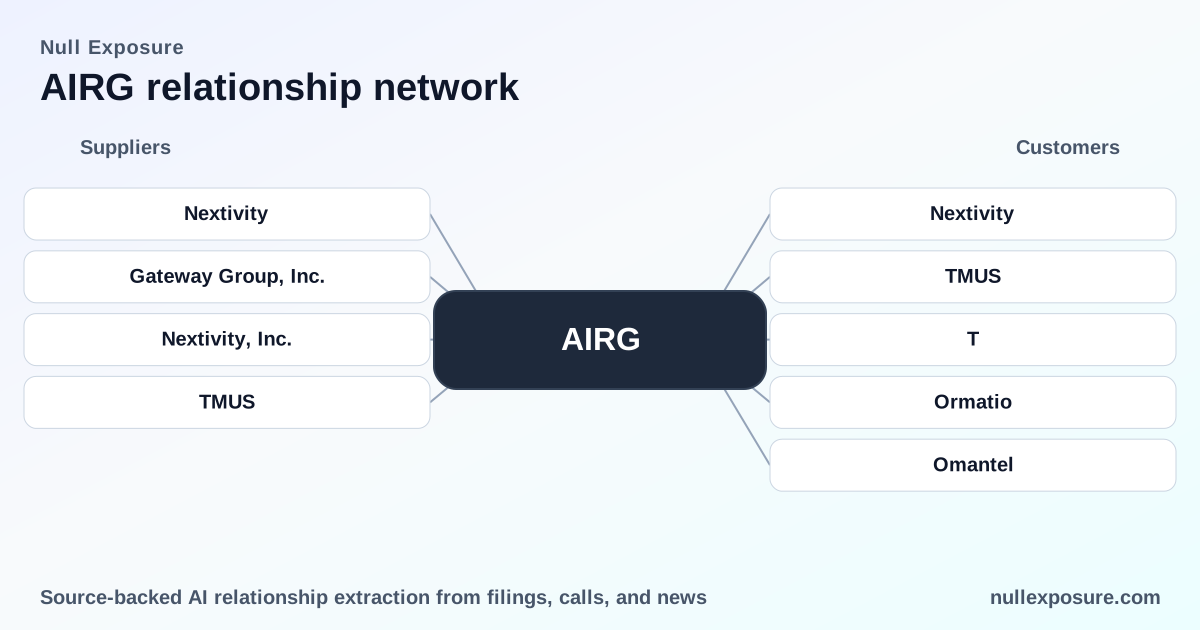
Airgain (AIRG) — supplier posture and the relationships that move valuation
Airgain is a fabless communications-equipment company that designs high-performance antennas and integrated 5G vehicle gateways and monetizes through hardware sales, OEM programs and service agreements tied to product deployments. The firm expands its system-level offerings through selective asset acquisitions and strategic certifications that accelerate commercial adoption in automotive and fleet markets. For investors, the key driver is whether Airgain can convert IP and certification wins into durable OEM relationships while managing concentrated manufacturing execution across North America and APAC suppliers.
For a deeper supplier-focused view, see NullExposure for mapped counterparty detail: https://nullexposure.com/
How to read Airgain’s supplier and partner model
Airgain operates with a fabless manufacturing posture and outsources production to third-party contract manufacturers (CMs). This creates a supplier relationship model with four defining characteristics that directly affect risk and return:
- Contracting posture — long-term orientation. Airgain’s disclosures show extended lease terms and explicitly state long-term working relationships with CMs, indicating multi-year supplier commitments and operational coordination on quality and compliance.
- Geographic footprint — North America and APAC manufacturing. Production runs across the United States, China, Taiwan, Vietnam and Mexico, which spreads operational exposure but introduces geopolitical and logistics complexity.
- Materiality and criticality — manufacturing is core. Manufacturing costs are a primary component of COGS, and CM interruptions are described as potentially business‑disruptive, making supplier performance a critical value driver.
- Relationship role — manufacturer and contract partner. All products are built by third-party CMs; Airgain is responsible for design, IP and system integration while production execution is outsourced.
These are company-level signals; they reflect overall operating model tradeoffs rather than any single counterparty.
All public supplier and partner mentions you should know
Below are every relationship entry surfaced in the public record for AIRG in the supplied results, summarized in plain English with source context.
Nextivity — strategic product acquisition expands vehicle gateway capabilities
Airgain acquired the HPUE product line assets from Nextivity, broadening its system-level connectivity portfolio and strengthening its vehicle gateway capabilities for higher-power cellular applications. Source: StockTitan report referencing the FY2026 disclosure (published March 9, 2026).
Northland Capital Markets — underwriting role in the company’s capital history
Northland Capital Markets served as one of the underwriters on Airgain’s IPO, a signal of the firm’s capital markets relationships that helped establish its public equity base. Source: MarketBeat alert summarizing underwriting details (March 2026).
Wunderlich — co-underwriter on the IPO
Wunderlich joined Northland as an IPO underwriter, reflecting the syndicate that brought Airgain public and the institutional channels used to raise capital. Source: MarketBeat alert summarizing underwriting details (March 2026).
Nextivity, Inc. — filing reaffirmation of the HPUE asset purchase
A separate filing-style notice reiterated that Airgain acquired the HPUE product line assets from Nextivity, confirming the strategic asset purchase in the company’s FY2026 communications. Source: MarketScreener press release covering the inducement awards disclosure (March 9, 2026).
Gateway Group, Inc. — investor relations firm contact in press materials (FinancialContent)
Airgain lists Gateway Group (Matt Glover) as an investor relations contact in a press release, indicating the external communications and IR support structure used for investor outreach. Source: BusinessWire/FinancialContent press release (filed October 16, 2025).
T‑Mobile (TMUS) — product-level carrier certification for the AC‑Fleet gateway
Airgain’s flagship AirgainConnect Fleet gateway achieved T‑Mobile T‑Priority certification, a meaningful commercial endorsement that improves operator integration and fleet deployment prospects. Source: StockTitan press coverage of the certification announcement (March 9, 2026).
TMUS — duplicate listing of the T‑Mobile certification item
The TMUS entry reiterates the T‑Priority certification for AirgainConnect Fleet; it is the same carrier certification noted above and underlines commercial carrier-level validation. Source: StockTitan (March 9, 2026).
Gateway Group, Inc. — investor contact referenced in inducement awards notice (StockTitan)
A second Gateway Group mention appears in coverage of Airgain’s NASDAQ inducement awards filing, again listing Gateway as the investor relations contact and confirming continuity in the company’s IR arrangements. Source: StockTitan coverage of the inducement awards disclosure (March 9, 2026).
Why these relationships matter to valuation and operations
- Acquisition of Nextivity’s HPUE assets is strategic and accretive to product breadth. The HPUE line gives Airgain higher-power cellular capability that complements its AC‑Fleet gateway and strengthens product differentiation for automotive and fleet OEMs. This is a pure product-portfolio expansion play that improves addressable market and pricing optionality. (Source: Airgain FY2026 disclosures summarized in StockTitan/MarketScreener, March 2026.)
- Carrier certifications like T‑Priority de‑risk commercialization. T‑Mobile certification reduces deployment friction for fleet customers and supports OEM contracting. Certification wins materially increase the probability of scaled revenue from gateway hardware and associated services. (Source: StockTitan, March 2026.)
- Capital-market relationships and IR posture matter for liquidity and funding. Underwriters such as Northland and Wunderlich shaped the company’s listing and initial investor base; consistent IR support (Gateway Group) maintains market access and messaging discipline. (Source: MarketBeat; BusinessWire/FinancialContent, 2025–2026.)
- Manufacturing execution is a binding constraint. Airgain is fabless and relies on third-party CMs across North America and APAC; as the company notes, CM disruptions are a direct path to shipment delays and margin pressure. Investors should treat supplier performance as a first-order variable for both revenue and gross-margin forecasts.
Investor checklist — monitor these operational signals
- Track carrier certification rollouts and OEM adoption cadence to translate product wins into revenue runway.
- Watch CM capacity, quality reports and geographic shifts in production to anticipate cost and delivery volatility.
- Review lease and long-term supplier agreements that lock in manufacturing continuity through 2031 and beyond.
- Evaluate M&A follow-through on Nextivity assets; integration and time-to-revenue are the critical next steps.
Key takeaway: Airgain’s upside is product-driven (HPUE and AC‑Fleet adoption) but conditional on flawless external manufacturing and carrier/OEM integrations. The company’s long-term contracting posture and geographically diversified CMs reduce single-country exposure but keep supplier execution and carrier certification at the center of investment risk.
For a mapped view of counterparties and supplier concentration that supports underwriting and operational due diligence, visit NullExposure: https://nullexposure.com/
Airgain’s public filings and press disclosures make the supplier story clear — a growth opportunity built on product and certification wins that requires sustained supplier reliability to realize valuation.