Air Industries Group (AIRI): Supplier relationships, constraints, and what investors should price in
Air Industries Group designs, manufactures and sells structural parts and assemblies to major U.S. defense and commercial aerospace primes and monetizes through contract manufacturing and long-tail production agreements tied to defense and commercial airframe programs. Revenue derives from component manufacturing margins, program backlog execution, and periodic working-capital financing; the company’s supplier posture—sole-source inputs, mixed domestic and APAC sourcing, and tight production lead-times—directly shapes margin volatility and execution risk. For a quick look at related coverage and supplier analytics, visit https://nullexposure.com/.
Why supplier relationships matter for AIRI right now
Air Industries operates on multi-stage production cycles where raw-material availability, prices, and specific single-source suppliers are operationally critical. Execution risk translates into earnings volatility because the company often commits to long lead-times and enters into long-term agreements with primes while raw-material suppliers resist long-term fixed-price contracts. That contracting mismatch is central to valuation—investors should underwrite the company with a premium on operational resilience and downside protection.
Visit https://nullexposure.com/ for more supplier intelligence and deal context.
Who AIRI is transacting with — the relationships investors need to know
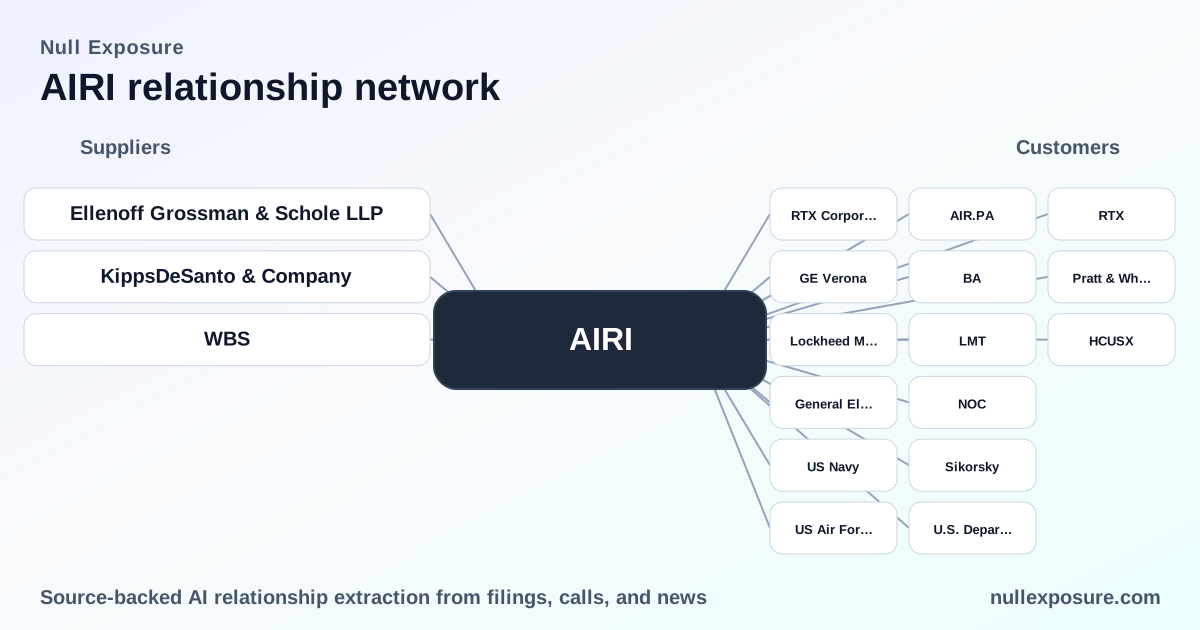
Below are the supplier, advisor and lender relationships surfaced in recent reporting and filings. Each relationship includes a concise plain-English summary and the source.
-
Ellenoff Grossman & Schole LLP — Vincent J. McGill and Charles Goodwin acted as legal advisor to Air Industries Group in FY2026. This legal engagement is tied to a corporate transaction announced in March 2026. (Source: MarketScreener coverage of the reverse-merger / acquisition announcement, March 2026.)
-
KippsDeSanto & Company — KippsDeSanto served as financial advisor and provided a fairness opinion to Air Industries Group in FY2026, supporting the strategic transaction framework disclosed in public reports. (Source: MarketScreener coverage of the Tenax Aerospace acquisition announcement, March 2026.)
-
Webster Bank (WBS) — Air Industries executed an Eleventh Amendment to its Loan and Security Agreement with Webster Bank on February 26, 2026, reflecting an ongoing lender-borrower relationship that supports working capital and lease obligations. (Source: Air Industries’ 8‑K reporting as published by StockTitan/SEC filing excerpts, February 2026; corroborated by market news outlets in March 2026.)
What the identified relationships imply about AIRI’s operating posture
These engagements together reveal a company managing near-term liquidity and executing a strategic transaction while relying on external legal and financial advisers. The lender relationship with Webster Bank is operationally critical—amendments to the loan agreement indicate covenant management and working-capital dependence. The use of fairness opinions and legal counsel for a reverse-merger or acquisition is consistent with a company pursuing structural strategic options to unlock shareholder value.
Operational constraints and supply-chain signals investors should price in
Air Industries’ public disclosures and recent reporting document several company-level constraints that shape risk and return:
-
Contracting posture: Raw-material suppliers historically resist long-duration fixed-price commitments; Air Industries’ strategy of entering long-term agreements with primes creates a mismatch that increases input-price risk. This is a company-level operating constraint that pressures margins when commodity or geopolitical shocks occur.
-
Geographic sourcing mix: The company sources some commercial aviation product components from China (APAC), but principally relies on domestic suppliers for metal castings and forgings. This hybrid footprint generates both concentration and substitution risk—domestic single-source critical suppliers present vulnerability, while APAC sourcing exposes the company to geopolitical and logistics volatility.
-
Materiality and concentration: Air Industries uses sole-source suppliers for certain parts, and those suppliers are the only available sources for specific inputs; such concentration is material and critical to production continuity. This is a systemic constraint in the business model rather than a single-relationship attribute.
-
Role dynamics and lead-times: Air Industries acts as a buyer for raw materials with production cycles that can stretch beyond a year, forcing early procurement and inventory build. The company is also a manufacturer with processing dependencies—this dual role amplifies working-capital needs and supplier negotiation leverage challenges.
These constraints are not tied to any single advisor or lender; they characterize the company’s supply-chain and contracting environment and should be reflected in modeling assumptions for working capital, margin compression during shocks, and the premium for cash liquidity.
Financial and strategic implications for investors
-
Short-term liquidity is a focal point. The Eleventh Amendment to the loan agreement with Webster Bank underlines ongoing covenant and liquidity management; investors should prioritize covenant headroom and acceleration risk when stress-testing scenarios.
-
Strategic transactions can reprice risk. Legal and financial advisors (Ellenoff Grossman & Schole; KippsDeSanto) were engaged for a reverse-merger/acquisition process, signaling either a growth consolidation strategy or a change-of-control event that could materially alter capital structure and supplier relationships. Market participants should watch transaction milestones closely.
-
Sourcing concentration is a valuation lever. Sole-source inputs and APAC exposure are direct inputs to downside scenarios; stress tests should assume slower ramp times and higher input costs if one supplier fails or border disruptions occur.
Risk versus opportunity — how to position
-
Risks: input price exposure, sole-source dependency, and working-capital strain tied to long lead-time production. Financial covenants with Webster Bank create path-dependent refinancing risk during adverse cycles.
-
Opportunities: Strategic recapitalization or an M&A outcome could de-risk the balance sheet and diversify supplier relationships, while disciplined contract wins with primes can scale fixed-cost absorption and improve margins over time.
What investors should watch next
-
Monitor public filings for further amendments to debt facilities and for definitive agreements related to the reverse-merger/acquisition announced in March 2026. Continued lender flexibility or fresh capital will materially change downside risk.
-
Track supplier disclosure in subsequent SEC filings for any shift away from sole-source suppliers or increased local content in critical forgings and castings.
-
Watch program revenue cadence and backlog conversion relative to inventory and payable cycles—these will reveal whether working-capital pressure is normalizing or accelerating.
For deeper supplier-risk analytics and transaction-tracking on Air Industries and its counterparties, visit https://nullexposure.com/.
Final take and action items
Air Industries operates a capital- and supplier-intensive manufacturing model where sole-source inputs, mixed geographic sourcing, and lender covenant dynamics are the primary drivers of near-term valuation risk. Investors should underwrite scenarios that stress input prices and working-capital constraints until either supplier concentration is reduced or the company secures a stronger capital buffer through transaction proceeds or refinancing.
Explore ongoing coverage and supplier mapping at https://nullexposure.com/ for updates and primary-source filing links.