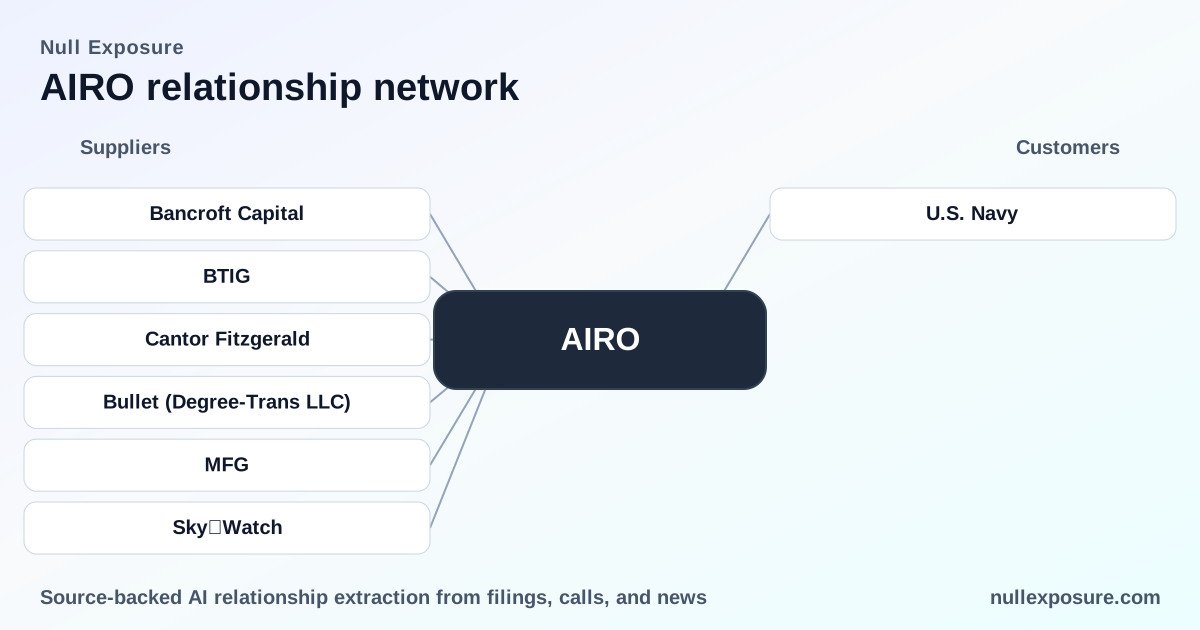
AIRO Group Holdings: supplier relationships that map capital access and go‑to‑market for advanced UAVs
AIRO Group operates as a multi‑faceted aerospace and defense manufacturer that monetizes through government and commercial drone sales, manufacturing partnerships, and now public‑market capital raises. The company funds growth through equity markets—evidenced by an underwritten IPO—and accelerates product availability and geographic reach via joint ventures and technology integrations with niche platform providers. For investors and operators, AIRO’s supplier relationships reveal a hybrid growth model: capital markets to fund scale, and targeted supplier/JV deals to rapidly field capability. Visit https://nullexposure.com/ for more supplier intelligence and market context.
How AIRO makes money and why supplier ties matter
AIRO’s revenue mix (Revenue TTM $82.36M, Gross Profit TTM $52.53M) reflects manufacturing and systems integration for ISR and interceptor unmanned systems, yet the company currently runs at negative EBITDA (‑$6.46M) as it invests in production and new product lines. Capital‑market activity (an underwritten IPO) supplies liquidity to fund manufacturing scale, while supplier and JV relationships supply differentiated hardware and access to new defense customers. Insider ownership (~34.8%) and modest institutional ownership (~27.0%) signal concentrated control with growing external scrutiny as AIRO transitions to a public company. If you want ongoing coverage of evolving supplier ties, go to https://nullexposure.com/.
Key commercial and capital relationships you need on your radar
Below I cover every relationship surfaced in public reporting and explain the commercial significance in plain English.
Bancroft Capital — IPO underwriter
Bancroft Capital is named among the underwriters for AIRO’s IPO, positioning the firm as one of the capital markets partners that structured AIRO’s public offering. According to a TradingCalendar post on the IPO (March 2026), Bancroft Capital was listed as an underwriter. (https://www.tradingcalendar.com/post/airo-ipo)
BTIG — joint bookrunner and capital markets partner
BTIG is identified as a joint bookrunner on AIRO’s IPO, giving it a central role in syndicating the equity and shaping investor demand for the offering. Renaissance Capital’s IPO coverage (March 2026) lists BTIG among the joint bookrunners. (https://www.renaissancecapital.com/IPO-Center/News/110352/Aerospace-and-defense-company-AIRO-sets-terms-for-$75-million-IPO)
Cantor Fitzgerald — lead underwriter role for the IPO
Cantor Fitzgerald served as a lead underwriter in AIRO’s public offering, which signals an institutional route to capital and broader market distribution for the company’s shares. TradingCalendar and Renaissance Capital both reference Cantor as a lead underwriter in reporting around the IPO (March 2026). (https://www.tradingcalendar.com/post/airo-ipo; https://www.renaissancecapital.com/IPO-Center/News/110352/Aerospace-and-defense-company-AIRO-sets-terms-for-$75-million-IPO)
Mizuho / Mizuho Securities — syndicate member and bookrunner
Mizuho and Mizuho Securities are cited alongside Cantor and BTIG as participating underwriters/bookrunners, indicating multi‑bank syndication to diversify distribution and share execution risk for the offering. TradingCalendar and Renaissance Capital both document Mizuho’s role in the transaction (March 2026). (https://www.tradingcalendar.com/post/airo-ipo; https://www.renaissancecapital.com/IPO-Center/News/110352/Aerospace-and-defense-company-AIRO-sets-terms-for-$75-million-IPO)
Bullet (Degree‑Trans LLC) — joint venture for interceptor UAVs
AIRO signed a letter of intent to form a joint venture with Bullet (Degree‑Trans LLC) to integrate Bullet’s high‑speed interceptor platform into U.S. manufacturing and defense supply chains, accelerating access to U.S. and NATO markets for that technology. Multiple outlets reported the JV intent and integration plans (StockTwits, Seeking Alpha PR, Defence‑Industry.eu, and Newsable — March 2026). (https://stocktwits.com/news-articles/markets/equity/airo-bullet-joint-venture-targets-us-nato-markets-with-high-speed-uavs/ch6pcJrR3ni; https://seekingalpha.com/pr/20268409-airo-group-and-bullet-sign-letter-of-intent-to-form-joint-venture-advancing-ukraine-developed; https://defence-industry.eu/airo-group-and-bullet-to-launch-joint-venture-bringing-ukraines-interceptor-drones-to-u-s-and-nato/; https://newsable.asianetnews.com/markets/airo-bullet-joint-venture-targets-us-nato-markets-with-high-speed-uavs-articleshow-bayb5bk)
Sky‑Watch — manufacturing and integration partner for ISR drones
Sky‑Watch supported AIRO’s U.S. production of RQ‑35 ISR drones, providing design collaboration and hands‑on operational support as AIRO stood up its domestic manufacturing capability. StockTitan’s coverage (March 2026) quotes AIRO leadership praising Sky‑Watch’s role in establishing U.S. production. (https://www.stocktitan.net/news/AIRO/airo-group-announces-first-u-s-produced-rq-35-isr-drones-completed-0ky3evvo580t.html)
What these relationships reveal about AIRO’s operating model
- Contracting posture: AIRO combines traditional defense supply behavior—direct integration with small, specialized platform providers (Bullet, Sky‑Watch)—with capital‑market financing to scale manufacturing. The company is executing a bilateral model: strategic JV/partner deals for capability and underwritten equity for growth capital.
- Concentration and criticality: The Bullet JV shows dependency on select platform suppliers to deliver new capability quickly; those relationships are operationally critical because they directly enable product line expansion into interceptor drones for high‑priority defense customers. The underwriter syndicate demonstrates concentration of capital partners but dispersion of distribution across multiple firms.
- Maturity and risk profile: AIRO’s financials (positive gross margin but negative EBITDA) and recent IPO indicate a growth‑stage public company transitioning from private partnerships to a broader investor base—execution risk sits in scaling production and converting JV technology into contract revenue.
- Commercial posture: High insider ownership and selective institutional interest create a governance posture that balances founder control with the need for external capital and credibility that underwriters and JV partners provide.
If you track how suppliers and capital partners change a defense OEM’s trajectory, our coverage at https://nullexposure.com/ provides ongoing supplier relationship maps.
Investment implications for operators and allocators
- Opportunity: The Bullet JV is a near‑term accelerator for capability and addressable markets; success in commercializing interceptor systems into U.S./NATO procurements would materially expand AIRO’s revenue runway.
- Risk: Execution and integration risk is material—converting LOIs and JV announcements into funded defense contracts requires procurement cycles and compliance with U.S. defense manufacturing standards. The IPO proceeds reduce immediate capital risk but increase scrutiny on execution and margin improvement given the company’s negative EBITDA.
- Governance: Concentrated insider ownership coupled with a newly syndicated public float means strategic decisions will have to balance founder priorities and public investor expectations.
Bottom line and next steps
AIRO’s supplier map reads like a two‑track growth plan: underwritten capital to fund scale, and targeted technology partnerships to accelerate capability. Operators should watch JV execution milestones and awarded contracts; allocators should monitor revenue conversion and margin trajectory as evidence that the supplier relationships are being monetized.
To keep pace with supplier dynamics and capital‑market moves that shape aerospace and defense winners, visit https://nullexposure.com/ and subscribe for ongoing analysis.