AirSculpt Technologies (AIRS): Supplier Relationships, Operational Constraints, and What Investors Should Know
AirSculpt Technologies monetizes a proprietary, minimally invasive body-contouring procedure by franchising the clinical method through a network of licensed surgeons and running company-operated centers; revenue derives from procedure fees, center-level throughput, and controlled supply of specialized devices used in the AirSculpt® procedure. The company outsources critical manufacturing and uses external investor-relations support, creating a business model that combines clinical revenue scaling with concentrated supplier exposure. For a deeper vendor-risk view visit https://nullexposure.com/.
Operational snapshot and investment thesis AirSculpt sells outcomes — not simply devices — and captures margins through branded procedural protocols, training and center economics. The company’s gross margin profile reflects durable pricing power in aesthetic procedures, while negative operating margins indicate ongoing investments in growth and marketing. Key value drivers: scalable surgeon network, branded clinical method, and control of a proprietary handpiece sourced from a single manufacturer. The balance between growth spend and single-supplier dependency defines the investment case.
A concentrated procurement posture with operational consequences AirSculpt’s procurement and contracting posture is a defining risk and an operational lever. The company discloses that it relies on a single third-party manufacturer for the FDA‑approved handpiece used in the AirSculpt procedure, creating single-source concentration and material supplier risk. The firm also relies on shorter contractual horizons and transactional purchasing for many suppliers, while surgeon relationships are governed by relatively brief clinical agreements.
- Contracting posture: Surgeon agreements are typically two to three years, indicating short-term renewal cycles and potential churn in practitioner coverage. The company also describes reliance on purchase orders rather than long-term supply contracts for some inputs, signaling a spot-oriented procurement posture.
- Concentration and criticality: Dependence on a single handpiece manufacturer is explicitly material to operations and exposes centers to supply disruption risk that could directly constrain patient throughput.
- Counterparty profile: The company works with individual surgeons at scale (around 97 contracted surgeons), reflecting a distributed clinical counterparty base but concentrated supplier-side manufacturing.
- Maturity and governance: AirSculpt mandates enterprise-grade cybersecurity controls for third-party service providers and uses managed detection and response solutions, indicating mature vendor governance for IT and privacy-sensitive services.
Supplier and service relationships investors should evaluate Below are the relationships surfaced in company disclosures and market reporting, with concise takeaways and source references.
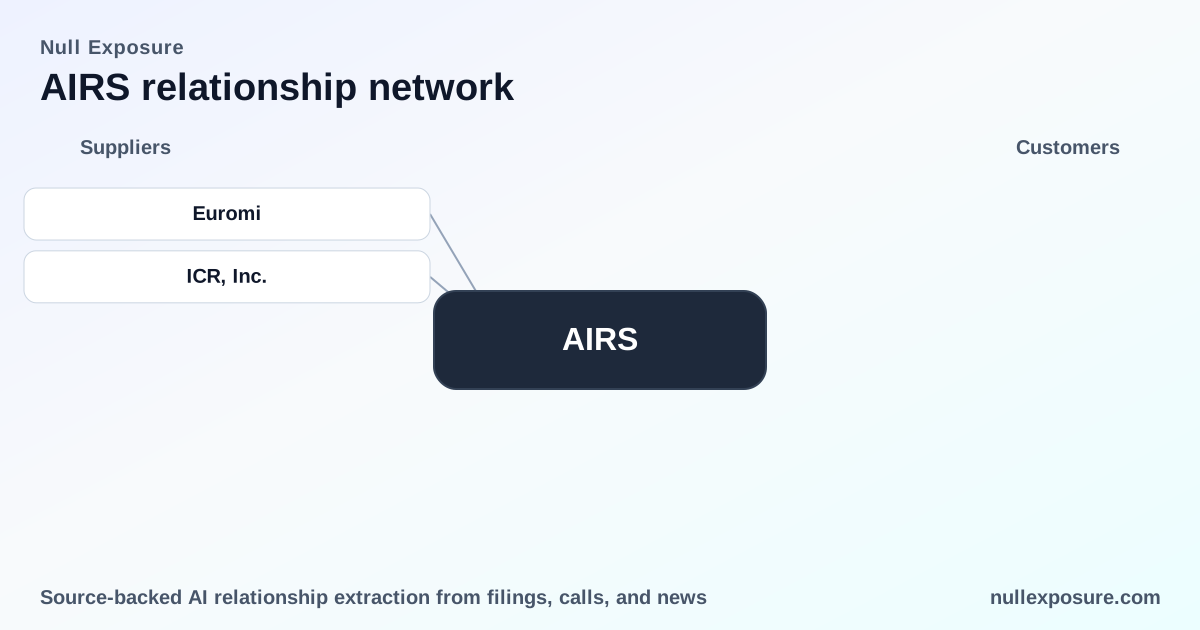
Euromi Euromi manufacturers the FDA‑approved handpiece used by AirSculpt surgeons and is the single third‑party manufacturer for that critical tool; this supplier relationship is identified as a material concentration risk in company filings. According to the FY2024 Form 10‑K, Euromi S.A., a Belgian manufacturer, produces the handpiece central to the AirSculpt® procedure and AirSculpt outsources manufacturing of key tool elements to this third party. (Source: AirSculpt Technologies FY2024 10‑K filing, December 31, 2024.)
ICR, Inc. ICR, Inc. is listed as an investor contact for AirSculpt and functions as external investor-relations support; investor-contact details for Allison Malkin were published in a market bulletin tied to an executive announcement. A March 2026 news release syndicated via StockTitan noted ICR, Inc. as the investor-contact channel for AirSculpt following the appointment of a non‑executive director. (Source: StockTitan news item citing investor contact details, March 2026.)
What the relationship map implies for operations and risk The Euromi relationship is the operational fulcrum: the handpiece is a direct input into revenue-generating procedures and Euromi’s role is categorized as manufacturer and material to the business. That dynamic converts supplier downtime or quality issues into immediate capacity and revenue risk. Because AirSculpt uses purchase orders rather than long-term manufacturing agreements for some inputs, the company’s procurement posture constrains negotiability and continuity—important considerations for risk-adjusted valuation.
Meanwhile, the ICR relationship is communications and capital‑market facing: structured investor relations support mitigates information risk and helps maintain capital-market access. External IR does not remove operational supplier concentration but improves narrative control around risk disclosures and investor outreach.
Financial and spend signals that matter AirSculpt’s disclosed spend mix and fees reveal prioritization between growth and controls. For FY2024 the company reported advertising spend of $33.4 million (primarily digital), which signals aggressive demand generation funding and underpins top-line growth initiatives. Audit and advisory fees and specific bank amendment fees (for example, a $125,000 arrangement fee in a financing amendment) put third‑party professional spend into the mid‑to‑high five‑figure range annually. High digital marketing spend combined with material supplier concentration creates a trade-off: aggressive demand generation increases dependence on uninterrupted device supply.
Company-level constraints and governance posture From a company-level perspective, disclosures indicate:
- Short-term contracting and spot procurement for many supplier relationships, increasing execution risk in the event of supplier disruption.
- Distributed counterparty exposure to individual practitioners, which supports patient access but requires robust retention and clinical quality programs.
- Regulatory and geographic complexity given that critical components are manufactured in EMEA (Belgium) and require FDA‑approved inputs for U.S. procedures.
- Mature cybersecurity expectations for vendors, including managed detection and response and external SOC monitoring, reflecting attention to privacy and clinical data protection.
What investors and operators should prioritize
- Supply continuity planning: Secure alternate manufacturing capability or strategic inventory to protect throughput against Euromi disruption.
- Contract strategy: Move select critical inputs from purchase-order to term agreements where economics allow, reducing spot-risk.
- Operational transparency: Use external IR to explain supply mitigation steps and growth investments to the market; reinforce that with public disclosure cadence.
- Marketing vs. capacity alignment: Ensure marketing spend aligns with device/surgeon capacity to avoid short-term revenue shortfalls when supply is constrained.
For direct vendor-risk benchmarking and deeper third‑party analysis, see our platform — it centralizes supplier risk indicators and contract signals for investors and operators: https://nullexposure.com/.
Bottom line AirSculpt scales a proprietary medical procedure with promising gross margins but faces a material supplier concentration that converts manufacturing hiccups into immediate revenue risk. The company balances that exposure with heavy marketing investment and institutional investor coverage supported by external IR. Investors should evaluate the firm’s mitigation steps for single‑source supply and monitor whether procurement moves from spot purchases to longer-term contracts as a signal of operational de‑risking.
Explore vendor-risk profiles and supplier disclosures for comparable healthcare operators at https://nullexposure.com/ to inform portfolio-level decisions.