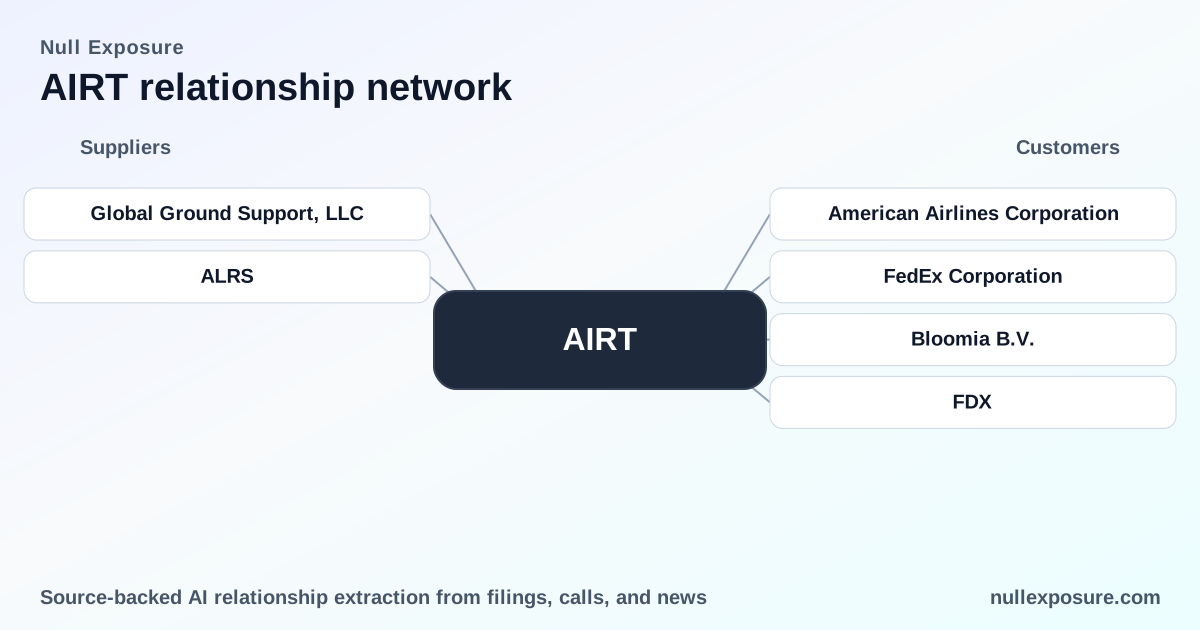
Air T (AIRT): Supplier relationships that shape capital resilience and operational uptime
Air T is an industrial conglomerate that monetizes through a combination of equipment sales (ground support and printing), parts and maintenance services for commercial and military aviation, and overnight cargo operations; revenue mixes between recurring service/parts margins and one‑off equipment sales, with working capital and credit facilities supporting the capital intensity of ground-equipment inventories. For investors, the supplier and credit relationships tilt the company toward capital-backed, long‑dated arrangements that support operations but concentrate funding and counterparty risk. Learn more about relationship intelligence at https://nullexposure.com/.
Why supplier and creditor links matter for AIRT now
Air T’s core operational resilience depends on a short list of specialized manufacturers and lending partners. Equipment suppliers and finance parties drive uptime and liquidity—two levers that determine whether the company converts inventory and service capability into sustained cash flow. The relationships disclosed in recent filings and coverage signal active, long-term financing commitments and vendor reliance on specialized ground-support equipment.
Global Ground Support, LLC — a supplier of deicers and ground equipment
Global Ground Support (GGS), based in Olathe, Kansas, manufactures, sells and services aircraft deicers and other specialized ground handling equipment sold to airlines, ground handlers, the U.S. Air Force and airports, which positions GGS as a direct supplier to Air T’s ground‑equipment and service lines. This relationship is documented in Air T’s FY2025 Form 10‑K and underscores the company’s dependence on third‑party OEMs for critical operational hardware. (Source: Air T FY2025 Form 10‑K filing, 2025.)
Alerus — lender and credit facility counterparty
Air T amended its revolving credit facility with Alerus, increasing borrowing capacity to $20 million, reducing interest costs, and extending maturity to Aug. 28, 2027, according to market coverage of the company’s Q2 results. This amendment follows other Alerus‑related term loan activity cited in company filings, indicating Alerus is a material credit counterparty playing a role in near‑term liquidity and interest expense management. (Source: TradingView news summarizing Zacks coverage, March 2026; underlying filing references in FY2025 filings.)
How the disclosed relationships map to Air T’s operating model and constraints
The documented relationships and the accompanying constraint excerpts reveal a consistent operating posture:
- Contracting posture: long‑tenor financing dominates. Company filings and amendment language reference term loans maturing in 2030 and a multiple‑advance note maturing in 2035, indicating a preference for long‑dated capital to fund acquisitions and working capital. Portions of that long‑term indebtedness are explicitly connected to Alerus via the Alerus Loan Parties referenced in filings.
- Counterparty role and criticality: suppliers of specialized ground equipment are operationally critical. Suppliers like GGS supply aircraft deicers and ground handling equipment that are not easily sourced from commodity vendors; this elevates the operational importance of maintaining those supplier relationships and spare‑parts access.
- Relationship maturity and activity: relationships are active and funded. The company reports active advances under a multiple‑advance note and recent credit amendments—both signs that those relationships are in ongoing, funded stages rather than dormant or contingent.
- Spend and financing scale: both mid‑range vendor spend and multi‑tens‑of‑millions of financing are present. Filings reference a Multiple Advance Note up to $100 million (company-level financing capacity) and specific term loan amounts (e.g., $1.1 million term loan connected to Alerus Loan Parties), which collectively indicate spend and capital exposure spanning the $1M–$100M bands.
These constraints should be read as company‑level signals. Where a filing explicitly names a party (for example, the Alerus Loan Parties), the long‑term credit linkage is attributable to that counterparty; otherwise, constraints reflect Air T’s overall contractual and capital posture.
What investors should watch next — risks and mitigants
Air T’s supplier and creditor mix creates a specific risk profile with offsetting mitigants:
- Risk — concentrated counterparty exposure: reliance on specialized suppliers for ground equipment creates single‑source operational risk; any supplier disruption directly impacts service revenue and parts sales. GGS exemplifies this category.
- Risk — leverage and refinancing profile: long‑dated notes and multiple amendments concentrate refinancing risk on a small number of lenders; Alerus is a principal counterparty to monitor for covenant changes and maturity schedules.
- Mitigant — secured long‑term funding and active amendments: the existence of multiple long‑term instruments and recent amendments indicates lenders are actively engaged and providing runway; this reduces immediate liquidity dilution risk but increases long‑term interest and covenant sensitivity.
- Mitigant — recurring service revenue: portions of Air T’s revenue derive from maintenance and parts, which are higher margin and more predictable than equipment sales, providing a partial cushion against equipment supply disruptions.
Operational metrics to monitor in future quarters: gross margin stability on parts and service lines, net leverage measures tied to the multiple‑advance note, and disclosure of any supplier concentration mitigation plans (secondary sourcing or inventory buffers).
Explore how supplier intelligence affects investment theses at https://nullexposure.com/.
Practical takeaways for operators and portfolio managers
- Treat Alerus as a strategic credit relationship. The company’s working‑capital runway and borrowing capacity materially depend on the amended revolving facility and associated term‑loan arrangements.
- Assess supplier sourcing for ground equipment. Vendors like GGS supply mission‑critical deicers and ground support equipment; procurement continuity and spare‑parts inventories are central to revenue continuity.
- Monitor covenant and maturity timelines as leading indicators. Given long‑dated instruments alongside active draws, covenant drift or lender sentiment changes will be early signs of stress or re‑rating events.
If you want deeper, relationship‑level signals integrated into a credit and operational due diligence deck, see more at https://nullexposure.com/.
Bottom line
Air T’s disclosed supplier and lender relationships present a clear tradeoff: long‑tenor financing and engaged lenders provide liquidity for capital‑intensive operations, while dependence on specialized equipment suppliers concentrates operational risk. For investors, the focus is simple—track credit covenants and supplier continuity and measure whether recurring service revenues can absorb capital costs as long‑dated debt amortizes. For operators, prioritize supplier diversification and inventory strategy to protect uptime.
For a consolidated view of counterparties and constraint signals tailored to investment decisions, visit https://nullexposure.com/ and request a relationship briefing.