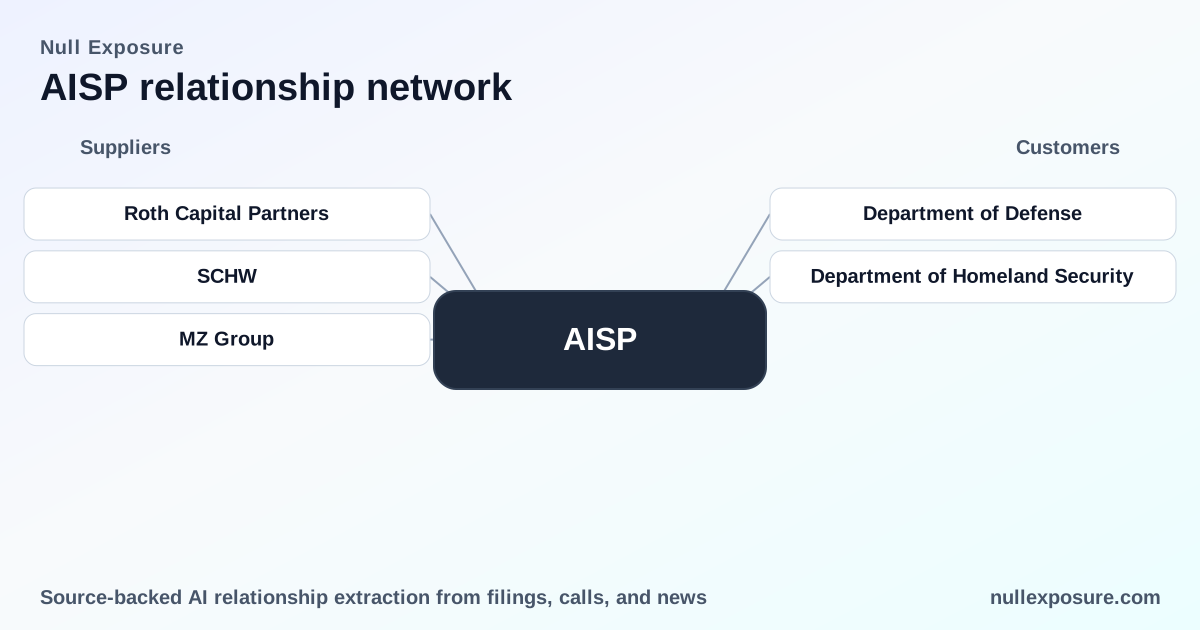
Airship AI Holdings (AISP): Supplier relationships that shape execution risk and optionality
Airship AI Holdings Inc builds and sells AI-driven platforms that combine software with edge hardware, monetizing through enterprise deployments, hardware-enabled solutions, and opportunistic capital markets activity. The company’s commercial profile is a hybrid of software margins and hardware dependence, with supplier relationships—particularly in APAC hardware manufacturing and financial intermediaries—directly affecting delivery schedules and liquidity flexibility. For investors and operators, the question is whether Airship AI’s supplier posture and partner mix create durable scale economics or concentrated execution risk.
Explore more supplier intelligence at https://nullexposure.com/ early-stage coverage and relationship mapping.
Why supplier relationships matter for an AI hardware-software integrator
Airship AI’s revenue base ($15.3M TTM) and negative operating margin (-9.44%) reflect an organization still scaling commercial throughput while absorbing hardware and supply-chain costs. Supplier performance is therefore both operationally critical and strategically material: late deliveries on Taiwan-sourced components will directly throttle shipments for edge-AI solutions, while access to capital through broker and capital markets partners underpins working capital flexibility.
Relationship-by-relationship: who does what and why it matters
Roth Capital Partners — on-demand equity capacity (FY2023)
Airship AI established an At-the-Market (ATM) offering agreement with Roth Capital Partners for up to $25 million of common stock, giving the company the ability to raise equity incrementally when market conditions and cash needs align (FY2023). Source: company news capture on the ATM agreement (https://www.stocktitan.net/news/AISP/).
Takeaway: the ATM is a deliberate contracting posture that provides opportunistic liquidity without long-term dilution commitments to a single investor.
Charles Schwab & Co — broker/transfer record in an SEC filing (FY2026)
An SEC filing in FY2026 lists Charles Schwab & Co in connection with common stock entries and movements (documented transfer/position data dated 02/25/2026), evidencing standard brokerage custodial activity and distribution of free float among retail/intermediary channels (https://www.stocktitan.net/sec-filings/AISP/144-airship-ai-holdings-inc-sec-filing-c9bc8d395bf1.html).
Takeaway: broad retail/intermediary distribution through major custodians like Schwab supports liquidity in the ticker but does not substitute for strategic capital relationships.
MZ Group — public relations and investor outreach (FY2024)
Press materials show MZ Group handling media and investor outreach for an Airship AI Nasdaq event (FY2024), with the firm acting as the company’s external communications and interview scheduling point (https://www.stocktitan.net/news/AISP/airship-ai-to-ring-the-nasdaq-closing-bell-on-wednesday-may-15-ei4t1cvt7xyo.html).
Takeaway: outsourced PR amplifies go-to-market and investor visibility, which supports liquidity and fundraising when combined with the ATM facility.
Constraints and what they reveal about the operating model
Airship AI’s public disclosures reveal concentrated operational characteristics that investors must underwrite as part of the equity case:
- APAC hardware concentration is a core execution risk. The company explicitly cites Taiwan-based products for its edge AI platform and notes geo-political-driven supply-chain constraints affecting timely production and delivery. This is a company-level signal that hardware sourcing geography is a non-trivial single-point sensitivity.
- The business depends on third-party licensors and manufacturers. Filings state reliance on external providers for hardware, software, and support, indicating a supplier-dependent delivery model rather than vertically integrated manufacturing.
- Inventory is tactical and order-driven. The company purchases inventory—primarily computer servers—to match customer purchase orders, signaling a just-in-time procurement posture that limits working capital drag but increases vulnerability to supplier lead-time volatility.
- Maturity profile is early commercial. Market capitalization (~$91.4M), Revenue TTM ($15.3M), negative EBITDA (-$7.2M) and a modest profit margin profile show an enterprise transitioning from development and pilot deployments to broader sales; supplier hiccups will therefore have amplified P&L and cash-flow effects.
- Ownership and liquidity characteristics matter. Insider ownership (~49%) implies concentrated insider control and a potentially higher tolerance for near-term dilution via ATM programs; institutional ownership (~27%) provides some external governance and liquidity support.
Collectively these constraints point to a contracting posture that is opportunistic on capital (ATM in place), dependent on APAC manufacturing, and operationally critical where supplier disruptions would have direct delivery and revenue consequences.
Explore partner-level risk scoring and procurement mapping at https://nullexposure.com/ for deeper diligence.
Investment implications — rewards, risks, and what to watch
- Reward vector: If Airship AI stabilizes hardware supply and leverages its PR / market access to expand enterprise contracts, margins will scale rapidly because software-driven services carry higher incremental margins than one-off hardware sales. The ATM facility gives management optionality to fund growth without immediate large equity raises.
- Primary risks: APAC supply-chain concentration (Taiwan components), third-party manufacturing dependency, and the company’s early commercial margins. A supplier delay or component shortage will compress revenue recognition and increase fulfillment costs.
- Key operational KPIs to monitor: supplier lead times for Taiwan components, inventory turnover for servers purchased to match orders, utilization of ATM capacity versus strategic equity placements, and any changes in licensor/manufacturer relationships disclosed in SEC filings.
Recommended actions for investors and operators
- For investors: track quarterly supplier disclosures and any amendments to the ATM; prioritize management commentary on APAC sourcing and contingency suppliers. Maintain scenario models that assume at least one significant hardware delay in a 12–18 month window.
- For operators and partners: formalize alternative suppliers outside Taiwan and negotiate contractual protections (penalties, prioritized slots) with manufacturers; convert seasonal inventory buys into hedged purchase agreements where possible.
Final note: supplier relationships are not peripheral for Airship AI—they are central drivers of execution and liquidity. For ongoing supplier mapping, counterparty risk scoring, and event-driven alerts, visit the central resource at https://nullexposure.com/ and subscribe for targeted supplier intelligence.
Bottom line: Airship AI’s supplier ecosystem combines useful capital-market optionality with concentrated hardware dependence; investor returns hinge on the company converting ATM-enabled capital and PR visibility into stable supply continuity and scalable enterprise contracts.