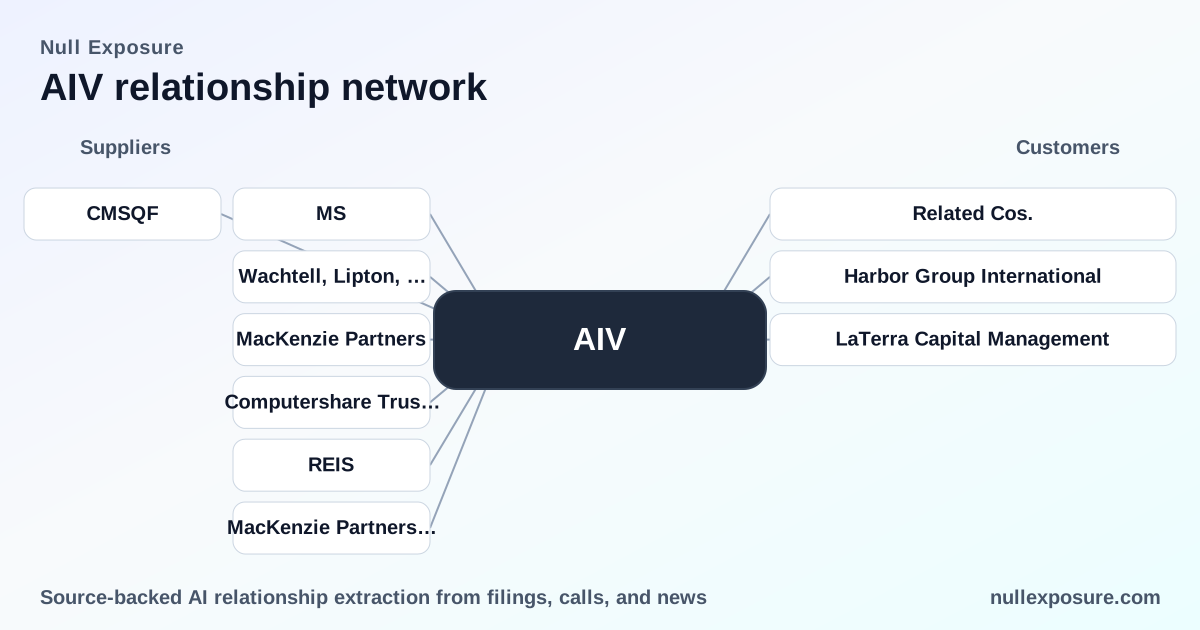
Aimco (AIV) — how advisor hires and supplier posture reshape value capture
Apartment Investment and Management Co (Aimco) operates as a US-focused multifamily REIT that creates value through development, redevelopment, rent collection and selective asset sales; the company monetizes via stabilized rental cash flow and episodic asset disposals, and the board has recently moved to a planned sale and liquidation of remaining assets, which re-frames how suppliers and financial counterparties will be paid and prioritized. Investors should treat Aimco as a holdings liquidation story supported by top-tier financial and legal advisors, with material near-term activity in sales, proxy solicitation and transfer-agent services. For a quick overview of supplier exposures and to track counterparties, visit https://nullexposure.com/.
Why the advisor and service roster matters to the investment thesis
Aimco’s choice of advisors and service providers signals an execution posture: sell or liquidate at asset-level prices while preserving operating continuity through third-party managers and standard transfer-agent arrangements. This roster also concentrates fee pools and shifts negotiating leverage toward advisors running sale processes and proxy solicitation.
Morgan Stanley & Co. LLC (Morgan Stanley)
Morgan Stanley is engaged as Aimco’s lead financial advisor for potential sale or liquidation transactions involving substantially all assets; the board cited Morgan Stanley’s role in recommending a plan of sale and liquidation in the company’s definitive proxy statement filed in March 2026. According to Aimco’s DEF 14A filing (March 2026), Morgan Stanley led market outreach and strategic review workstreams that underpinned the board’s liquidation recommendation.
Wachtell, Lipton, Rosen & Katz
Wachtell is retained as Aimco’s outside legal advisor for the strategic review and the plan of sale and liquidation, positioning the firm to manage complex transactional and governance issues during the wind‑down. The DEF 14A filing (March 2026) identifies Wachtell as counsel guiding the board’s deliberations.
MacKenzie Partners / MacKenzie Partners, Inc.
Aimco engaged MacKenzie Partners to assist with proxy solicitation and shareholder outreach ahead of the liquidation vote, a role that drives the mechanics of shareholder approval and voter turnout. The proxy statement (DEF 14A, March 2026) lists MacKenzie Partners, Inc. as the company’s designated proxy solicitor and provides contact information for shareholder assistance.
Computershare Trust Company, N.A. / Computershare
Computershare is the transfer agent handling registered stockholder records and proxy returns, responsible for vote tabulation and administrative transfer functions during the liquidation process. The DEF 14A (March 2026) instructs registered holders to return proxy cards to Computershare and identifies it as the transfer agent administering the vote.
REIS
Aimco uses REIS data as a third‑party benchmark for local market rent comparisons and property-quality metrics, informing valuation and asset-management decisions historically. A 2016 ADVFN article documented Aimco’s use of REIS data to assess rent positioning relative to local markets.
(Each relationship summary above is drawn from Aimco’s filings and contemporary reporting, including the DEF 14A proxy statement filed March 2026 and press coverage around the strategic review in March 2026.)
Operational characteristics and constraints that shape supplier risk
Aimco’s operating model and disclosed constraints create a clear vendor and counterparty profile:
- Contracting posture — long‑dated financing and leases: The company emphasizes long-dated, fixed‑rate, non‑recourse property debt on stabilized assets and records long lease terms on finance leases, implying a conservative capital structure that favors counterparties willing to transact under long-term terms.
- Service model — third‑party property managers run day‑to‑day operations: Aimco delegates property management to external managers; these managers can commit to purchases for operations (usually one-year terms) and will be the primary point of contact for vendors on the ground.
- Spend scale and timing — development capex remains material but variable: Aimco invested $126.1 million in development and redevelopment in 2024 versus $274.9 million in 2023, indicating a >100M annual spend band historically but with meaningful year‑to‑year volatility.
- Relationship posture — buyer and active service consumer: Disclosures frame Aimco both as an active buyer (lessee on several finance leases and lessee for development sites) and as a consumer of services (property managers, transfer agents, proxy solicitors), which concentrates short-term opportunity around operations and disposition work.
These are company-level signals taken from Aimco’s public filings and disclosures; they define negotiating levers and execution timelines for suppliers without attributing a specific constraint to any single vendor unless the filing does so explicitly.
If you are mapping counterparty exposure for investment or vendor risk, see more curated supplier profiles at https://nullexposure.com/.
What the liquidation plan means for suppliers and investors
The board’s unanimous approval of a plan of sale and liquidation, conditioned on stockholder approval, transforms Aimco from a go‑forward operator into an asset‑disposition vehicle. That change elevates advisory, brokerage and legal fees in the near term while compressing the runway for long-term vendor contracts to materialize. Expect concentrated activity in:
- Broker and capital-markets fees as assets are marketed through Morgan Stanley;
- Elevated legal and governance work through Wachtell;
- Heightened proxy solicitation and administrative work via MacKenzie and Computershare during the vote cycle.
MileHighCRE and contemporaneous filings reported the board’s conclusion after market outreach conducted with Morgan Stanley and Wachtell (March 2026), and the DEF 14A lays out the administrative roles of MacKenzie and Computershare for the shareholder vote.
Practical recommendation for supplier negotiations and operators
Aimco is executing a narrowly timed sale-and-liquidation playbook. Suppliers and prospective partners should prioritize:
- Short‑term, performance‑oriented bids aligned to asset sales and transition services rather than long-term speculative deals.
- Flexible contract terms that allow for rapid unwind or assignment during a disposition process.
- Engagements through third‑party property managers for operational work, since Aimco’s managers run day‑to‑day operations and can commit near-term purchases under one‑year arrangements.
Aimco’s recent disclosures show sizable development capex in recent years yet declining spend into 2024, underscoring the need for suppliers to price for timing risk and potential scale‑down.
Final read: what matters to investors and counterparties
Aimco’s deliberate selection of Morgan Stanley, Wachtell, MacKenzie Partners and Computershare for the liquidation and proxy process is a decisive governance signal: the company is converting from operating REIT to orderly asset monetization. For investors, the path to value is asset-by-asset realization conducted by top-tier advisors; for suppliers, the opportunity window is concentrated and transactional. Track filing updates and proxy outcomes closely; operational counterparties with experience in rapid transition and asset sale workflows will capture the largest share of near-term work.
For a deeper supplier‑level view and ongoing monitoring of Aimco’s counterparties, visit https://nullexposure.com/. If you want tailored exposure mapping or subscription access to counterparty briefs, start at https://nullexposure.com/ — actionable intelligence for investors and operators.