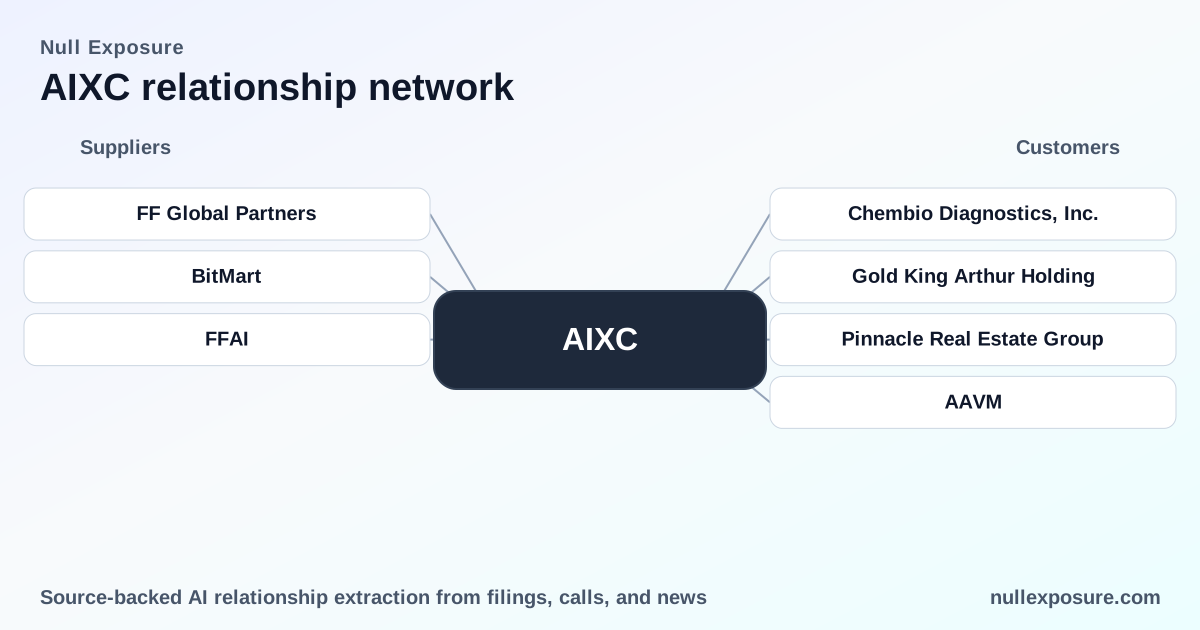
AIxCrypto (AIXC) — Supplier relationships and operating constraints investors must price in
AIxCrypto Holdings operates as a clinical-stage therapeutics company that monetizes through licensed intellectual property, sponsored research and financing transactions, while simultaneously pursuing crypto-enabled product strategies such as tokenized-stock projects and co-branded payment products. The company funds development through equity raises and placement agent arrangements, supplements capabilities with short-term consulting and vendor contracts, and is building alternative revenue channels via strategic crypto partnerships. Investors should value AIXC as a small-cap R&D issuer with parallel experimental crypto initiatives that introduce both optionality and execution risk.
For a deeper supplier and counterparty risk profile, visit https://nullexposure.com/.
Three partner moves that change the supplier risk picture
FF Global Partners — strategic consulting engagement
AIxCrypto engaged FF Global Partners under a consulting agreement effective November 1, 2025, to support strategic planning, funding initiatives, blockchain architecture and risk management, with monthly fees and potential discretionary bonuses. This is a short-term advisory posture intended to accelerate funding and crypto product execution. (TradingView news item, March 9, 2026: tradingview.com)
BitMart — co-branded prepaid card partnership
AIxCrypto announced a strategic partnership with BitMart to launch a co-branded virtual prepaid card program for eligible users in the AIxC ecosystem, positioning the company to monetize platform activity and on-ramps for tokenized products. The agreement signals a direct commercial push into consumer-facing crypto services. (StockTitan investor update, March 2026)
FFAI — tokenized-stock pilot through a $5 million initial position
AIxCrypto stated its first tokenized-stock project will involve an initial $5 million purchase of FFAI shares through an independent third party to explore stock-token offerings, establishing a capital-commitment test-bed for asset tokenization and synthetic product offerings. This is a material, program-level commitment relative to AIXC’s small market capitalization. (StockTitan rebrand/announcement, FY2025)
What the vendor fabric and contract language tell us about how AIXC runs the business
Company disclosures and contract excerpts show a blended operating model: exclusive long-form licenses for core therapeutic IP, combined with short-term, cancelable service contracts for commercialization and investor relations work, plus experimental commercial partnerships in crypto.
- The company explicitly cites an exclusive in-license from University College London in January 2022 for a G-Quadruplex selective transcription inhibitor platform, which confirms a traditional biotech licensing model for core R&D assets. This is a company-level signal grounded in licensing evidence naming UCL and UCL Business Limited.
- A set of consulting and IR agreements are structured as short-term, cancelable engagements; the IR Agency arrangement included a milestone-style fee ($800,000 payable upon raising $1.8 million) that reflects reliance on equity financing to fund vendor payouts. That IR Agency example and the September placement agent agreement with Univest are called out explicitly in company disclosures.
- Procurement flows include contract manufacturers and CROs for preclinical/clinical activity, but the contracts are described as terminable on notice, which reduces lock-in and simultaneously raises operational churn risk.
- The company presents itself as licensee and sponsor for university-originated IP (UCL and University of Louisville Research Foundation are referenced in filings). That licensing posture gives AIXC control of specific IP assets while preserving dependency on external regulatory and development partners for trials and manufacturing.
Key constraint signals: licensing for core IP (global rights), short-term/cancelable vendor contracts, service-provider orientation, and mid-six-figure contingent vendor fees that are payable on financing events.
For an actionable vendor-risk scorecard and continuous monitoring, visit https://nullexposure.com/.
Why these relationships change the risk and reward calculus
- Concentration and capital intensity: The announced $5 million initial purchase of FFAI shares is a high-concentration allocation relative to AIXC’s reported market capitalization (~$6.24 million), converting balance-sheet capital into counterparty exposure and signaling aggressive use of limited liquidity for strategic experimentation. (StockTitan FY2025 notice)
- Financing-driven vendor economics: The IR Agency fee structure ($800k contingent on a $1.8M raise) and the Univest placement-agent economics (3% of gross proceeds plus warrants) make vendor cash flow sensitive to the company’s ability to close financings; vendor payouts are therefore levered to fundraising success rather than steady operating cash generation. (Company disclosures/excerpts)
- Operational maturity and cancelability: Most external professional services and manufacturing contracts are cancelable on notice, which reduces long-term vendor lock but introduces execution risk during rapid program changes or fund-raising shortfalls.
- New regulatory and commercial vectors: Partnerships with crypto platforms like BitMart introduce non-traditional regulatory and compliance obligations for a therapeutics company, increasing legal and execution complexity during commercialization of payment or tokenized products. (StockTitan investor update, March 2026)
Practical takeaways for investors and operators
- Treat counterparty exposure to tokenized assets as material: the $5M FFAI position is proportionally large for AIXC; investors must underwrite liquidity, custody, and mark-to-market risk on that book. (StockTitan, FY2025)
- Model financing-dependent vendor payouts explicitly: the contingent $800k IR fee and placement-agent economics will compress runway if expected raises fail; stress-test scenarios where financings are delayed or under-subscribed. (Company filing excerpts)
- Prioritize contractual diligence on cancellable manufacturing/CRO engagements: cancelability limits stranded-cost risk but increases the odds of start/stop project execution in a cash-constrained environment.
- Monitor regulatory signals for crypto/tokens: partnerships with trading and payments platforms introduce new compliance vectors that require board-level oversight and legal budget allocation.
Final recommendations and next steps
AIxCrypto is executing a dual-track strategy: traditional IP-driven therapeutics development supported by licensing and CRO/CMO relationships, and an experimental commercial trajectory built around tokenization and crypto product partnerships. Investors should value the upside from crypto-enabled revenue only after underwriting concentration, regulatory, and financing execution risk.
For an in-depth supplier risk score and ongoing alerts tied to these counterparties, visit https://nullexposure.com/.
Monitor three near-term items closely: completion and terms of announced financings that trigger vendor fees, the size and custody treatment of the FFAI position, and regulatory guidance affecting co-branded crypto payment products. These vectors will determine whether the company’s partnerships are accretive to shareholder value or a source of elevated execution risk.