Assurant (AIZ): Supplier relationships, operational posture, and what investors should price in
Assurant is a global risk-management business that sells insurance and warranty products and provides related services to consumer and commercial channels; it monetizes through underwriting margins, fee income for administration, and investment income on reserves. The company scales by embedding services into distribution partners (auto dealers, device retailers, mortgage channels) and by acting as an administrator for large public programs, converting recurring fee streams and underwriting spreads into predictable cash flow. For investors evaluating supplier exposure, the key question is how partner integrations and third‑party dependencies convert into execution risk and commercial leverage for Assurant. Visit the firm overview and supplier scan at https://nullexposure.com/ for the full supplier map.
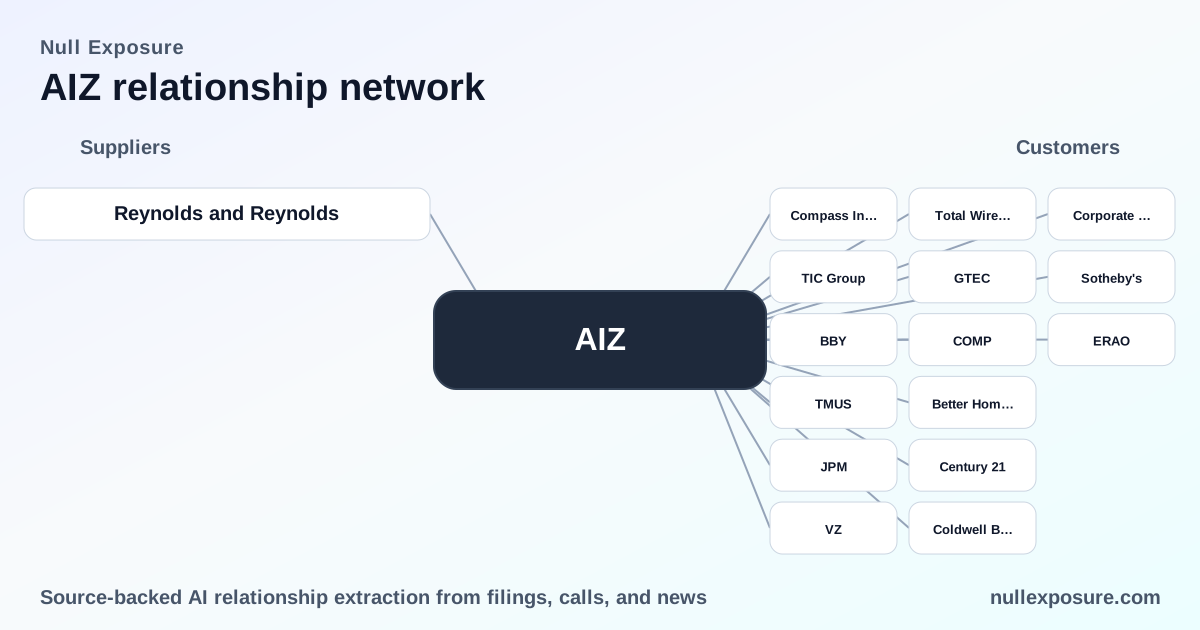
A single, clear supplier relationship in the feed: Reynolds and Reynolds
Assurant's recent public activity shows a focused commercial tie to Reynolds and Reynolds centered on auto retail digitization. In March 2026 Assurant expanded its Automotive Training Academy to include training on Reynolds and Reynolds’ docuPAD eContracting system, positioning Assurant as an option for dealers whose F&I managers will use docuPAD to execute contracts and customer interactions. A StockTitan news report described the partnership and Reynolds’ acting CEO praising the training integration (March 9, 2026, https://www.stocktitan.net/news/AIZ/automotive-training-academy-by-assurant-expands-exclusive-offering-wf1z6ltf310s.html). An Intellectia piece the same day noted that Assurant launched the training program in Atlanta using the docuPAD system to address demand for dealer training (March 9, 2026, https://intellectia.ai/news/stock/assurant-receives-feefo-platinum-trusted-service-award). Several Finviz headlines in March 2026 repeated the expansion of the Automotive Training Academy onto the docuPAD eContracting platform (e.g., March 9, 2026, https://finviz.com/news/325984/morgan-stanley-maintains-hold-on-assurant-aiz-with-248-target).
Why this relationship matters: the Reynolds integration is a distribution and execution play — it enhances Assurant’s ability to capture fee-bearing F&I sales at point of contract through a dealer-facing electronic workflow. The tie increases revenue capture opportunities in automotive channels and raises the commercial stickiness of Assurant’s product offerings. Sources: StockTitan (March 9, 2026), Intellectia (March 9, 2026), Finviz headlines (March 2026).
How Assurant’s supplier posture shapes its operating risk and leverage
Assurant’s supplier and counterparty profile is not limited to dealer platforms. Company disclosures and operational language create three company‑level signals investors must weigh:
-
Government counterparty exposure is explicit and material. Assurant acts as an administrator under the voluntary National Flood Insurance Program and reported reinsurance recoverables and ceded claims to the U.S. government of $911.7 million, $123.6 million and $424.3 million as of December 31, 2024, 2023, and 2022, respectively, in its filings. This is not a peripheral arrangement — it places Assurant squarely in an administrative role with federal counterparties and the associated regulatory oversight and timing risks (company disclosure as of Dec 31, 2024).
-
Service-provider dependency is embedded in the operating model. The company explicitly states that it relies on vendors, independent contractors and third parties for technology, operations, facilities and investment management; these providers execute core processes that affect product delivery and regulatory compliance. Assurant’s outsourcing posture increases scalability but also transfers operational concentration and continuity risks to suppliers (Assurant filings).
-
Supplier interruptions are a critical operational vulnerability. Management warns that an interruption or cessation of service by a service provider due to systems failures, capacity limits or financial distress “could materially disrupt our operations” and trigger contractual or regulatory penalties. This elevates supplier availability and resilience to the level of a systemic, company-level risk rather than a routine vendor-management issue (company risk disclosure).
Together, these signals describe an operating model that pursues scale through third‑party channels and administrative contracts, while accepting counterparty and supplier concentration that can be material to operations if not actively managed.
Visit https://nullexposure.com/ to map how these supplier signals compare across peers and to access the full vendor-risk dashboard.
What investors should watch in the next 12–24 months
Assurant’s financials show scale and margins that provide a buffer, but supplier and counterparty exposures are the primary operational levers:
-
Monitor vendor concentration and contract terms: how many single‑vendor dependencies exist for critical systems (e.g., eContracting, claims platforms)? Favorable commercial leverage is only durable if contract terms protect Assurant against service interruptions and provide remedies or alternatives.
-
Track NFIP administration cash flows and timing: the disclosed ceded amounts tied to the U.S. government are large; timing and recoverability of these reinsurance recoverables affect liquidity and reserve fungibility.
-
Watch systems resilience metrics and third‑party SLAs: given the company’s reliance on outsourced technology, investors should prioritize disclosure of uptime, incident frequency and recovery times.
-
Financial signal checkpoints: Assurant’s Revenue (TTM $12.8B), Profit Margin (~6.8%), ROE (~15.9%) and Forward P/E (~10.3) (company profile data through latest quarter) show profitable underwriting and room for operational investment, but downside risk from supplier disruption would compress these margins quickly.
These are not abstract concerns — the partnership with Reynolds and Reynolds is a practical example of revenue upside from distribution integrations, while the NFIP role and vendor reliance demonstrate countervailing execution risk.
Portfolio implication and recommended monitoring
Assurant delivers scalable revenue through distribution partnerships (e.g., the Reynolds docuPAD integration) while simultaneously running significant administrative contracts with government programs and outsourcing core operational capabilities. For investors and operators, the trade-off is clear: commercial embedment with partners drives growth, but supplier concentration and government counterparty exposure are material, not peripheral, risks.
Recommended actions:
- Require quarterly updates on critical‑vendor concentration and remediation plans in investor calls.
- Demand transparency on NFIP-related receivables and timing of recoveries in periodic filings.
- Assess contract terms with major partners (like Reynolds and Reynolds) for exclusivity, escape clauses and business continuity obligations.
Continue your supplier diligence and comparative peer analysis at https://nullexposure.com/ for the full supplier relationship roster and risk scoring.
Final takeaways
- Reynolds and Reynolds is a strategic distribution partner for Assurant’s auto-channel training and eContracting integration, enhancing Assurant’s ability to capture dealer F&I revenue (StockTitan, Intellectia, Finviz; March 2026).
- Assurant’s government administration role and third‑party reliance are company‑level risk factors that increase operational sensitivity to supplier failures and timing of recoverables (company disclosures as of Dec 31, 2024).
- For investors, the immediate upside from partner integrations is tangible; risk-adjusted valuation depends on the company’s ability to demonstrate vendor diversification, contractual protections, and timely recoveries from government counterparty arrangements.
If you want a side‑by‑side supplier risk bookmark that translates these signals directly to portfolio actions, start with the supplier map at https://nullexposure.com/ and subscribe for alerts on critical third‑party changes.