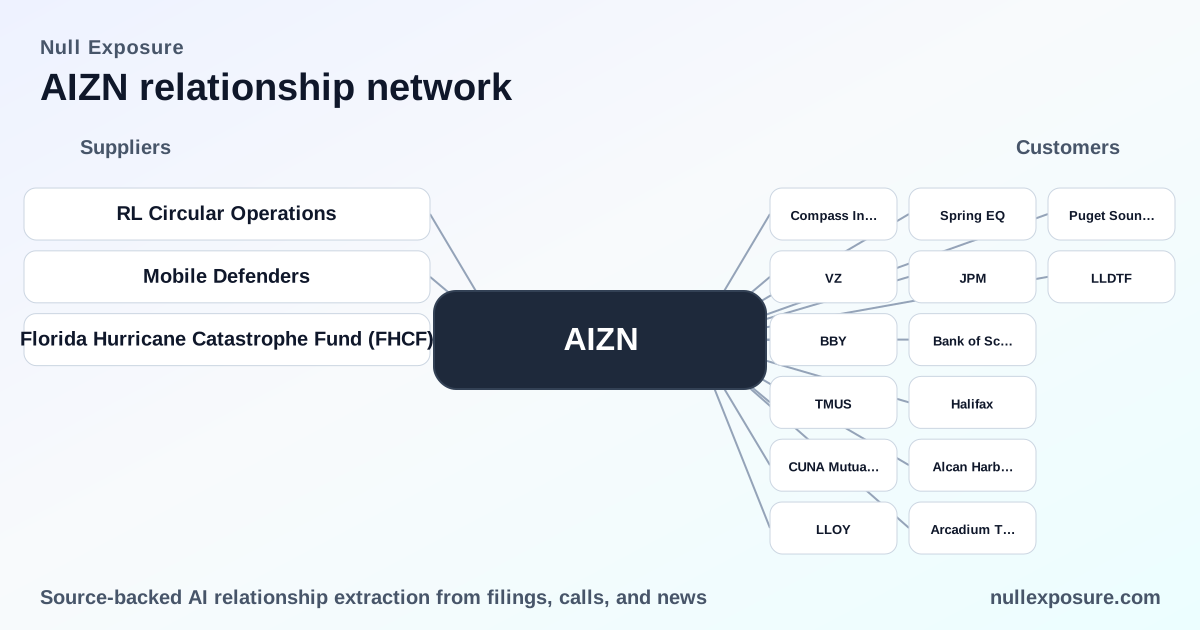
Assurant Inc. (AIZN): Supplier Relationships That Matter to Investors
Assurant operates as a specialist risk manager, underwriting and administering insurance products across consumer electronics, mobile device protection, automotive and real estate lines. The company monetizes through premium income, fee-based servicing, and risk-transfer arrangements (reinsurance and ceded recoverables), while augmenting operational capability via strategic acquisitions and minority stakes in vendor partners. For investors, supplier relationships are both a cost lever and a potential source of concentration, operational risk and reputational exposure. Learn more about supplier risk signals at https://nullexposure.com/.
Why supplier relationships drive performance at Assurant
Assurant’s operating model blends underwriting with outsourced execution: core pricing and claims liability remain on the balance sheet, while fulfillment — repairs, reverse logistics, parts supply and catastrophe recoveries — relies heavily on third parties. This structure creates four actionable characteristics for investors:
- Contracting posture: Assurant combines direct ownership, minority investments and long-term service contracts to control supply chain economics while retaining underwriting risk.
- Concentration: Reinsurance placements and large service vendors produce material single-counterparty exposures that influence capital and earnings volatility.
- Criticality: Logistics, parts supply and reinsurance are mission-critical; interruptions translate immediately into claim backlogs, higher loss costs and client disputes.
- Maturity and spend scale: Relationships range from newly acquired regional operations to entrenched reinsurance treaties with nine-figure recoverables, indicating evolved supply governance but significant financial stakes.
The company-level constraint signals reinforce this picture: explicit evidence of reinsurance ceded to U.S. government entities, a direct acknowledgment that service-provider interruptions are material to operations, identification of vendors and contractors as principal service providers, and documented reinsurance recoverables in the hundreds of millions (e.g., a $471.5 million recoverable with John Hancock as of December 31, 2024). These are company-level signals that shape contracting strategy, counterparty selection and capital allocation.
The supplier relationships you need on the radar
Below I cover every relationship returned in the supplier data, with concise, investor-focused takeaways and source context.
RL Circular Operations — strengthening reverse logistics in ANZ
Assurant closed the fourth-quarter acquisition of RL Circular Operations, the reverse logistics arm of TIC Group serving Australia and New Zealand, to bolster device repair, refurbishment and end-of-life handling in that region. This acquisition directly strengthens Assurant’s control of returns and repair economics in a high-volume market, improving margin capture on device protection programs. According to Assurant’s 2025 Q4 earnings call, the deal was presented as a strategic capacity and capability enhancement for its mobile and connectivity services (earnings call, 2025Q4).
Mobile Defenders — partial ownership and franchise disputes
Franchisees filed arbitration claims alleging that CPR (a franchisor/operator channel) directed them to buy repair parts exclusively from Mobile Defenders, a supplier in which Assurant held a partial ownership stake, and complained that parts were more expensive and lower quality than alternatives. This relationship introduces governance and reputational risk where supplier ownership intersects with distribution oversight, and it has prompted arbitration activity that requires monitoring for potential financial or contractual ripple effects. The detail is reported in Franchise Times coverage of FY2023 arbitration filings.
Florida Hurricane Catastrophe Fund (FHCF) — government-backed reinsurance capacity
Industry reporting indicates Assurant utilized FHCF-backed reinsurance following Hurricane Ian; under those arrangements, after an $86 million retention, FHCF provides 90% coverage of losses up to $200 million. This demonstrates Assurant’s use of government-sponsored reinsurance as part of its catastrophe risk-transfer stack and highlights dependency on government-backed capacity for peak-event loss mitigation. Reinsurance commentary on FY2022 losses documents this FHCF involvement and the retention/coverage structure (reinsurance industry reporting, FY2022).
What these relationships reveal about risk and optionality
Assurant’s supplier footprint mixes strategic acquisitions, minority investments, and reliance on government or large reinsurance counterparties. That mix creates opportunities to capture more value from claims handling and device lifecycle monetization, while exposing the insurer to legal disputes, integration execution risk and counterparty concentration.
Key signals to monitor:
- Integration execution of RL Circular Operations. Acquisitions deliver upside only if operational integration reduces cycle times and parts costs; watch KPIs for repair throughput and refurbishment yield.
- Legal and franchise exposure tied to Mobile Defenders. Arbitration claims connected to supplier procurement rules are a potential source of financial liability and client churn; track case outcomes and any changes to supplier governance or ownership.
- Reinsurance recoverables and government counterparty reliance. Large recoverable balances (example: $471.5 million with John Hancock reported for FY2024) and continued use of FHCF indicate that reinsurance counterparties carry meaningful balance-sheet risk and liquidity implications in stress scenarios.
- Service-provider concentration and operational continuity. Company disclosures explicitly identify vendor outages as a material operational risk; investors should prioritize disclosures around vendor diversification and contingency planning.
If you’d like a deeper, vendor-level mapping and stress-testing of these relationships, start with our research hub at https://nullexposure.com/.
Practical monitoring checklist for investors
- Track legal filings and arbitration updates tied to supplier ownership or procurement constraints. Material legal costs and reputational damage are plausible outcomes.
- Monitor quarterly disclosures for reinsurance recoverable changes and any government counterparty involvement. Large movements materially affect capital adequacy and earnings timing.
- Require management commentary on integration milestones for recent acquisitions (customer retention, cost synergies, service-level metrics).
- Confirm counterparty concentration limits and third-party risk management practices in annual reports and 10-K/earnings commentary.
Bottom line — how to position around AIZN supplier risk
Assurant has structured supplier relationships to capture operational value, but those same relationships produce material counterparty and operational risk. The RL Circular acquisition strengthens control over a core fulfillment capability; the Mobile Defenders episode highlights governance and legal risk where supplier ownership intersects distribution; FHCF usage confirms reliance on government-backed capacity to manage catastrophe losses. Investors should weigh the upside of improved margin capture against concentration, legal exposure and reinsurance recoverable risk.
For a structured vendor due-diligence briefing and ongoing supplier monitoring tied to Assurant’s filings and market signals, visit https://nullexposure.com/ and sign up for targeted supplier-risk alerts.