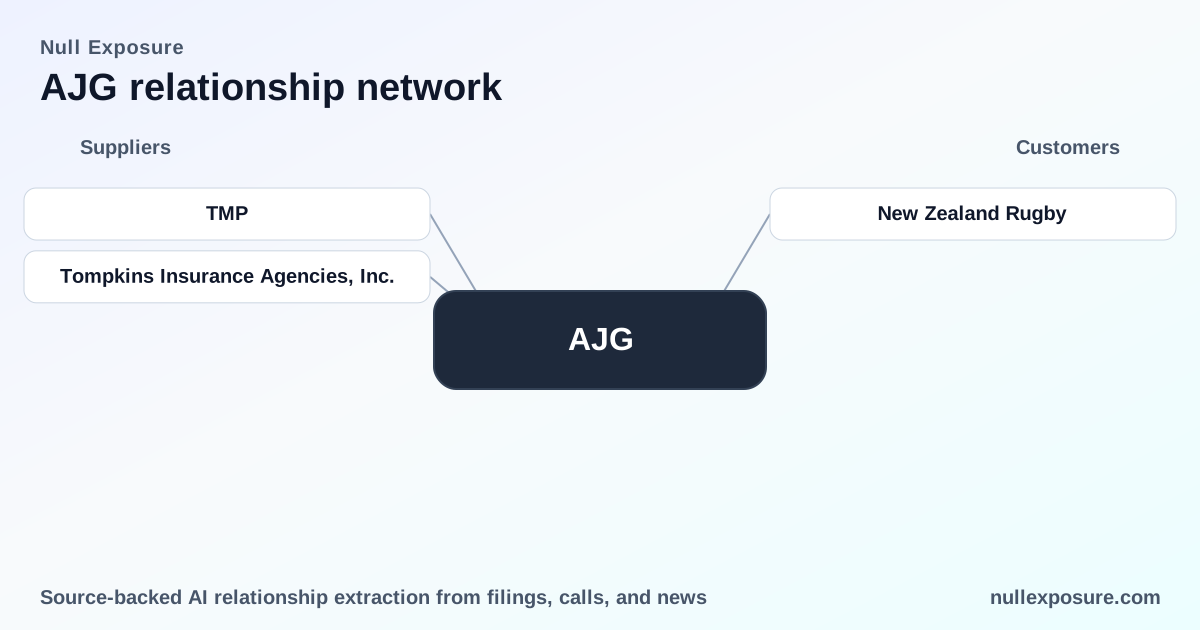
AJG Supplier Relationships: The Tompkins Deal and Its Strategic Signals for Investors
Arthur J. Gallagher (AJG) operates as a global insurance broker and risk‑management services provider that monetizes through brokerage commissions, service fees for claims and risk management, and strategic acquisitions that expand distribution and recurring fee income. Recent evidence in supplier/relationship data shows AJG acquiring operating agencies and absorbing related payables and reimbursement flows—an acquisitive operating model that converts franchise-level cash flows into consolidated revenue and shareholder value. For an investor evaluating AJG’s supplier posture, the core takeaway is simple: AJG grows by buying and integrating agencies and by layering service delivery that depends on third‑party IT and service vendors. Learn more about how we surface supplier relationships at https://nullexposure.com/.
Why the Tompkins transaction matters to AJG’s commercial model
AJG’s monetization strategy uses M&A to scale local agency economics into global fee streams. The Tompkins transaction demonstrates three operational characteristics that influence both upside and risk:
- Contracting posture — acquisitive and long‑duration: AJG’s purchase consideration frequently embeds earnouts and contingent payments measured over multi‑year windows. The company records earnout obligations and treats them as part of acquisition consideration, which creates multi‑year payment commitments tied to acquired business performance.
- Service integration and third‑party reliance: AJG integrates acquired agencies into its claims and risk‑management platform, while simultaneously increasing dependence on cloud, IT, and other third‑party vendors to run integrated service offerings and to manage client reimbursements.
- Scale and spend concentration: The company carries material earnout exposure related to recent deals, underlining that AJG’s supplier/partner cashflows are not marginal; they operate at scale and can be materially consequential to balance sheet and cash flow dynamics.
According to AJG’s disclosures captured in the constraints evidence, the aggregate maximum earnout obligations for acquisitions made from 2021 onwards were $1,998.2 million as of December 31, 2024, with $1,302.0 million recorded on the consolidated balance sheet based on estimated fair value of expected payments. That magnitude places supplier / acquisition-related spend squarely in the >$100 million band, and it matters for liquidity planning and valuation.
Explore deeper supplier intelligence at https://nullexposure.com/.
The relationships recorded in the results — what investors should know
Below are the relationships that appear in the supplied results. Each entry includes a concise, plain‑English summary and a source citation.
-
Tompkins Financial Corporation — Tompkins sold its wholly‑owned insurance subsidiary to Arthur J. Gallagher Risk Management Services, LLC on October 31, 2025, marking a strategic divestiture and AJG’s expansion into the acquired agency’s footprint. According to TradingView’s coverage of Tompkins Financial Corporation’s FY2026 filing, the transaction was disclosed in Tompkins’ SEC materials (TradingView, March 2026 — https://www.tradingview.com/news/tradingview:b232c7558f37b:0-tompkins-financial-corp-sec-10-k-report/).
-
Tompkins Insurance Agencies, Inc. — The operating subsidiary, Tompkins Insurance Agencies, Inc., was sold to Arthur J. Gallagher Risk Management Services, LLC for approximately $223.0 million in cash, representing a cash‑for‑asset acquisition that immediately extends AJG’s agency distribution and fee base. This amount and transaction detail was reported in Tompkins’ FY2026 10‑K as referenced by TradingView (TradingView, March 2026 — https://fr.tradingview.com/news/tradingview%3Ab232c7558f37b%3A0-tompkins-financial-corp-sec-10-k-report/).
These relationship entries confirm AJG’s playbook: buy local agencies, fund with cash and/or stock, and fold them into AJG’s global services.
Operational constraints and what they reveal about AJG’s supplier posture
The supplied constraint excerpts provide company‑level signals about how AJG manages supplier and acquisition relationships:
- Long‑term contractual commitments are embedded in acquisitions. Earnouts are measured over two‑ to three‑year post‑acquisition periods and are recorded at fair value as part of purchase price consideration. This creates multi‑year contingent liabilities that influence both leverage and cash planning.
- AJG acts as both principal and service integrator. The company describes itself as being considered a principal in certain service partner relationships because it directs third parties, controls specified services, and combines those services into integrated solutions—implying operational control over outsourced components and the attendant responsibility for client outcomes.
- Dependence on IT and cloud vendors is material. AJG explicitly increases use of cloud storage and cloud computing services and relies on vendors with system access to support secure processing of sensitive information—raising operational risk and third‑party cyber/availability considerations.
- Spend and contingent obligations are large. The recorded earnout obligations disclose aggregate maximums near $2.0 billion with over $1.3 billion recognized at fair value as of year‑end 2024, signaling high spend concentration tied to M&A.
These constraints should be treated as company‑level characteristics that describe AJG’s supplier and contracting posture rather than attributes of a specific seller or vendor.
Where the risks and value intersect for investors and operators
For investors, the Tompkins transaction and the constraint signals translate into a clear risk‑reward profile:
- Value upside: Acquisitions like Tompkins expand recurring fee revenue and agency reach, improving organic growth prospects and cross‑sell opportunities. AJG’s role as principal and service integrator allows it to capture higher margin service flows.
- Risks to monitor: Integration execution, earnout funding, and third‑party IT dependency. Large earnout liabilities dilute near‑term free cash flow and increase sensitivity to acquired business performance; third‑party vendor exposure raises operational and compliance risk.
- Operational recommendations for operators: Prioritize integration playbooks that lock in revenue retention and create clear governance over third‑party vendors, including cyber controls and SLAs tied to critical client services.
Key takeaway: AJG’s supplier relationships are not passive vendor links; they are acquisition‑driven, materially sized, and central to the company’s growth model.
Bottom line and next steps for due diligence
AJG’s acquisition of Tompkins Insurance Agencies for $223 million exemplifies the company’s strategy of buying agencies to scale fee income while assuming multi‑year contingent obligations and deeper third‑party service dependencies. Investors should treat these supplier/partner linkages as strategic levers that both create growth and introduce balance‑sheet and operational risk.
If you are evaluating AJG or comparable broker‑acquirers, start with integration economics, earnout schedules, and vendor control frameworks as primary due‑diligence checkpoints. For a more complete view of supplier network exposure and relationship-level signals, visit https://nullexposure.com/ to see how we map and contextualize supplier relationships across counterparties.
Take action: review AJG’s acquisition disclosures and earnout schedules, evaluate vendor access and cyber controls, and compare integration performance against realized synergies. For tailored supplier intelligence and relationship analysis, go to https://nullexposure.com/.