Akamai (AKAM): Supplier relationships that reshape its edge, security and AI compute posture
Akamai monetizes a global edge platform by selling content delivery, security and distributed cloud services under multi-year contracts and managed offerings; revenue flows from subscription-like service contracts, sizable bandwidth and datacenter commitments, and now from offering colocated AI compute built on third‑party silicon. Investors should view Akamai less as a commodity CDN vendor and more as a capital‑intensive infrastructure operator that converts long contracts and hardware partnerships into recurring cash flow and platform stickiness. For further supplier intelligence on Akamai, visit https://nullexposure.com/.
Why the supplier roster matters for valuation and execution
Akamai’s recent supplier signals reposition the company from pureplay edge delivery toward an AI-enabled distributed cloud + industrial cyber platform. That shift changes unit economics (higher gross margins on managed security and AI services), increases capital intensity (GPU and datacenter leases), and elevates supplier concentration risk where a few strategic vendors control key inputs. Investors need to calibrate growth assumptions against both the revenue upside of new services and the fixed obligations needed to support them.
NVIDIA: supplying the compute and the safety rails for Akamai’s AI push
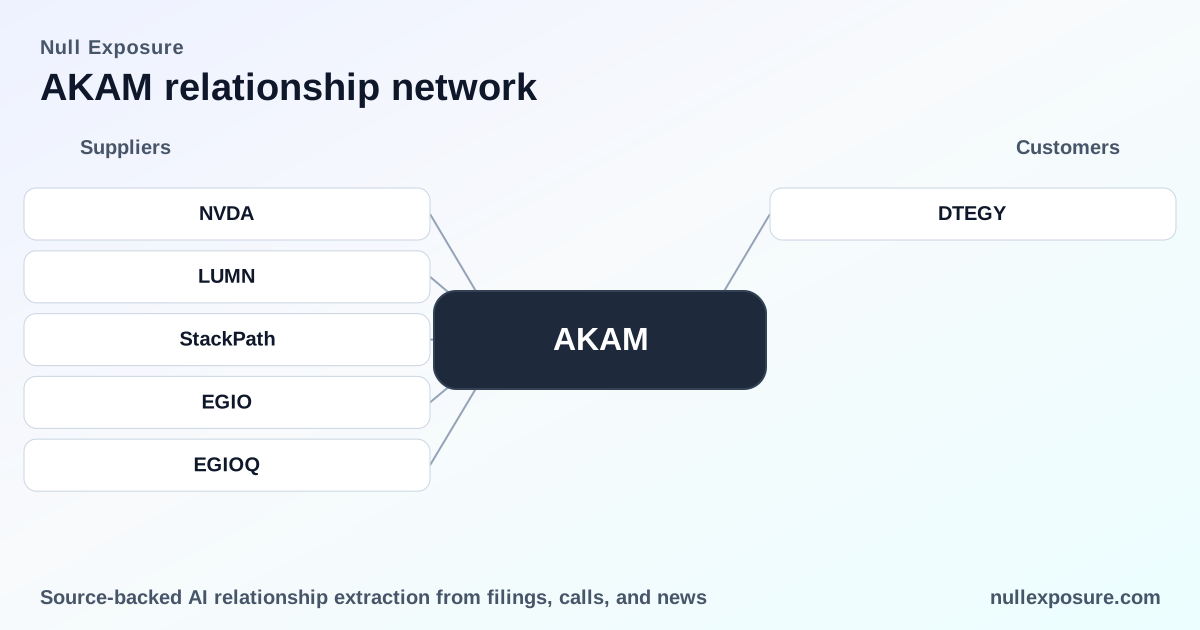
Akamai has contracted to deploy thousands of NVIDIA Blackwell GPUs across its distributed cloud to offer AI R&D, fine‑tuning and post‑training optimization at the edge, and is bundling NVIDIA BlueField DPUs into Guardicore segmentation to harden OT/ICS environments. This is framed publicly as both an AI compute commitment and a security solution powered by NVIDIA hardware (press release and earnings commentary, early 2026). Source: Akamai press materials and media coverage (GlobeNewswire press release, Feb 23, 2026; earnings call / transcript reporting, March 2026 — see https://www.globenewswire.com/news-release/2026/02/23/3242805/0/en/Akamai-Secures-Critical-Infrastructure-with-Agentless-Zero-Trust-Segmentation-Powered-by-NVIDIA.html and https://www.insidermonkey.com/blog/akamai-technologies-inc-nasdaqakam-q4-2025-earnings-call-transcript-1699765/).
Lumen: customer contracts acquired to scale delivery footprint
Akamai disclosed it acquired customer contracts from Lumen to bolster its content delivery and edge business, a transaction that expands Akamai’s addressable delivery base without building new last‑mile assets. Source: 2025/2026 filing coverage and 10‑K reporting summarized in market writeups (TradingView coverage of Akamai SEC filings, March 2026 — see https://www.tradingview.com/news/tradingview:df4caf4f47496:0-akamai-technologies-inc-sec-10-k-report/).
Edgio: contract transfers that accelerate revenue mix expansion
Akamai purchased customer contracts from Edgio as part of its delivery consolidation, adding contracted recurring revenue and customer relationships that strengthen its CDN market share and upsell runway for security and cloud services. Source: SEC filing summarized in market commentary and TradingView’s coverage of Akamai’s filings (March 2026 — see https://www.tradingview.com/news/tradingview:df4caf4f47496:0-akamai-technologies-inc-sec-10-k-report/).
StackPath: incremental delivery capacity through contract acquisition
Akamai acquired customer contracts from StackPath, adding niche customers and edge delivery routes that fit Akamai’s strategy of consolidating internet delivery relationships and cross‑selling higher‑value security and compute services. Source: Company 10‑K / filing summary reported by market outlets (TradingView, March 2026 — see https://www.tradingview.com/news/tradingview:df4caf4f47496:0-akamai-technologies-inc-sec-10-k-report/).
What the documented constraints reveal about operating risk and leverage
Akamai’s public disclosures and filings establish meaningful company‑level constraints that shape supplier strategy and investor risk:
- Long‑term contracting posture: The company states it enters long‑term agreements with network and ISP partners for bandwidth and executes purchase orders with minimum commitments, indicating a business model built on predictable, multi‑year revenue but also on fixed supplier obligations.
- Buyer and service‑provider roles: Akamai operates both as a purchaser of capacity (bandwidth, datacenter leases, GPUs) and as a provider of managed services to customers — a dual posture that increases operational complexity but improves margin capture when the platform is fully utilized.
- Material fixed commitments: Filings reference a datacenter lease with gross payments of approximately $750 million over 12 years and total obligations reported at $1,231.6 million as of Dec 31, 2024 (with $263.1 million due in 12 months), which is evidence of high capital and contractual leverage on the balance sheet.
- Active supplier relationships at scale: Mentions of ongoing partnerships and recent hardware purchases position many supplier relationships as active and strategically integrated into product offerings.
These are company‑level signals drawn directly from Akamai’s public language; they are not allocated to any single supplier unless the excerpt names that supplier explicitly.
Investment implications for operators and research teams
- Growth vs. capital intensity trade‑off: The NVIDIA relationship is a revenue upside lever for higher‑margin AI services, but it increases capital intensity and supplier concentration; Akamai’s market cap (
$15.3B) and revenues ($4.21B TTM) must be viewed against these incremental hardware and lease obligations. - Operational dependence and vendor risk: Bundling NVIDIA GPUs and DPUs into core products makes Akamai sensitive to supply constraints, pricing change, or shifts in NVIDIA’s product roadmap; conversely, it accelerates product differentiation versus competitors.
- Consolidation benefits: The contract acquisitions from Lumen, Edgio and StackPath accelerate customer scale without proportionate incremental infrastructure build, improving utilization of Akamai’s edge footprint and cross‑sell opportunities for security and compute.
- Margin and valuation catalysts: If Akamai successfully monetizes distributed AI compute and enterprise OT security, forward P/E compression to ~15.2x (forward PE per public comps) is justifiable versus trailing multiples; the upside depends on customer adoption and margin expansion.
For a tactical supplier due‑diligence pack and to track evolving relationships in real time, see our detailed supplier pages at https://nullexposure.com/.
Practical next steps for investors and operators
- Model the incremental capital spend and fixed lease obligations into free‑cash‑flow scenarios; assume accelerated GPU amortization and higher utilization targets to justify the AI growth premium.
- Monitor contractual terms in future 10‑Q / 10‑K filings for minimum commitments and termination clauses tied to the NVIDIA hardware and datacenter leases.
- Assess counterparty risk: evaluate alternate GPU suppliers, DPU ecosystems, and bandwidth providers to gauge negotiating leverage.
If you want an executive‑grade supplier risk brief or a tailored scenario model for Akamai’s AI compute rollout, request a bespoke report at https://nullexposure.com/.
Conclusion — Akamai is executing a deliberate pivot from delivery‑only to a capital‑backed, security‑and‑AI platform, with NVIDIA as the strategic compute supplier and contract acquisitions from Lumen, Edgio and StackPath accelerating customer scale; investors should value both the revenue optionality and the meaningful fixed obligations now embedded in the business. For tracking updates and supplier‑level intelligence, visit https://nullexposure.com/.