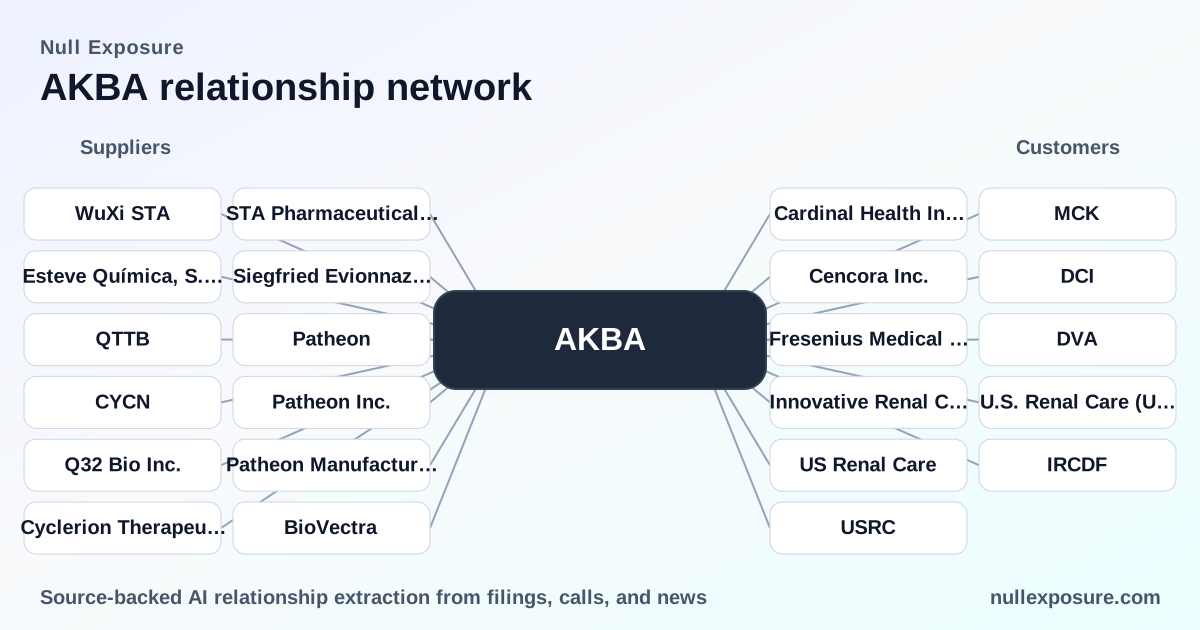
Akebia Therapeutics (AKBA): supplier map, leverage points, and investment implications
Akebia operates as a development and commercial-stage kidney therapeutics company that monetizes through product sales of marketed drugs (Auryxia and Vafseo), licensing and targeted asset acquisitions, and by outsourcing virtually all manufacturing and distribution functions to third parties. The company’s gross margin and commercial scalability are therefore directly tied to third‑party contract manufacturers (CMOs), logistics partners, and selective licensing deals, making supplier counterparty risk a first‑order factor for investors. For deeper supplier intelligence, visit https://nullexposure.com/.
Why this matters now
- Akebia has transitioned into a mixed commercial/pipeline company: commercial revenue relies on external manufacturers and distributors, while pipeline expansion is fueled by asset purchases and licensing. That structure concentrates operational risk off‑balance‑sheet with suppliers and partners.
- Cost of goods and contract commitments are material to near‑term cash flow: the company reports multiyear contract commitments and significant remaining R&D contract costs that will influence free cash flow.
If you want a centralized view of supplier exposures as you model AKBA’s margins and execution risk, start here: https://nullexposure.com/.
Operational constraints that drive valuation Akebia’s 10‑K and public statements define a clear operating model: the company does not own manufacturing or distribution facilities and relies on CMOs, third‑party logistics and specialty distributors. That contracting posture creates several persistent features investors should price into models:
- High counterparty concentration and criticality: production of both drug substance and drug product is performed by named CMOs rather than in‑house, making single‑site outages or regulatory actions capable of disrupting supply and sales.
- Regulatory dependency: changes to manufacturing processes require regulator engagement and approval; the company explicitly ties COGS and supply continuity to cGMP compliance at third parties.
- Moderate committed spend: public disclosures show a remaining R&D contract commitment (
$48.0M at 12/31/2024) and minimum contractual commitments ($15.0M through end of 2026), which are material to cash runway and supplier cash flow expectations. - Service outsourcing: IT, clinical data management and logistics are handled by vendors; operational resilience therefore depends on vendor SLAs and integrations.
These company-level signals drive the assessment of supplier risk without attributing the constraint to any specific counterparty unless the disclosure names them.
Supplier-by-supplier: what investors need to know Below are the counterparties disclosed in Akebia’s FY2024 filing and subsequent press coverage, with a concise plain-English takeaway and source for each entry.
-
STA Pharmaceutical Hong Kong Limited — Akebia has entered supply agreements with STA for the manufacture of Vafseo drug substance and drug product for commercial use, making STA a named supplier on the commercial Vafseo supply chain. According to Akebia’s 2024 Form 10‑K (FY2024), STA is contractually engaged to supply both substance and product for Vafseo. (Akebia 10‑K, FY2024)
-
Siegfried Evionnaz SA — Siegfried supplies the drug substance for Auryxia under a supply agreement that includes per‑kilogram pricing, which establishes unit‑cost sensitivity to volume and raw material inputs. This is disclosed in Akebia’s 2024 Form 10‑K. (Akebia 10‑K, FY2024)
-
Patheon / Patheon Inc. — Patheon is contracted for the manufacture of Vafseo drug product for commercial use, positioning Patheon as a core CMO for Akebia’s newer product. The relationship is documented in the company’s 2024 Form 10‑K. (Akebia 10‑K, FY2024)
-
Patheon Manufacturing Services LLC (Thermo Fisher) — For Auryxia drug product, Akebia uses Patheon Manufacturing Services LLC under a Master Manufacturing Service Agreement with tiered per‑bottle pricing (unit price falls as volume increases), which creates scale economics at the product level. This contractual detail is disclosed in the 2024 Form 10‑K. (Akebia 10‑K, FY2024)
-
BioVectra — Akebia terminated all supply agreements with BioVectra for the supply of Auryxia drug substance on December 22, 2022; the termination represents a past supplier transition and operational remediation event. The termination is noted in Akebia’s 2024 Form 10‑K. (Akebia 10‑K, FY2024)
-
WuXi STA — WuXi STA is listed as a manufacturer for Vafseo drug product, making WuXi another material CMO partner for Akebia’s commercial product mix. This supplier relationship is included in the company’s 2024 Form 10‑K. (Akebia 10‑K, FY2024)
-
Esteve Química, S.A. — Akebia and Esteve have agreed to negotiate a new supply agreement for Vafseo drug substance manufacture, signaling a potential additional or backup source for substance production. The negotiation intent is stated in the 2024 Form 10‑K. (Akebia 10‑K, FY2024)
-
Q32 Bio Inc. (QTTB) — In November 2025 Akebia acquired global rights to ADX‑097 (renamed AKB‑097) from Q32 Bio under an asset purchase agreement; Akebia has also acquired a humanized anti‑C3d monoclonal antibody fusion protein from Q32, indicating targeted M&A to expand its rare kidney disease pipeline. This was reported in a November 2025 Finviz writeup and reiterated in Akebia’s February 26, 2026 press release. (Finviz, Nov 28, 2025; Akebia press release, Feb 26, 2026)
-
Cyclerion Therapeutics, Inc. — Akebia licensed praliciguat from Cyclerion (an oral sGC agent) and dosed the first patient in a Phase‑2 trial for focal segmental glomerulosclerosis (FSGS), reflecting a pipeline partnership that supplies clinical‑stage assets rather than manufacturing services. This licensing and clinical update were announced in a January 6, 2026 GlobeNewswire release. (GlobeNewswire, Jan 6, 2026)
How the network shapes investment risk and opportunity
-
Margin sensitivity and upside: the use of tiered pricing with Patheon (Thermo Fisher) for Auryxia introduces direct operating leverage—higher sales volumes yield lower per‑unit COGS, improving margins. Conversely, per‑kilogram pricing with Siegfried ties COGS to raw‑material and process economics, which can compress margins if input costs rise.
-
Concentration risk: multiple commercial products are tied to a small set of CMOs (Patheon, WuXi STA, STA, Siegfried), creating single‑point-of-failure exposure that is meaningful given the company’s lack of internal manufacturing.
-
Contractual commitments and cash flow: disclosed minimum commitments and outstanding R&D contract costs are material near‑term cash obligations that investors should incorporate into liquidity stress tests.
-
Execution risk mitigation: the presence of negotiation with Esteve and past supplier termination (BioVectra) indicate active supplier management and a willingness to shift manufacturing partners when necessary, which reduces but does not eliminate operational risk.
For modelling or diligence, prioritize monitoring: CMO inspection outcomes and warning letters, volume/price movement reports from Siegfried and Patheon, and progress on AKB‑097 and praliciguat clinical readouts. If you need consolidated supplier risk scoring and contract maturity data, see https://nullexposure.com/.
Bottom line and recommended actions Akebia’s commercial and pipeline upside is real but structurally dependent on third‑party manufacturing and distribution. Investors must price supplier concentration, contract economics (per‑kg and per‑bottle pricing), and the company’s identified contractual commitments into valuation and liquidity scenarios. Recommended next steps: (1) track regulatory inspection reports for Patheon/Thermo Fisher, WuXi and Siegfried; (2) stress test margins under adverse raw‑material price scenarios; (3) follow AKB‑097 and praliciguat clinical milestones as potential de‑risking events for pipeline value.
For an actionable supplier risk dashboard and updated counterparty alerts, visit https://nullexposure.com/.