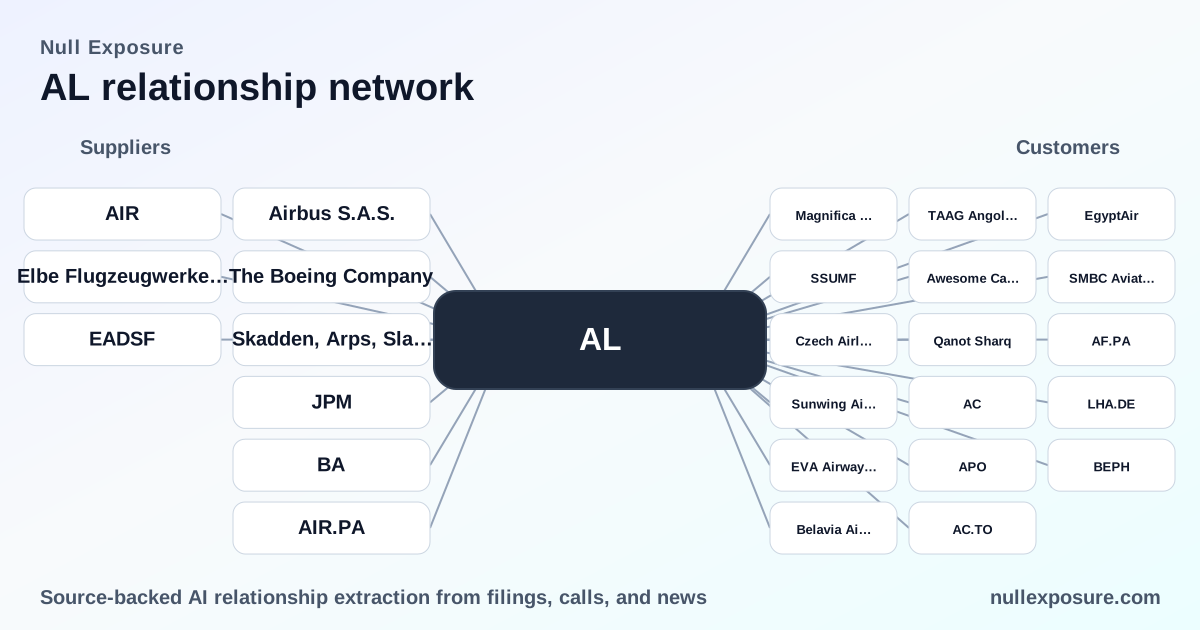
Air Lease Corporation (AL): supplier relationships that define an aircraft lessor’s economics
Air Lease Corporation purchases new commercial jet aircraft from manufacturers and leases them to airlines worldwide; it monetizes by capturing lease spread and residual value appreciation while financing fleet growth through capital markets and secured debt. AL’s economics are driven by long-term purchase commitments with OEMs, recurring lease cashflows from airlines, and asset-management outcomes on redelivery. For a deeper supplier analysis and comparative relationship mapping, visit https://nullexposure.com/.
How AL’s supplier footprint becomes a financing story
Air Lease is a classic asset-centric lessor: it contracts with aircraft manufacturers for large, long-dated hardware purchases, places aircraft on multi-year leases to airlines, and relies on predictable asset specifications to support securitizations and loan collateral. The company’s FY2025 10‑K documents commitments to acquire 218 aircraft through 2031 with an aggregate commitment of $12.6 billion, which is a structural driver of capital allocation and counterparty dependency. AL’s procurement posture is concentrated on OEMs (Airbus and Boeing) and complemented by conversion and maintenance suppliers for freighter and reconfiguration work.
Visit https://nullexposure.com/ for supplier diligence tools and contact options.
The supplier and advisor roll call — what each relationship tells investors
Below are every relationship mentioned in the source results, with a plain-English summary and a concise source citation.
Airbus S.A.S. (10‑K, FY2025)
Air Lease identifies Airbus as a principal aircraft manufacturer from which it purchases modern, fuel‑efficient jets for placement with airlines. This confirms Airbus is a core long‑term supplier in AL’s purchase pipeline. (Air Lease FY2025 Form 10‑K)
The Boeing Company (10‑K, FY2025)
Boeing is likewise listed as a principal OEM supplier and a primary source of the Boeing-family aircraft that populate AL’s order book and lease placements. (Air Lease FY2025 Form 10‑K)
Skadden, Arps, Slate, Meagher & Flom LLP (SEC exhibit, FY2025)
Skadden is named as Air Lease’s legal advisor in a company filing, indicating use of a major international law firm for transactional and regulatory matters. (SEC exhibit filed March 2026)
J.P. Morgan Securities LLC — financial advisor (SEC exhibit, FY2025)
J.P. Morgan Securities LLC is identified as Air Lease’s financial advisor, showing the company’s engagement with a global investment bank for strategic financing or M&A processes. (SEC exhibit filed March 2026)
Boeing — 2014 aircraft order (Boeing media release, FY2014)
A Boeing press release from July 15, 2014 documents a historic order for 26 airplanes—six 777‑300ERs and 20 737 MAX 8s—valued at $3.9 billion list, illustrating long‑standing OEM procurement relationships. (Boeing media release, July 2014)
Airbus — A330neo launch order mention (AINonline, FY2014)
Industry reporting from 2014 notes Air Lease as an early buyer for Airbus’s re‑engined A330neo, underlining the company’s role as a launch customer and early adopter of new variants. (AINonline, July 2014)
Airbus — lease placement with Czech Airlines (Aviation24, FY2023 / delivery 2024)
Aviation24 reported that four Airbus A220‑300s scheduled for delivery in 2024 came from AL’s order book with Airbus, demonstrating active fleet deployment from commitments. (Aviation24, FY2023)
Elbe Flugzeugwerke (EFW) — A330P2F conversion delivery (AviTrader, FY2025)
Elbe Flugzeugwerke completed delivery of the first of three A330 passenger‑to‑freighter conversions to Air Lease, highlighting AL’s use of specialized conversion partners to generate freighter assets. (AviTrader, June 2025)
J.P. Morgan Securities — advisory role (Economic Times / Infra report, FY2025)
News coverage during a strategic process cited J.P. Morgan as Air Lease’s advisor while other banks advised competing bidders, reinforcing the firm’s reliance on top‑tier financial advisory services. (Economic Times / infrastructure news, FY2025)
Airbus S.A.S. — lease placement announcement (MarketScreener, FY2025)
MarketScreener covered a FY2025 announcement that reiterated AL’s practice of purchasing Airbus aircraft and placing them under lease with carriers, reflecting ongoing OEM order‑to‑lease execution. (MarketScreener, FY2025)
The Boeing Company — referenced in lease announcement context (MarketScreener, FY2025)
The same MarketScreener piece references Boeing alongside Airbus as core manufacturers from which AL sources aircraft for leasing programs. (MarketScreener, FY2025)
Airbus — historical partnership reference (Aviation24, FY2016)
A 2016 industry write‑up characterizes ALC as a longstanding partner of Airbus, indicating durable commercial ties across several aircraft programs. (Aviation24, FY2016)
Airbus — A350 freighter launch customer (SamChui, FY2021)
Reporting from the 2021 Dubai Airshow documents Air Lease as the launch customer for the A350 freighter variant with an order for seven aircraft, underscoring AL’s role in program launches. (SamChui, November 2021)
How these relationships translate into financial constraints and strategic posture
The relationship evidence and company filings convey a clear operating model: AL is a buyer with long‑term, high‑value commitments to OEMs, supporting a capital structure that funds multi‑year hardware acquisition. The FY2025 10‑K specifically discloses 218 committed aircraft through 2031 and $12.6 billion of aggregate commitments, which signals material capital concentration and procurement-driven cash needs. The company also reports non‑refundable deposits of $1.1 billion at year end 2025, which indicates active contract performance exposure to manufacturer delivery schedules and conversion partners.
- Contracting posture: predominantly long‑term purchase commitments with OEMs, which increases predictability of fleet composition but raises execution risk tied to manufacturer performance.
- Concentration: heavy dependency on Airbus and Boeing as primary hardware suppliers, creating supplier concentration risk for specific aircraft types and delivery slots.
- Criticality: these OEM and conversion relationships are critical to AL’s revenue model because lease assets cannot be sourced economically from alternate suppliers on short notice.
- Maturity: relationships range from seasoned (historic orders and launch‑customer roles) to active (ongoing deliveries and conversions), indicating both entrenched partnerships and continued execution needs.
For investors evaluating AL’s supplier risk profile, the combination of large committed spend (> $100m bands) and non‑refundable deposits elevates the importance of tracking OEM delivery performance and conversion timelines. Access more supplier risk dashboards at https://nullexposure.com/ to model counterparty delivery risk and capital staging.
Investor takeaways and next steps
- Air Lease’s business model is fundamentally tied to large, long‑dated OEM purchase commitments and high‑quality advisory relationships that support financing and transactions.
- Concentration with Airbus and Boeing is deliberate and operationally critical; failures of OEM delivery or conversion partners would directly pressure liquidity and asset growth plans.
- For portfolio managers and operators, prioritize monitoring OEM delivery schedules, deposit exposure, and conversion partner performance as leading indicators of execution risk.
To request tailored supplier analytics or scenario stress tests on AL’s commitments, visit https://nullexposure.com/ and contact the team.