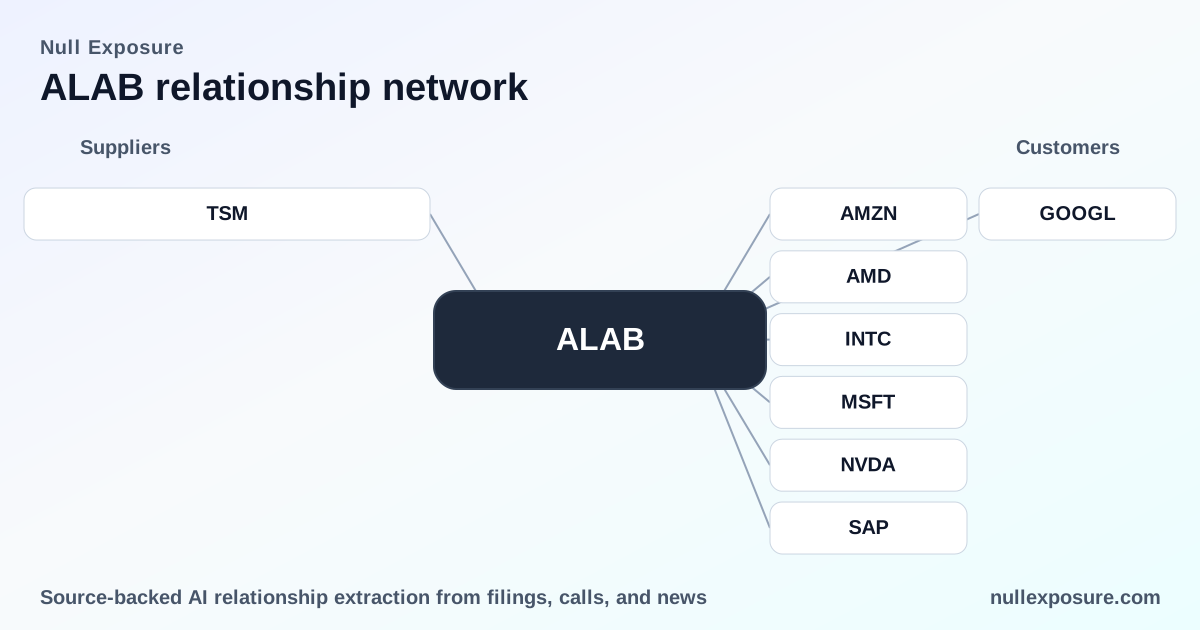
Astera Labs (ALAB) — Supplier Profile and Commercial Risk Brief
Astera Labs is a fabless semiconductor company that designs and sells high-speed connectivity components for cloud and AI infrastructure and monetizes through product sales of ICs, modules, and board-level connectivity solutions to hyperscalers and enterprise OEMs. The company converts design IP into recurring hardware revenue by outsourcing fabrication and assembly while capturing margin through proprietary silicon and system-level integration; FY2025 revenue ran roughly $852.5M with healthy gross margins, reflecting a product-led, capital-light manufacturing model.
If you are evaluating supplier exposure in ALAB’s supply chain, review the supplier map and contract posture below for negotiation levers and concentration risk. For further supplier intelligence and ongoing monitoring, visit https://nullexposure.com/.
What the company filings say about how it buys and who it relies on
Astera Labs operates with a classic fabless contracting posture: the company purchases manufacturing capacity on a purchase-order basis and does not depend on long-term capacity contracts. The company disclosed that it does not generally enter long-term manufacturing contracts and that nearly all purchases are executed via purchase orders, signaling a transactional procurement style that favors flexibility over guaranteed capacity (company filings, reported in FY2024/FY2025).
The filing-level constraints also reveal three structural characteristics that dictate commercial risk and operational priorities:
- Geographic concentration in APAC: the majority of third-party manufacturers and distributors — and a large share of revenue — are concentrated in Taiwan, China, and South Korea, exposing ALAB to regional trade, logistical, and geopolitical risk (company disclosure, December 31, 2024).
- Supplier concentration and criticality: the company relies on a limited number of manufacturing partners for ICs, modules, boards, and substrates, and identifies one single manufacturing partner for integrated circuits as part of its supply chain profile (company disclosure).
- Spend magnitude and near-term commitments: purchase commitments totaled $27.5 million as of December 31, 2024, with $12.0 million payable within 12 months — a mid-range committed spend that is material to operations but small relative to overall annual revenue.
Together these points create a supplier posture that is short-term contracted, APAC-concentrated, and materially dependent on a small set of manufacturers — a profile that influences pricing leverage, continuity planning, and contingency costs.
How that contracting posture affects commercial and operational risk
Astera’s procurement approach provides commercial flexibility that supports rapid demand swings and product iterations, but it also creates three clear investor-level risks:
- Capacity and allocation risk: without long-term capacity commitments, ALAB competes for foundry and assembly capacity in cycles, particularly when hyperscaler demand accelerates.
- Concentration and single-point failure: reliance on a limited number of partners and a single IC manufacturing partner elevates the impact of any supplier outage into a company-level production shock.
- Geopolitical and logistics exposure: heavy concentration in Taiwan, China, and South Korea ties manufacturing continuity to regional trade policy and natural-disaster risk.
From an operator perspective, these constraints imply priorities: secure alternate qualified sources, tighten supply planning and safety stock policies, and negotiate service-level provisions in purchase orders even where long-term contracts are absent.
For clients or investors who want a vendor risk dashboard or targeted supplier intelligence on ALAB’s manufacturing partners, see our resources at https://nullexposure.com/.
Supplier relationships discovered in our review
TSMC (Taiwan Semiconductor Manufacturing Company)
Astera Labs uses a fabless manufacturing model and partners with TSMC for IC fabrication, outsourcing wafer production while relying on other partners for assembly and testing; this supplier relationship supports high-volume, hyperscaler-grade production needs (TradingView news item referencing FY2026 disclosures, March 9, 2026 — https://www.tradingview.com/news/tradingview:5a4d27195e016:0-astera-labs-inc-sec-10-k-report/).
That is the single supplier relationship captured in the available results. The trading-report citation frames TSMC as the primary IC foundry in the disclosed manufacturing model; company-level filings separately highlight supplier concentration and the use of third parties for modules, boards, and substrates (company SEC disclosures, FY2024/FY2025).
What investors and procurement teams should watch next
- Capacity commitments vs. demand forecasts: Track foundry lead times and ALAB’s build-to-order cadence; short-term purchasing implies sensitivity to allocation cycles.
- Secondary-sourcing milestones: Monitor progress on qualifying alternate foundries or assembly partners to assess the company’s resilience to outages.
- Geopolitical indicators: Shipping restrictions, export controls, or tariff changes in APAC will disproportionately affect companies with the same concentration profile; monitor policy developments in Taiwan/China/Korea.
- Contract language in purchase orders: Although long-term contracts are limited, purchase orders and service-level addenda can carry protective clauses; procurement should prioritize enforceable supply commitments where possible.
Bold operational actions for operators: push for formal contingency KPIs, quantify the cost of temporary capacity shortages, and test second-source qualification timelines so that any supplier disruption can be priced and mitigated in advance.
Bottom line for investors
Astera Labs’ fabless model and partnership with TSMC enable rapid scaling and gross-margin capture while keeping capital expenditures low, but the company’s supplier concentration and short-term contracting approach create a measurable risk surface that investors must price. Given ALAB’s revenue scale and margins, the supplier constraints represent material operational risk rather than a purely tactical procurement issue.
For deeper supplier benchmarking, continuous monitoring, or to commission a targeted supplier risk report on ALAB, visit https://nullexposure.com/.
Summary: ALAB monetizes through product sales built on outsourced manufacturing; TSMC is the identified wafer foundry partner; company filings indicate short-term purchase order contracting, APAC concentration, and material supplier concentration — all factors that shape near-term operational risk and bargaining leverage.