Aldel Financial II (ALDF) — supplier relationships and what they mean for investors
Aldel Financial II (ALDF) operates as a special-purpose acquisition company that raises capital through an IPO with proceeds held in a trust invested in U.S. government securities. The company monetizes the SPAC structure primarily through sponsor-provided administrative services for a fixed monthly fee, underwriting and transaction-related fees tied to its IPO and business combination activity, and the operational control exercised during deal execution. For investors and operators evaluating supplier relationships, the record shows a conventional SPAC advisory and service roster: financial advisers, legal counsel and an independent auditor, backed by a large trust balance that shapes contracting posture and counterparty risk.
Explore more research and supplier intelligence at https://nullexposure.com/.
Executive summary: the signal investors should carry forward
Aldel’s public filings and announcements show a classic SPAC operating posture: material trust assets (~$233m) invested in short-duration U.S. government securities, an ongoing administrative services agreement with the sponsor ($20,000/month), and single-event underwriting and transaction expenses in the low millions. Those structural facts drive three practical implications: (1) capital is concentrated and ring-fenced in the trust, (2) operations depend on a small set of service providers, and (3) the relationship profile is transactional and time-bound around the business combination lifecycle.
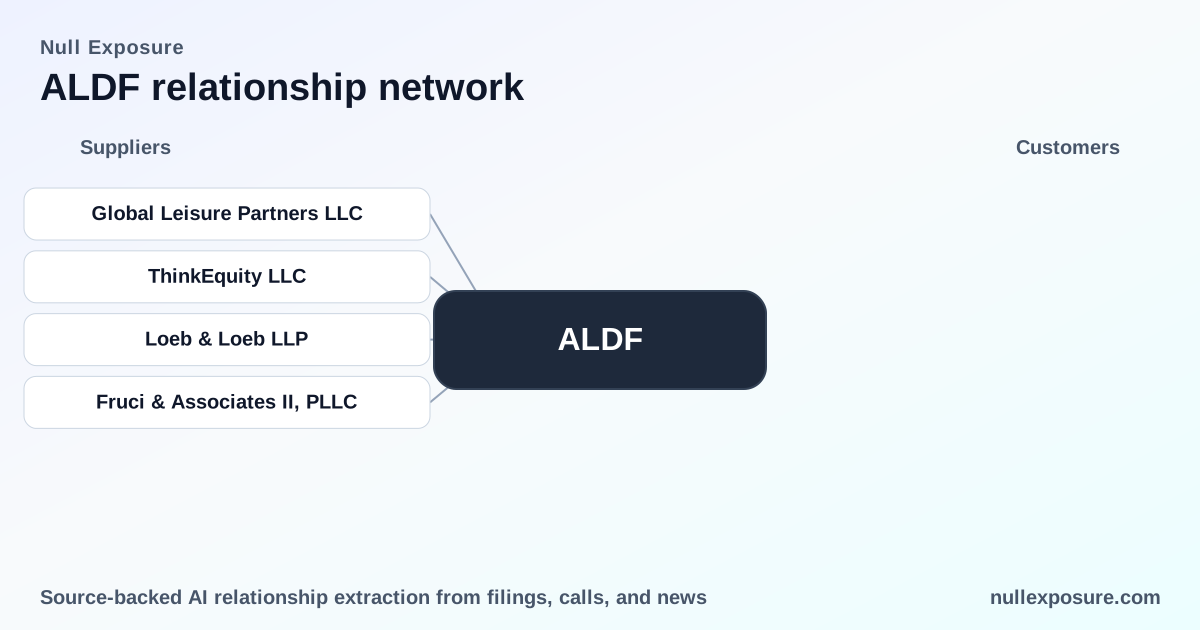
Who Aldel works with — the public record
Global Leisure Partners LLC
Global Leisure Partners LLC served as a financial advisor to Aldel in connection with the Hagerty business combination. This relationship positions GLP as a deal adviser during the transaction process and is publicly reported in press coverage of the merger announcement. Source: TraverseTicker press coverage on March 9, 2026 — https://www.traverseticker.com/news/hagerty-to-become-publicly-traded-company-under-merger-agreement-with-aldel-financial/.
ThinkEquity LLC
ThinkEquity LLC is also listed as a financial advisor to Aldel for the same business combination, sharing advisory duties with Global Leisure Partners. ThinkEquity’s involvement evidences the use of external capital markets advisers to execute and syndicate the transaction. Source: TraverseTicker press coverage on March 9, 2026 — https://www.traverseticker.com/news/hagerty-to-become-publicly-traded-company-under-merger-agreement-with-aldel-financial/.
Loeb & Loeb LLP
Loeb & Loeb LLP acted as legal advisor to Aldel, providing the customary transactional and disclosure counsel necessary for SPAC mergers and the subsequent public listing. Legal counsel of this caliber signals standard market practice for underwriting, securities documentation and regulatory filings. Source: PR Newswire announcement on March 9, 2026 — https://www.prnewswire.com/news-releases/hagerty-debuts-today-as-a-publicly-traded-company-on-the-new-york-stock-exchange-after-completing-business-combination-with-aldel-financial-301436896.html.
Fruci & Associates II, PLLC
Fruci & Associates II, PLLC was ratified as the independent auditor for the fiscal year ending December 31, 2025, indicating the company’s current audit appointment and governance posture. An auditor change or appointment is a direct governance signal for investors monitoring financial reporting quality. Source: The Globe and Mail press release (period cited in filing) — https://www.theglobeandmail.com/investing/markets/stocks/ALDF-Q/pressreleases/36538638/aldel-financial-ii-appoints-new-director-and-auditor/.
Operating model and constraints — how supplier arrangements shape execution
Aldel’s supplier profile is defined by a handful of corporate-level constraints that govern contracting posture, cash concentration and vendor criticality:
- Short-term, ring-fenced capital posture. The IPO proceeds—approximately $231.15 million placed in a trust—are invested in U.S. government securities with maturities of 185 days or less, which enforces a short-term investment horizon and limits long-duration deployment of trust assets. This is a company-level signal driven by the trust mechanics of the SPAC structure.
- Subscription-style administrative relationship. Aldel has an Administrative Services Agreement with its sponsor that provides monthly services for $20,000 per month, establishing a subscription-like vendor arrangement for day-to-day corporate support rather than deep, bespoke outsourcing.
- Government-counterparty exposure for trust assets. The trust is explicitly invested in U.S. government securities, which reduces credit risk on the trust balance but leaves liquidity and timing constraints tied to short maturities.
- Service-provider orientation and active stage. Public filing excerpts list multiple service-provider agreements (trustee, warrant agent, underwriters, and administrative sponsor services) and indicate the company is in an active stage of operations following IPO close, reinforcing operational dependence on external advisers and intermediaries.
- Spend concentration and profile. The balance held in trust places Aldel in the $100m+ spend band for capital under custody, while immediate near-term transaction costs—underwriting fees (
$4.0m) and other IPO-related expenses ($580k)—fall in the $1m–$10m operating spend band.
These constraints collectively create an operational model that is transaction-focused, capital-concentrated and advisor-dependent, with short contract tenors and predictable recurring administrative fees rather than long-term vendor lock-in.
Explore supplier risk scoring and supplier relationship mapping at https://nullexposure.com/.
Investment implications and a concise risk checklist
- Capital protection but limited operating flexibility. Government securities in a short-duration trust protect principal but restrict use of funds until transaction consummation or redemption events are resolved. That reduces credit risk while constraining opportunistic deployment.
- Concentration of operational know-how in a few providers. The Administrative Services Agreement and the reliance on a trustee, warrant agent and external financial advisers make service continuity critical; vendor failure or conflicts could slow deal execution.
- Costs are material to transaction economics. Underwriting and transaction fees in the low millions materially affect SPAC economics on a single-deal basis; sponsor and advisor fees are allocable costs investors should adjust for when modeling post-combination returns.
- Governance signals are mixed but complete. The appointment of a named independent auditor and a well-known law firm are governance positives; investors should confirm auditor independence and legal conflict disclosures in 8‑K filings.
Next steps for investors and operators
- Review the latest Form 8‑K and proxy materials to confirm continuing existence and terms of the Administrative Services Agreement and trustee arrangements.
- Validate the independence and tenure of Fruci & Associates II, PLLC and obtain the audit engagement letter if available for deeper governance due diligence.
- Track deal advisers (Global Leisure Partners and ThinkEquity) for any disclosed conflicts or related-party compensation that could reallocate transaction economics.
For ongoing supplier intelligence, vendor scoring and to request a deeper supplier dossier on ALDF, visit https://nullexposure.com/.
Bottom line: Aldel’s public supplier footprint is orthodox for a SPAC — concentrated capital, short-term financial instruments, subscription-style sponsor services, and transaction-focused advisers — and these elements will dominate execution risk and economics through the business combination lifecycle. Explore company-level supplier exposure and monitoring tools at https://nullexposure.com/.