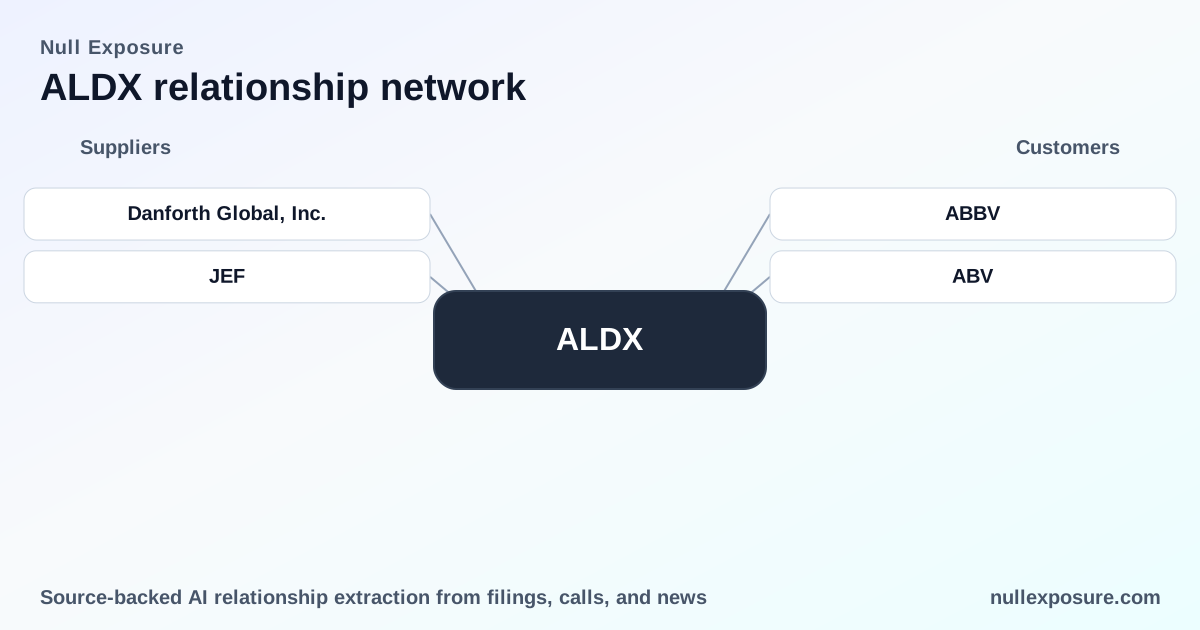
ALDX supplier map: what investors need to know about third‑party exposure and financing partners
Aldeyra Therapeutics (ALDX) runs a capital‑intensive, asset‑led model: the company monetizes by advancing licensed drug candidates toward regulatory milestones and commercial partnerships, while funding operations through capital markets and outsourced services. Operationally Aldeyra combines exclusive licensing of core intellectual property with a heavy reliance on third‑party contract manufacturers, clinical service providers, and outsourced corporate functions; financing flexibility is preserved through at‑the‑market style equity arrangements. For investors evaluating supplier counterparty risk, the key themes are license concentration, outsourced operating posture, manufacturing criticality, and episodic capital markets dependence. Learn more about coverage and signals at https://nullexposure.com/.
Quick snapshot of named supplier and financing relationships
Danforth Global, Inc. — outsourced finance and accounting provider
Following the departure of the interim CFO in August 2024, Aldeyra outsourced its principal financial and principal accounting officer roles to Danforth Global, Inc., engaging the firm for strategic and operational finance services, according to the company’s FY2024 Form 10‑K. This is an operational outsourcing decision that transfers a material governance function to a third party and reduces in‑house headcount and fixed overhead (FY2024 10‑K filing, referenced 2024).
Jefferies — equity distribution agreement for incremental capital
Aldeyra entered into a sales agreement with Jefferies to offer and sell up to $75 million in common stock; as of the end of 2025, no shares had been sold under the facility, according to coverage of the company’s SEC disclosures. This arrangement preserves near‑term financing optionality without immediate dilution and places Jefferies in the role of an on‑demand capital markets distributor (TradingView report citing SEC filing, March 2026).
How the relationship set shapes operational risk and optionality
The named relationships — one a services supplier for core finance functions, the other a capital markets intermediary — reveal a deliberate lean, outsourced operating model and a financing strategy that favors optionality over committed lines.
- Outsourced corporate functions: The engagement of Danforth Global for CFO and principal accounting officer roles signals a strategy to control fixed costs and access external expertise quickly. Outsourcing senior finance duties centralizes a governance dependency on a single provider for critical controls and financial reporting cadence.
- Capital markets as a standby funding mechanism: The Jefferies sales agreement is a flexible, non‑committal funding channel that Aldeyra can draw on to finance R&D or bridge to milestones without negotiating bank covenants; the agreement also creates dilution risk only when executed.
For more on how Aldeyra’s supplier posture affects counterparty exposure and procurement strategy, see https://nullexposure.com/.
Company‑level constraints and what they mean for suppliers and partners
A review of Aldeyra’s disclosures yields consistent company‑level signals that shape supplier risk and partner negotiations.
- Contracting posture — license‑centric and mixed tenors: Aldeyra’s core clinical program for ADX‑2191 is governed by an exclusive worldwide license (the MEEI Agreement), which constitutes a long‑dated intellectual property relationship that lasts until the expiration of the last licensed patent. The company also operates short‑term commercial arrangements in other areas; for example, its weighted average lease term was 1.0 year as of December 31, 2024, and operating lease expense for the year was $0.3 million, consistent with a mix of long‑tail IP commitments and short‑term facility contracts (MEEI Agreement language and FY2024 lease disclosures).
- Concentration and criticality of manufacturing: Aldeyra relies on a limited number of Contract Manufacturing Organizations (CMOs). The company explicitly warns that failure of any CMO to deliver timely, commercial‑quality material would significantly harm operations, delay trials, and threaten regulatory timelines. This elevates supplier criticality and increases bargaining leverage for qualified CMOs.
- Service dependency and maturity: Aldeyra depends on multiple third‑party service providers — CROs for clinical execution, consultants and IT managed service providers for cybersecurity and operations, and external finance vendors for accounting and CFO duties — indicating a mature, outsourced service mix rather than vertically integrated capabilities.
- Geographic exposure: The company flags exposure to trade law changes and tariffs across Canada, China, and Mexico, reflecting a global manufacturing footprint that creates supply‑chain vulnerability to cross‑border policy shifts.
- Spend profile and fiscal modesty: Lease expense and the reported weighted average lease term suggest non‑material facility spend at less than $1 million annually, though manufacturing and clinical spend associated with CMOs remains the dominant cost driver.
These constraints combine into a clear negotiating landscape: long‑lived IP obligations (license counterparties) coexist with short‑term commercial contracts and critical manufacturing concentration, requiring investors to watch counterparty resilience and geographic risk.
Implications for investors evaluating ALDX supplier exposure
- Operational governance is outsourced: The CFO/accounting outsourcing to Danforth Global reduces headcount risk but introduces counterparty and control concentration; investors should monitor SLA scope, termination provisions, and data access controls in vendor arrangements.
- Manufacturing is a single‑point risk: The critical dependence on a few CMOs is the largest operational vulnerability; any CMO disruption would have outsized impact on timelines and value creation. Suppliers with capacity and regulatory track records hold strategic leverage.
- Financing flexibility reduces immediate liquidity risk but creates optional dilution: The Jefferies sales agreement is a readily deployable capital tool that preserves runway flexibility; its existence is positive for liquidity but requires monitoring of usage and dilution pacing.
- Global trade exposure demands scenario planning: Tariff or export‑control shifts across manufacturing jurisdictions can affect timelines and cost curves, elevating the need for supplier diversification.
Bottom line and investor action points
Aldeyra’s supplier posture is deliberately outsourced, license‑driven, and manufacturing‑concentrated; these traits compress operating leverage in staff costs but expand counterparty concentration and regulatory sequencing risk. Investors should prioritize due diligence on CMO relationships, monitor vendor governance for finance functions, and track any draws on the Jefferies facility as a leading indicator of cash deployment and potential dilution.
If you track counterparty exposure across life‑science suppliers or want an actionable map of who matters to ALDX operations, start here: https://nullexposure.com/.
Key takeaways:
- License commitments (MEEI) anchor the program long term; short‑term commercial leases coexist alongside material manufacturing risk.
- Danforth Global handles critical financial functions following the CFO exit; that creates governance dependency.
- Jefferies provides an on‑demand equity distribution channel that preserves runway but can produce dilution when used.
For a deeper counterparty profile and continuous monitoring of ALDX supplier relationships, visit https://nullexposure.com/ and request targeted coverage.