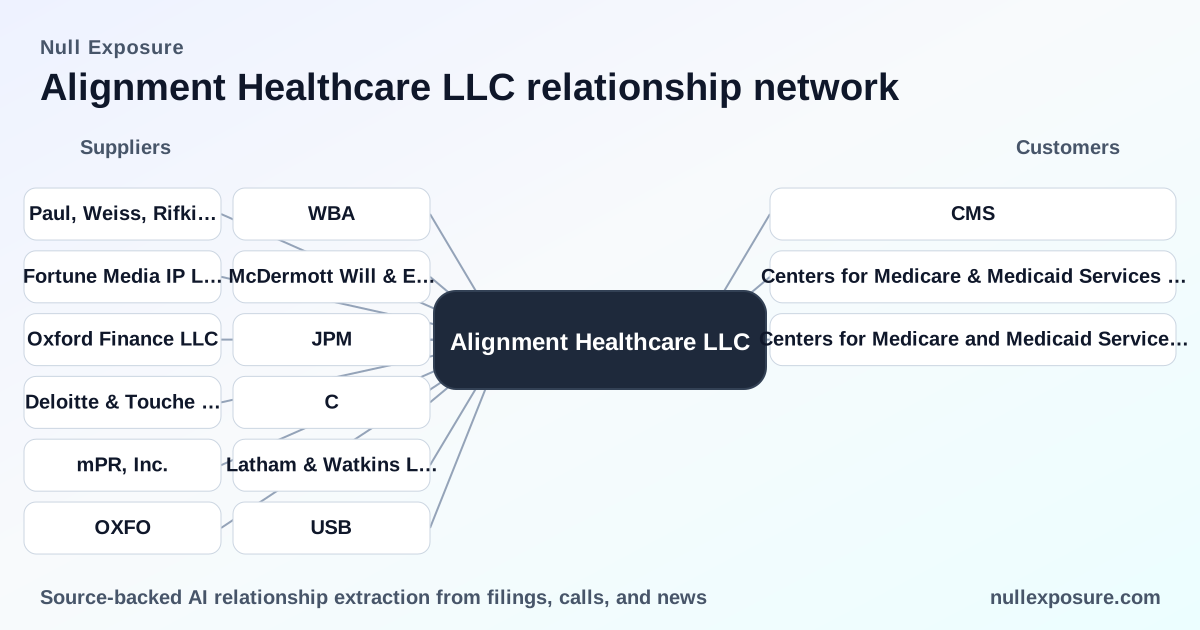
Alignment Healthcare (ALHC): supplier map and commercial signals investors need
Alignment Healthcare operates a Medicare Advantage-focused care platform that earns revenue by managing risk-based Medicare contracts, collecting premiums and CMS capitation payments, and monetizing supplemental services and pharmacy benefits for seniors. The company layers provider networks, digital engagement (the AVA platform) and delegated-provider arrangements to contain cost and drive membership growth. For more detailed counterparty analysis and supplier intelligence visit https://nullexposure.com/.
Executive snapshot — what moves the P&L
Alignment’s economics combine membership scale, capitated revenue, and third-party service relationships. Revenue growth is driven by enrollment expansion across 53 markets and by co-branded distribution partnerships that lower acquisition cost; margins depend on care management effectiveness and vendor execution. Balance sheet flexibility rests on hybrid capital actions — convertibles, a new revolving credit line, and equity offerings underwritten by major banks — which together fund network expansion and working capital.
Counterparties and strategic partners — a line-by-line read
Below I cover every relationship disclosed in the supplier-scope results with a concise, source-linked takeaway for investors and operators.
Walgreens (WBA)
Alignment and Walgreens signed an agreement to offer $0-premium co‑branded Medicare Advantage plans in select markets (AZ, CA, FL, TX) targeting roughly 1.6 million Medicare-eligible adults, launching Jan. 1, 2024 pending approvals. According to an ADVFN news item (reported in FY2026), the relationship is distribution-first and strategic for retail reach and member acquisition.
McDermott Will & Emery LLP
McDermott provided legal services to Alignment during fiscal years 2023–2025, and a disclosure notes a governance linkage: a director’s son is a partner at the firm. The FY2026 10‑K filing (via StockTitan) identifies this ongoing legal engagement and highlights a vendor relationship with board-level proximity.
J.P. Morgan (JPM)
J.P. Morgan acted as underwriter for Alignment’s proposed secondary share offerings in FY2026, per StockTitan news reports; this confirms major-bank distribution support for equity raises and public capital market access.
Citibank, N.A. (C)
Alignment entered a credit agreement with Citibank as administrative agent for a senior secured revolving credit facility (Effective Date Feb 26, 2026), as described in a Latham & Watkins announcement and corroborated in the FY2026 10‑K; this establishes near-term liquidity through bank‑led syndicated lending.
Latham & Watkins LLP
Latham & Watkins represented Alignment in the revolving credit transaction (team led by Elizabeth Oh and Haim Zaltzman), according to Latham’s FY2026 press release; the firm is external counsel on financing matters.
U.S. Bank Trust Company, National Association (USB)
U.S. Bank Trust Company serves as trustee for Alignment’s November 22, 2024 convertible notes indenture, disclosed in the FY2026 10‑K (StockTitan). This positions USB as trustee for material convertible debt on the capital structure.
Paul, Weiss, Rifkind, Wharton & Garrison LLP
Paul Weiss provided a legal opinion referenced in an FY2026 S‑3 filing (StockTitan), indicating securities‑law counsel engagement for registered offerings.
Fortune Media IP Limited
A GlobeNewswire press release (Feb 26, 2026) used Fortune trademark language in the earnings release; this is a press/brand citation rather than a commercial supplier relationship, noted for completeness.
Deloitte & Touche LLP
Deloitte provided consent (23.1) in connection with an S‑3 registration filing in FY2026 (StockTitan), confirming external audit provider involvement for public filings.
mPR, Inc.
mPR is listed as Alignment’s media/PR contact on multiple GlobeNewswire releases across FY2026; the firm handles investor and public communications.
Oxford Finance LLC / Oxford
Oxford Finance appears as administrative agent and lender under a term loan agreement (the “Oxford Loan Agreement”); subsequent reporting notes Alignment sold $330 million of 4.25% Convertible Senior Notes and used proceeds to repay $215 million of Oxford term loans (TradingView and StockTitan FY2026 filings). Oxford was a previous credit provider replaced via convertible issuance, an important capital-structure transition.
What the contract excerpts and constraints say about the operating model
Alignment’s disclosed constraints form a coherent operating profile rather than isolated facts:
- Contracting posture — mostly multi‑year but renewable: The company states a preference for contracts spanning three or more years, though several provider agreements contain termination or non‑renewal clauses, indicating long‑duration relationships with embedded renewal risk (company-level signal from FY2026 filing).
- Payment model — mixed usage and capitation: Alignment pays providers via fee‑for‑service and capitation, so cost volatility ties directly to utilization trends and population health outcomes.
- Geographic footprint — national scale within Medicare markets: Expansion to 53 markets across five states covering ~209,900 members highlights both diversification and regional exposure that will drive enrolment momentum.
- Role of vendors — mission‑critical service providers: The company depends on third parties for IT, claims processing, PBM, supplemental benefits and outsourced operations; these dependencies are operationally critical and contractually active.
- Segments — infrastructure and services: Supplier exposure spans both physical/hosting infrastructure that supports the AVA platform and service delivery networks for care — implying integration risk across tech and clinical vendors.
Investment implications and risk framework
- Capital flexibility is improving but levered: The convertible note issuance and the new Citibank credit facility provide liquidity; U.S. Bank’s role as trustee and J.P. Morgan’s underwriting show access to capital markets and institutional lenders (FY2026 filings and press releases). Debt mix and conversion mechanics remain a governance and dilution consideration.
- Growth versus margin tradeoff: The Walgreens co‑brand opens low‑friction membership channels but increases reliance on partner distribution economics; success depends on care management to translate enrollment into sustainable margin.
- Vendor concentration and execution risk: Heavy reliance on a set of legal, audit, banking and operational providers (Latham, Paul Weiss, Deloitte, Oxford, Citibank, mPR) creates single‑point operational dependencies that investors should monitor through contract terms and service SLAs.
- Governance observation: A disclosed related‑party proximity with McDermott underscores the need to watch vendor selection governance and conflict‑of‑interest oversight.
For a deeper supplier-risk dashboard and to map these counterparties against spend, contract length and criticality, explore our coverage at https://nullexposure.com/.
Bottom line and recommended actions
Alignment Healthcare runs a capitated Medicare Advantage platform monetized through membership growth, partner distribution and vendor-enabled operations. The FY2026 disclosures show active financing maneuvers, major distribution tie‑ups (Walgreens), and an ecosystem of legal, audit and bank counterparties that underpin expansion. Investors should watch three vectors closely: membership growth and retention, care‑management margin outcomes (to absorb usage‑based exposure), and the evolution of the capital stack as convertibles and bank facilities settle on the balance sheet.
If you assess supplier risk or evaluate ALHC’s counterparty concentration, start with our supplier mapping tools and financing timelines at https://nullexposure.com/ — they provide the line‑item context institutional investors need.