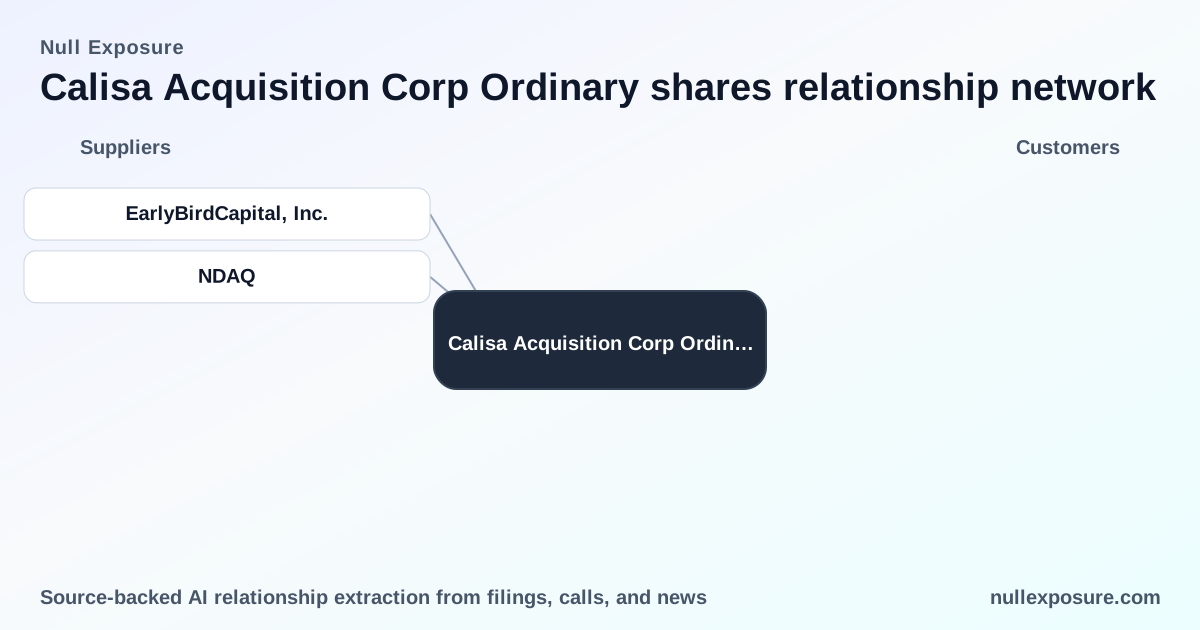
ALIS supplier relationships: underwriting and market access that shape a post-IPO trajectory
ALIS operates as a capital-raising vehicle whose economics are driven by unit issuances and the deployment of proceeds into a business combination; the company monetizes primarily through sponsor economics around transaction fees and the value realized from a future business combination or dissolution. Key supplier relationships today center on capital markets infrastructure and underwriting execution—the providers that enable ALIS to list units, sell into public markets, and close an initial offering.
For investors and operators evaluating counterparties, the practical takeaway is simple: market access and underwriting execution are the operational spine for ALIS’s short-term value realization, and both relationships should be monitored for continuity, terms, and reputational risk. Learn how we map these relationships at the company level at https://nullexposure.com/.
What the supplier map tells you about ALIS’s operating posture
ALIS’s supplier profile is narrow and highly transactional at this stage. That concentration creates a few straightforward characteristics investors should treat as structural:
- Contracting posture — transactional and market-standard. Engagements with underwriters and listing venues are typically governed by standard underwriting agreements and exchange listing rules rather than bespoke, long-term supply contracts; that implies commercial flexibility but also exposure to market conditions at transaction points.
- Concentration — materially concentrated. With only a small set of named counterparties documented, ALIS is exposed to single-point providers for critical functions (capital formation and listing). This raises the importance of counterparty reliability and fee competitiveness.
- Criticality — high for the named relationships. If underwriting or listing access is disrupted, ALIS’s immediate ability to monetize or close its offering is directly affected.
- Maturity — early-stage, issuance-focused. The supplier footprint is consistent with an entity that has recently completed an initial units offering and is in the execution window for further capital deployment or combination activity.
No supplier-specific contractual constraints are reported in the available records; this is a company-level signal that the supplier relationships captured are standard market arrangements rather than constrained partnerships.
Relationship inventory — the counterparties you need on your screen
Below I cover every supplier relationship recorded in the available results. Each description is concise and source-linked.
EarlyBirdCapital, Inc.
EarlyBirdCapital acted as the book-running manager for ALIS’s initial offering, running the syndicate that sold the units and managed allocation and distribution. According to a StockTitan news report covering the offering closing, EarlyBirdCapital filled the lead underwriting role for the transaction (StockTitan, March 9, 2026 — https://www.stocktitan.net/news/ALIS/calisa-acquisition-corp-announces-closing-of-60-000-000-initial-qofo1btmfxgw.html).
The Nasdaq Stock Market (Nasdaq)
ALIS’s units are listed on the Nasdaq Global Market and trade under the ticker symbol ALISU, securing exchange-level liquidity and continuous market access for investors and secondary trading. The same StockTitan report that described the offering notes the Nasdaq listing and ticker (StockTitan, March 9, 2026 — https://www.stocktitan.net/news/ALIS/calisa-acquisition-corp-announces-closing-of-60-000-000-initial-qofo1btmfxgw.html).
Why these relationships matter for value and risk
The two named counterparties perform complementary, high-impact roles: underwriting execution converts private capital appetite into public raisings; exchange listing sustains tradability and price discovery post-issuance. For an investor assessing ALIS, evaluate both the execution quality of the book-runner and the health of the trading environment provided by the exchange.
Key implications:
- Underwriter selection influences distribution quality and pricing. A lead manager with strong placement capabilities improves the odds of a clean closing and favorable retail/institutional mix.
- Listing venue sets visibility and regulatory profile. Nasdaq’s listing standards and trading ecosystem influence liquidity and index inclusion potential, which matter for post-combination investor access.
- Concentration amplifies counterparty risk. With few documented suppliers, operational disruption—regulatory issues at the exchange or a withdrawal from the underwriting syndicate—would have an outsized effect on ALIS’s near-term prospects.
If you want a systematic view of how counterparties affect a capital formation trade and follow-up governance, see our supplier intelligence hub: https://nullexposure.com/.
Practical watchlist for investors and operators
Monitor the following items to convert the supplier map into actionable signals:
- Underwriter disclosures: track prospectus exhibits and underwriter fee schedules for future offerings to spot changes in economics or new syndicate partners.
- Exchange status and ticker activity: daily trade volumes and any exchange notices that affect listing eligibility will be early signals of liquidity stress.
- Sponsor and board composition changes: while not a supplier, sponsor behavior determines whether ALIS will seek new counterparties or broadly alter its go-to-market strategy.
Important near-term indicators include follow-on offerings, announced business combination agreements, or any material exchange communications. These will change the supplier list and the relative importance of existing partners.
Bottom line and next steps
ALIS’s current supplier footprint is lean and execution-centric: a book-running manager to raise capital and Nasdaq to provide the market venue. That combination is standard for vehicles operating in an issuance-to-combination lifecycle, but the concentration makes the quality and continuity of those two relationships a primary valuation input.
For a structured supplier-risk assessment and tracking for ALIS and peer issuers, visit our platform and see how counterparties map to capital outcomes: https://nullexposure.com/.
Remain focused on underwriter disclosures and Nasdaq communications as your early-warning indicators; those will dictate the immediate ability of ALIS to monetize and progress toward a value-creating combination.