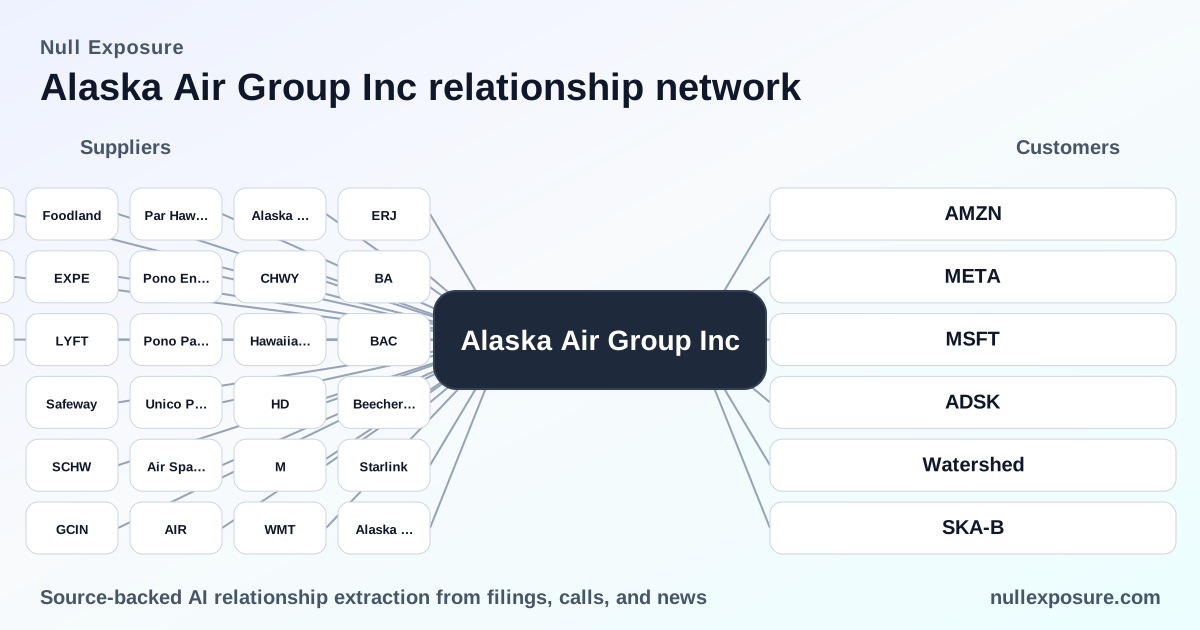
Alaska Air Group (ALK): a supplier map investors need to read
Alaska Air Group operates and monetizes as an integrated network carrier: ticket and cargo revenue from scheduled air transportation, incremental margin from a growing international and long‑haul fleet, loyalty and co‑brand credit card revenue, and a steady stream of ancillary partnerships and CPAs (capacity purchase agreements) with regional operators. Supplier relationships drive both capital intensity (airframe OEMs, SAF suppliers) and recurring commercial revenue (loyalty, payment, connectivity and in‑flight services) — making supplier concentration and contract structure material to equity and operational risk.
For a concise supplier risk briefing and relationship tracker, visit https://nullexposure.com/ for more context and sourcing.
Fleet suppliers and the strategic fleet push
Boeing: the dominant fleet partner and the largest order in company history
Alaska signed supplemental purchase agreements with Boeing that collectively represent the largest aircraft order in the airline’s history — 105 Boeing 737‑10s and five Boeing 787 Dreamliners, plus options, reshaping capacity through 2035 and increasing Boeing exposure materially. This commitment is documented in Alaska’s January 2026 announcement and Boeing’s Jan 7, 2026 press release, and was reiterated on Alaska’s FY2025/FY2026 disclosures and earnings call (Jan–Mar 2026). (Sources: Alaska press release Jan 2026; Boeing press release Jan 7, 2026; FY2025 10‑K references and Q4 FY2025 earnings call transcript, Mar 2026.)
Embraer: regional jet commitments and CPA fleet role
Alaska (via Horizon and third‑party operators) has contractual commitments for Embraer E175 aircraft and confirmed near‑term deliveries of Embraer 175s alongside a single 787 delivery in recent communication; Embraer jets supply regional capacity sold to Alaska under capacity purchase agreements. The company’s FY2025 10‑K and the FY2026 earnings call describe these Embraer commitments and delivery cadence. (Sources: ALK 10‑K FY2025; earnings call transcript, Mar 2026.)
Airbus: limited exposure through Hawaiian operations
Hawaiian Airlines (included in the consolidated airline group reporting) operates Airbus aircraft for its network, creating a modest Airbus exposure within the consolidated fleet mix. The FY2025 commentary and market summaries reference Airbus usage on the Hawaiian segment. (Source: FY2025 reporting and investor commentary, early 2026.)
Connectivity, in‑flight services and food partners
Starlink: cabin connectivity rollout underway
Alaska has started installing Starlink Wi‑Fi across its branded fleet, with 24 aircraft completed and mainline installations slated to continue in spring 2026 — a direct service partnership affecting passenger experience and ancillary product potential. (Sources: Q4 FY2025 earnings call transcript, Mar 2026; PRNewswire q4 results, Mar 2026.)
Beecher’s and onboard catering partners: local food partnerships
Alaska’s guest experience teams are integrating local brands such as Beecher’s Mac & Cheese into refreshed seasonal menus, reinforcing a local branding strategy that supports ancillary sales. (Source: Alaska Airlines spring menu announcement via StockTitan/news release, Mar 2026.)
Air Space Intelligence: operational fuel and efficiency software
Alaska developed an AI route‑efficiency tool (Flyways) in collaboration with Air Space Intelligence, which the company credits with tangible fuel savings (900,000 gallons reported). This is an operational supplier relationship that improves unit economics. (Source: profile and reporting on operational initiatives, Trellis, 2026.)
Payments, loyalty and distribution — monetization partners
Bank of America / Bank of America, N.A.: co‑brand issuer and commercial partner
Bank of America issues and administers the Atmos Rewards co‑branded credit card and is described by management as a deep, strategic partner supporting growth; the card program is a concrete revenue stream from interchange and co‑marketing. (Sources: Atmos Rewards program release, Mar 2026; earnings call transcript, Mar 2026.)
Visa U.S.A. Inc.: payments network licensee
Visa branding and licensing underpin the Atmos Rewards card products and payment rails used by the issuer, as disclosed in loyalty program materials. (Source: Atmos Rewards program release, Mar 2026.)
Charles Schwab & Co., Inc.: broker handling of equity transactions
Recent SEC filing entries list Charles Schwab as broker on specific insider or institutional trades; this reflects routine brokerage services rather than core operating supply. (Source: ALK SEC filing reported on StockTitan, Feb 2026.)
Expedia, Lyft, Home Depot, Macy’s, Walmart, Chewy, Foodland, Safeway: loyalty and retail partners
Alaska expanded Atmos Rewards partnerships to include major retail and travel partners — Expedia, Lyft, Home Depot, Macy’s, Walmart, Chewy, Foodland and Safeway — converting partner transactional flows into status and redeemable points and creating third‑party revenue capture and customer engagement touchpoints. (Source: Atmos Rewards 2026 expanded partners announcement, Mar 2026.)
GCI and CLEAR: connectivity and travel convenience tie‑ins
GCI is integrated as a qualifying partner for points accrual (internet/cellular), and CLEAR membership is positioned as a status‑earning product within the loyalty program — both convert third‑party subscriptions into loyalty economics. (Source: Atmos Rewards program materials, Mar 2026.)
Sustainable aviation fuel and local energy suppliers
Par Hawaii, Pono Energy and Pono Pacific: regional SAF supply links
Reporting ties Alaska/Hawaiian operations and the broader industry to locally produced SAF initiatives; Par Hawaii and Pono Energy / Pono Pacific are named in reporting related to Hawai‘i SAF deliveries and regional SAF investment programs that support decarbonization goals. These relationships are part of a broader supply chain for alternative fuels rather than current volume‑scale fuel replacement. (Sources: Trellis article on SAF partnerships and Hawaiian Airlines investment announcements, early 2026; Hawaiian Airlines news.)
Company‑level constraint signal: Alaska has agreements to purchase SAF for future delivery, and those contracts are contingent on supplier regulatory approvals and production ramp — a long‑term contracting posture that introduces delivery and execution risk into fuel strategy (constraint excerpt from internal relationship constraints). Treat SAF commitments as a strategic, contingent exposure across the enterprise rather than a fully predictable input at present.
Real estate, training and other operational suppliers
Unico Properties: training facility acquisition
Alaska purchased a new global training center from Unico Properties in 2024, moving a capital/real‑estate relationship on‑balance‑sheet and centralizing training operations. (Source: Alaska Airlines announcement on training center, 2024/2026 company release.)
What the supplier map implies for investors
- Concentration risk is real and deliberate: Alaska’s fleet strategy is strongly Boeing‑centric after the January 2026 purchase agreements, making Boeing performance and delivery cadence direct drivers of capex, fleet availability and schedule risk. (Sources: Boeing press release Jan 2026; Alaska FY2025 disclosures.)
- Regional capacity is contractually structured: Embraer E175 capacity is delivered via contracts and CPAs with Horizon—and third‑party operators like SkyWest are integral to that model—meaning regional flying is outsourced under long‑standing commercial frameworks that stabilize cost and capacity. (Evidence: FY2025 10‑K and constraints excerpt describing CPAs and regional carriers.)
- Loyalty and payments diversify revenue: The Atmos Rewards ecosystem with Bank of America, Visa and a broad set of retail and travel partners produces steady ancillary cashflows and customer lock‑in that mitigate ticket price cyclicality. (Source: Atmos Rewards partner announcements, Mar 2026.)
- SAF is a multi‑year, contingent contractual exposure: Long‑term SAF agreements exist but are contingent on supplier approvals and production scale, creating execution uncertainty in the fuel transition (company‑level constraint signal).
Explore a concise supplier risk scorecard and live relationship tracking at https://nullexposure.com/ to integrate these partner exposures into your investment model.
If you are modeling ALK’s capital plan or constructing scenario analyses, prioritize Boeing delivery assumptions, timing of Starlink installations (revenue/ancillaries), the earnings contribution from Atmos Rewards, and the contingent nature of SAF deliveries. For an actionable supplier risk report and deeper sourcing, visit https://nullexposure.com/ to request a tailored briefing.