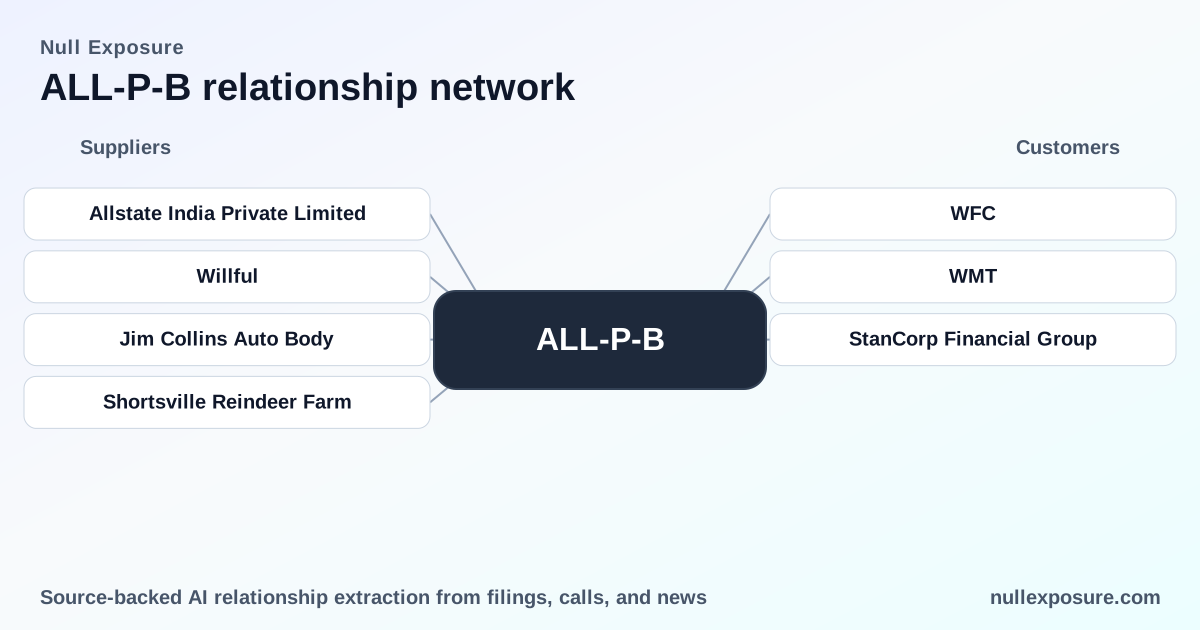
Allstate (ALL-P-B) supplier relationships: what investors need to know
Allstate underwrites property and casualty risk and monetizes that underwriting through earned premiums, investment income and access to capital markets — including subordinated securities such as the 5.100% Fixed-to-Floating Rate Subordinated Debentures due 2053. Investor focus on supplier relationships should concentrate on how external partners affect claims execution, digital distribution and brand risk, because those operational nodes drive loss adjustment, retention and cost control. For an operationally focused supplier view, visit https://nullexposure.com/.
How Allstate organizes supply-side capability
Allstate’s operating model combines a large agent network, centralized claims operations and captive shared-services subsidiaries that provide technology, finance and back-office support. The company funds volatility with capital instruments while outsourcing a mix of high-volume operational tasks and discrete partnerships for customer-facing services and marketing. Contracting posture is predominantly standardized across agents and captive centers, but the supplier mix includes small, local vendors whose disputes can amplify reputational risk. No supplier-level constraints were recorded in the available supply-scope signals, which is a company-level signal that no flagged contractual restrictions or formal supply constraints were detected in this review period.
The capital profile uses subordinated debt to create a buffer between policyholders and equity; that structure elevates the importance of predictable claims outcomes and stable loss ratios because unexpected operational issues translate to capital volatility faster when debt maturities and coupons are fixed.
Supplier map: partners that touch claims, digital services and marketing
Below are every supplier relationship returned for ALL-P-B in the reviewed results, each summarized in plain language with source context.
Allstate India Private Limited
Allstate India functions as a captive service provider across technology, policy administration, accounting, transformation design and global operations, supporting parent-company business areas from Bengaluru and Pune. According to a PR Newswire release (FY2023), the unit’s remit includes policy administration and transformation services, making it a material operational node for back-office efficiency: https://www.prnewswire.com/in/news-releases/allstate-india-joins-kincentric-best-employers-club-301768608.html.
Willful
Willful is a consumer legal-tech partner accessible via an Allstate banner and sold through Allstate agents, representing a cross-sell digital service integrated into Allstate’s customer channel strategy. A profile in Canadian Lawyer Magazine (FY2021) notes Willful’s distribution through Allstate’s site and agents, reflecting an intent to monetize adjacent service partnerships through agent-led sales: https://www.canadianlawyermag.com/resources/legal-technology/as-covid-drives-demand-willful-expands-partners-with-allstate-insurance-company/356571.
Jim Collins Auto Body
Jim Collins Auto Body publicly posted that it would not accept Allstate insurance claims, signaling retailer-level friction between a local repair shop and Allstate claims handling; this is a localized supplier/partner dispute that affects claims routing and customer experience. A BodyShopBusiness report (FY2023) covered the shop’s sign and the resulting public dispute, which is a reputational and operational red flag at the point of repair: https://www.bodyshopbusiness.com/fox19-spotlights-cincinnati-body-owners-beef-with-allstate/.
Shortsville Reindeer Farm
Shortsville Reindeer Farm was featured co-starring with Allstate’s “Mayhem” character in a television commercial, representing a discrete creative and marketing partnership that supports brand campaigns. The Democrat and Chronicle covered the creative tie-in (FY2024), indicating use of niche partners for advertising assets rather than core operational dependency: https://www.democratandchronicle.com/story/lifestyle/2024/12/03/shortsville-reindeer-farm-allstate-walmart-tv-commercial-mayhem/76731179007/.
What the supplier list reveals for investors
The supplier mix shows a clear split between strategic captive operations (Allstate India) that drive scale in technology and administration, distribution partnerships (Willful) that expand non-insurance services and agent monetization, and local vendor interactions (Jim Collins Auto Body) that carry reputational and claims-routing risk. Advertising partnerships (Shortsville Reindeer Farm) illustrate marketing flexibility but are low operational criticality.
- Concentration and criticality: The presence of a sizable captive (Allstate India) lowers third-party concentration risk for central processing, while dependence on local repair shops and agents creates many low-dollar, high-frequency touchpoints where execution quality matters.
- Contracting posture: Allstate operates with standardized agent and tech contracts for scale, but local vendor disputes demonstrate that uniform contracting does not eliminate execution frictions in the field.
- Maturity: The mix reflects a mature insurer’s supplier ecosystem — internalized scale in shared services plus selective external partnerships for distribution and marketing.
No supplier constraints were reported in the reviewed signals; therefore, there is no recorded supplier-level contractual restriction or disclosure that limits Allstate’s ability to operate in the supplied relationship scope during the review window. That absence should be treated as a neutral company-level indicator rather than proof of zero risk.
For operational due diligence and monitoring, see https://nullexposure.com/ for deeper supplier intelligence.
Investor risk and value levers
- Claims execution is the critical value lever. Local repair-shop frictions create direct customer pain and potential loss-ratio pressure if repairs are delayed or the insurer’s network is fragmented.
- Captive service maturity is an asset. Allstate India’s involvement in policy administration and transformation supports scale and cost control; this reduces outsourcing risk for large operational flows.
- Distribution partnerships can lift non-premium revenue. Willful demonstrates how Allstate leverages agent channels to sell adjacent services that increase customer lifetime value.
- Brand partnerships are tactical. Creative suppliers like the Shortsville Reindeer Farm enhance advertising but do not change core underwriting economics.
Recommended monitoring and next steps
- Track public disputes with repair shops and agent sentiment to assess near-term claims friction; operational derailment here is the highest short-term risk to loss ratios.
- Evaluate integration and turnover metrics for captive centers that handle policy administration; back-office stability drives predictive reserving.
- Monitor cross-sell partnerships and uptake rates to quantify non-premium revenue contribution from initiatives like Willful.
- Maintain capital vigilance: subordinated securities such as the 5.100% debentures due 2053 require steady underwriting performance to preserve credit metrics.
For a supplier-focused risk briefing or to subscribe to ongoing relationship monitoring, visit https://nullexposure.com/.
Bottom line
Allstate’s supplier footprint in this review shows a deliberate mix of internalized scale (Allstate India) and external partnerships that extend distribution and marketing while exposing the company to localized reputational risk via repair-shop disputes. Investors should prioritize claims execution and captive-service stability when assessing the operational resilience supporting the company’s subordinated capital instruments. For continuous supplier intelligence and alerts, go to https://nullexposure.com/.