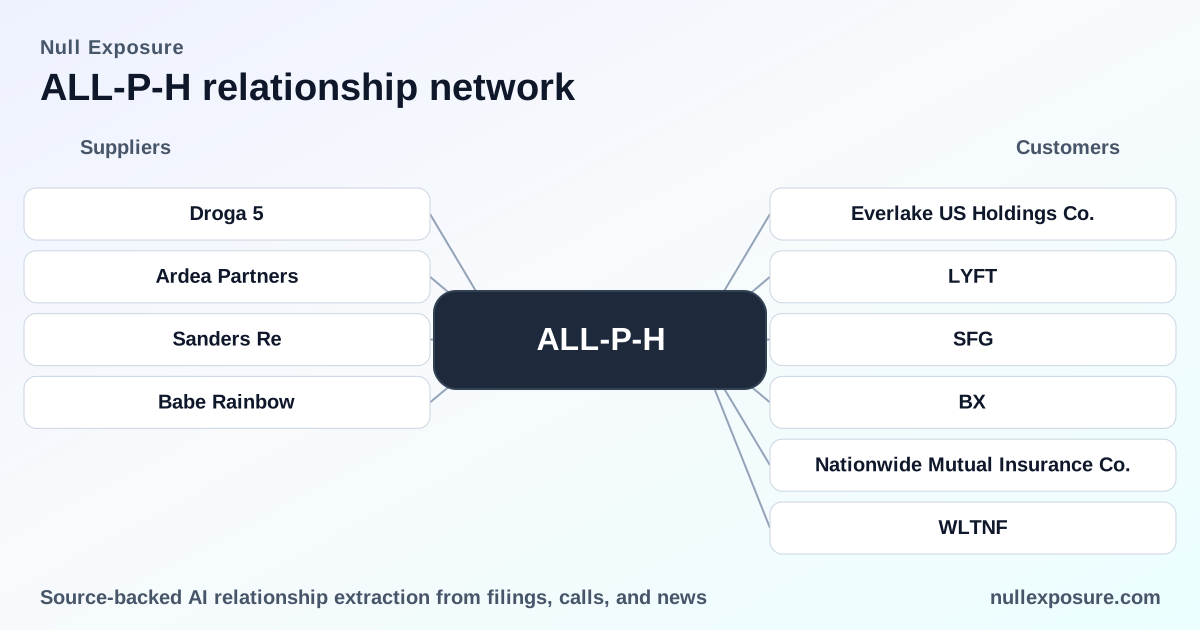
ALL-P-H (Allstate preferred): supplier relationships that matter to investors
Allstate operates as a large U.S. insurer that underwrites personal and commercial policies and monetizes through insurance premiums and investment income, while capital structure instruments such as the ALL-P-H preferred stock sit ahead of common equity for dividend and claim priority. Investors evaluating supplier risk should treat these supplier relationships as extensions of Allstate’s marketing, reinsurance, and transaction-advisory capabilities that influence underwriting economics, brand exposure, and contingent capital recovery. For a consolidated view of supplier signals and to track supplier-driven risk factors, visit https://nullexposure.com/.
Quick read: what the supplier list tells you about operating leverage
Allstate’s extracted supplier events span creative/advertising, financial advisory, reinsurance capital, and music licensing — a mix that signals investment in brand, balance-sheet transactions, and catastrophe protection. These suppliers are not homogeneous: marketing vendors drive customer acquisition, advisory firms support inorganic growth, and reinsurance/cat bond structures protect capital under stress. Each relationship has discrete implications for cash flow volatility, reputational exposure, and capital resilience.
Supplier snapshots: the relationships you need to know
Below are the concrete supplier references surfaced in the record. Each entry is one to two sentences with the original source.
Droga 5 — advertising partner on national TV creative
Droga 5 engineered an Allstate national TV commercial that used licensed music to support a marketing campaign, indicating Allstate’s continued investment in high-profile creative to sustain distribution and retention metrics. The Music Network reported this campaign activity in FY2020: https://themusicnetwork.com/babe-rainbow-pandemic-syncs-apple-nissan-netflix/.
Babe Rainbow — music licensing tied to advertising
The band Babe Rainbow’s track “Morning Song” was licensed for use in an Allstate television commercial, illustrating how media and sync deals support Allstate’s brand positioning and ad effectiveness. The Music Network covered the sync placement in FY2020: https://themusicnetwork.com/babe-rainbow-pandemic-syncs-apple-nissan-netflix/.
Ardea Partners — financial adviser on acquisition activity
Ardea Partners acted as Allstate’s financial adviser in the National General acquisition, demonstrating the use of boutique advisors in strategic M&A and capital-structure decisions that shape long-term returns to preferred holders. Fox Business reported Ardea’s advisory role in FY2020: https://www.foxbusiness.com/markets/insurer-allstate-to-buy-national-general-for-about-4b.
Sanders Re — catastrophe bond counterparty for aggregate tower protection
Allstate’s aggregate reinsurance protection for the referenced period was provided solely through the Sanders Re series of catastrophe bonds, indicating a capital markets approach to transferring peak catastrophe exposure rather than relying exclusively on traditional treaty reinsurance. Reinsurance News documented the Sanders Re structure and expected recoveries in FY2025: https://www.reinsurancene.ws/allstate-anticipates-123m-of-reinsurance-recoveries-from-aggregate-tower/.
What these suppliers reveal about Allstate’s operating model
The combination of creative agencies, music licensors, boutique advisers, and cat-bond counterparties paints a coherent operational posture:
- Contracting posture: Allstate contracts with both large and specialized suppliers for discrete capabilities — high-end creative for brand, boutique financial advisers for M&A, and capital-markets counterparties for reinsurance layering. This indicates a transactional-but-strategic contracting approach that sources expertise where it adds value.
- Concentration: Supplier roles are functionally concentrated (marketing, advisory, reinsurance) rather than supplier-name concentrated; the current feed shows diverse vendor types rather than dominance by a single supplier. This structure reduces single-vendor operational risk but increases reliance on specialized providers for critical capabilities.
- Criticality: Reinsurance/cat-bond counterparties carry high criticality because they directly affect loss recovery and capital volatility in catastrophe scenarios. Marketing and advisory suppliers are medium criticality — they influence growth and strategic outcomes that affect long-term capital returns.
- Maturity: Use of established creative agencies and capital-market instruments signals mature vendor relationships and sophisticated balance-sheet management. Preference for catastrophe bonds reflects institutional access to capital markets rather than ad hoc risk transfer.
The data feed contains no extracted supplier constraints or legal covenants. This absence functions as a company-level signal: there are no supplier-specific contractual restrictions surfaced here that would limit Allstate’s agility in vendor selection or capital-structure adjustments.
Investor implications: risks and upside distilled
- Reinsurance through catastrophe bonds is a structural pivot. The Sanders Re reliance for aggregate protection reduces traditional treaty dependence and shifts counterparty risk into capital markets. This lowers short-term ceded premium costs but increases exposure to investor sentiment and bond-market liquidity under stress.
- Marketing investments are active and visible. Engagements with Droga 5 and music licensors reflect continued spending to sustain acquisition and retention; this supports top-line growth but increases expense leverage in soft pricing cycles.
- Boutique advisory use signals targeted M&A playbook. The Ardea Partners role on the National General deal shows Allstate uses focused advisors for strategic transactions that reshape competitive position and capital allocation.
- No supplier constraints surfaced is informative. The lack of recorded supplier constraints suggests flexible contracting and the ability to reprice or re-source suppliers, a positive for managers executing capital or commercial pivots.
For investors tracking supplier-driven pressure points or seeking supplier-level due diligence, review consolidated supplier intelligence at https://nullexposure.com/ to convert these qualitative signals into position-level risk assessments.
Tactical calls-to-action for analysts and operators
- For portfolio managers: stress-test preferred holdings against scenarios where cat-bond recoveries underperform; this directly affects capital available to cover preferred claims.
- For corporate development teams: document how boutique advisers were sourced and what fees/contingencies were agreed in recent M&A to understand future transaction economics.
- For procurement and risk teams: evaluate concentration within functional buckets (marketing, reinsurance, advisory) and ensure contingency plans for high-criticality suppliers.
Access deeper supplier mapping and monitoring tools at https://nullexposure.com/ to operationalize these recommendations.
Bottom line
The supplier signals for ALL-P-H show a company operating with strategic vendor sourcing across marketing, advisory, and reinsurance capital markets, a posture that supports growth and capital resilience while introducing dependency on capital-market liquidity and specialized providers. Investors should treat reinsurance capital structures and transaction-advisory arrangements as first-order drivers of downside protection and long-term return on capital for preferred instruments. For continuous monitoring of material supplier events tied to Allstate, visit https://nullexposure.com/.