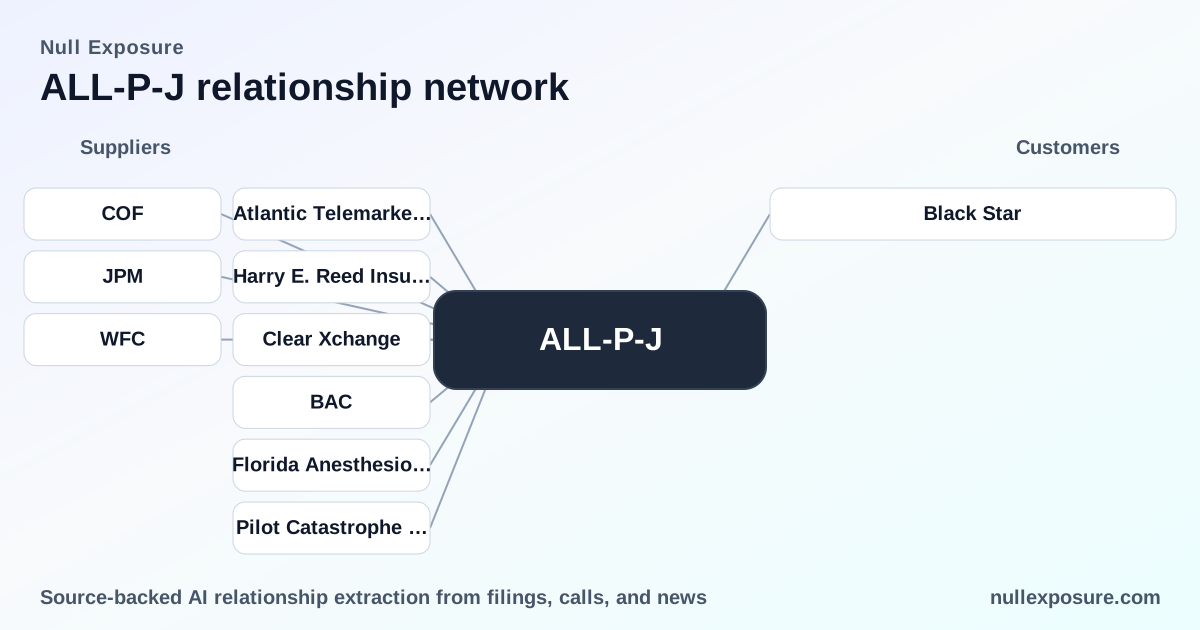
Allstate (ALL‑P‑J) supplier snapshot: what vendor ties reveal about operational leverage and reputational risk
Allstate monetizes through insurance underwriting, premium collection and investment income while outsourcing a range of high‑frequency operational functions — claims payments, agent distribution, telemarketing and catastrophe response — to third parties. The supplier map shows a blend of large-bank payment rails and niche service providers whose actions directly affect claims outcomes, client experience and regulatory exposure. Investors should treat these vendors as operationally critical partners whose conduct feeds into loss adjustment variability and reputational downside.
Explore the supplier landscape in detail at https://nullexposure.com/ — the supplier signals in this review are distilled for investors and operators.
How Allstate contracts and why supplier behavior matters
Allstate’s operating model is outsourced at the margin: core underwriting and capital management remain internal, while execution of payments, customer outreach and field adjusting is delegated. This contracting posture produces a few important company-level signals:
- Distributed counterparty footprint — Allstate uses national banks for payment rails alongside specialized vendors and independent agents, reducing single‑vendor concentration but increasing management overhead.
- High criticality relationships — Payments, adjusters and frontline agents are directly material to claim outcomes and brand risk; failures translate into rapid reputational sensitivity.
- Mixed maturity — Some partnerships (payment rails via ClearXchange and major banks) date back to at least FY2015, while litigation and agent‑termination items surface across FY2022–FY2025, showing an active refresh of vendor governance.
- Contracting posture is responsive — Public terminations and litigation show Allstate enforces codes of conduct and will sever ties when compliance or reputational breaches occur.
If you want continuous monitoring of supplier risk and public signal analysis, visit https://nullexposure.com/ to see how these relationships track over time.
Relationship roll call — what the public record shows
Below are every supplier relationship returned in the results, with a concise investor‑oriented takeaway and the source.
-
Atlantic Telemarketing
Atlantic Telemarketing operated as a telemarketing vendor connected to Transfer Kings and was identified in litigation as the call vendor that initiated a contested call, exposing Allstate to a telemarketing scrub/DNC compliance claim (reported FY2022). Source: TCPA World (https://tcpaworld.com/2022/06/30/good-hands-allstate-faces-massive-exposure-after-telemarketing-vendor-hired-by-agents-allegedly-failed-to-scrub-against-corporate-dnc-list/). -
Harry E. Reed Insurance agency
Allstate terminated its contract with independent agent Harry E. Reed after photos of a racist sign prompted immediate action citing the company’s code of conduct and diversity policy (reported FY2022). Source: WSVN/CNN coverage (https://wsvn.com/news/us-world/allstate-and-progressive-end-relationships-with-local-insurance-agency-due-to-alleged-racist-juneteenth-sign/). -
Clear Xchange
Allstate adopted Clear Xchange as an EFT payment rail to accelerate claim disbursements and was described as an early U.S. user of the Clear Xchange system in FY2015 reporting. Source: Repairer Driven News (https://www.repairerdrivennews.com/2015/01/28/allstate-new-customer-claim-payments-faster-than-checks-eft/). -
Bank of America Merrill Lynch (Bank of America / BAC)
Allstate offered a Fast Mobile payment option in partnership with Bank of America Merrill Lynch, enabling electronic claim payments to customers’ banks (reported FY2015). Source: Repairer Driven News (https://www.repairerdrivennews.com/2015/01/28/allstate-new-customer-claim-payments-faster-than-checks-eft/). -
Florida Anesthesiology & Pain Clinic
Allstate named Florida Anesthesiology & Pain Clinic in a FY2024 lawsuit alleging fraudulent billing practices tied to implausible same‑day procedures and inappropriate invoicing, making the clinic a litigation counterparty in claim subrogation/recovery activity. Source: Insurance Business Magazine (https://www.insurancebusinessmag.com/us/news/breaking-news/allstate-sues-florida-doctor-for-alleged-insurance-fraud-scheme-474182.aspx). -
Pilot Catastrophe Services
Testimony connected to Pilot Catastrophe Services’ adjusters in FY2025 alleged that Allstate reviewers instructed adjusters to remove line items or reclassify damage on storm estimates, a statement that highlights potential dispute activity around claim scope and estimate integrity. Source: Insurance Journal (https://www.insurancejournal.com/magazines/mag-features/2025/06/02/825571.htm). -
Capital One (COF)
Capital One is identified as one of the Clear Xchange owners and therefore a participant in the payment rail Allstate used to speed customer claim payments as of FY2015. Source: Repairer Driven News (https://www.repairerdrivennews.com/2015/01/28/allstate-new-customer-claim-payments-faster-than-checks-eft/). -
Bank of America (BAC)
Bank of America is listed as a Clear Xchange owner and partner in the FY2015 payment offering Allstate employed for faster claim disbursements. Source: Repairer Driven News (https://www.repairerdrivennews.com/2015/01/28/allstate-new-customer-claim-payments-faster-than-checks-eft/). -
JPMorgan Chase (JPM)
JPMorgan Chase appears as another owner of Clear Xchange that underpinned Allstate’s faster payment option in FY2015. Source: Repairer Driven News (https://www.repairerdrivennews.com/2015/01/28/allstate-new-customer-claim-payments-faster-than-checks-eft/). -
Wells Fargo (WFC)
Wells Fargo, named as a Clear Xchange owner, was part of the payment network Allstate used to accelerate claims disbursement in FY2015. Source: Repairer Driven News (https://www.repairerdrivennews.com/2015/01/28/allstate-new-customer-claim-payments-faster-than-checks-eft/).
What this supplier mix implies for investors
- Operational sensitivity is high where vendors touch claims and customer communication: telemarketers, independent agents and adjusters have direct line‑of‑sight into customer outcomes and regulatory exposure. Public terminations and litigation show Allstate enforces controls but still incurs reputational volatility.
- Payment rails are commoditized but critical; using Clear Xchange and major banks reduces settlement friction and operational float risk but ties Allstate to the compliance and tech cadence of large financial institutions.
- Litigation and vendor conduct are active governance levers — Allstate sues providers when necessary (e.g., medical providers implicated in alleged fraud) and terminates agents for code breaches, demonstrating an assertive vendor governance stance that protects brand at the cost of episodic headline risk.
If you want an investor-ready view of supplier risk exposure and trending headlines, see full coverage at https://nullexposure.com/.
Bottom line for investors and operators
Allstate’s supplier set is a functional mix of payment infrastructure and frontline service partners whose actions materially affect claim economics and reputation. The company enforces termination and litigation when supplier conduct crosses policy lines, which reduces long‑term governance risk but creates episodic headline exposure that investors must price into operational volatility. For continued monitoring and supplier risk scoring, visit https://nullexposure.com/ for ongoing signal aggregation and analysis.