Allogene Therapeutics (ALLO) — Supplier Relationships, Risks, and Operational Posture
Allogene Therapeutics develops and plans to commercialize off-the-shelf, allogeneic CAR‑T cell therapies and related reagents; the company monetizes through ownership of development and commercial rights to licensed programs, future product sales upon approval, and strategic collaborations for companion diagnostics and regional rights. Its supplier model is a hybrid of in‑house manufacturing capacity (Cell Forge 1) and outsourced CDMO/CRO services, with value capture dependent on successful clinical milestones and the enforcement of licensed intellectual property. For investors evaluating counterparty risk, the operating model is licensing‑heavy, manufacturing‑dependent, and milestone‑sensitive. Learn more at https://nullexposure.com/.
How Allogene organizes suppliers and partners — what matters to investors
Allogene runs a mixed operating posture: it is both a licensee of external IP and an operator of internal manufacturing, creating a layered supplier exposure. Company disclosures identify active reliance on third‑party licensors and service providers (CROs, CDMOs and supply chain partners) while emphasizing CF1—its Cell Forge 1 facility—for clinical manufacturing. This structure produces four practical characteristics for counterparties and financiers:
- Contracting posture — licensing and short-term third‑party arrangements. Allogene depends on intellectual property licensed from third parties and states it does not maintain long‑term agreements with CDMOs for all products; this implies negotiating flexibility but also execution risk if providers change terms.
- Concentration and criticality — a small number of licensors and manufacturers create single‑point risk. The company treats CDMO performance and license continuity as critical to timelines and approvals.
- Relationship roles — licensee, manufacturer, and service consumer. Allogene is a licensee of core technologies, operates its own manufacturing (CF1) for some programs, and uses external CDMOs and CROs for other components and logistics.
- Maturity and stage — clinical‑stage with active partnerships. The business is clinically focused: relationships are operationally active and will determine near‑term de‑risking and commercial readiness.
These signals describe company‑level constraints: licensing dependence, short‑term CDMO arrangements, critical service roles for third parties, and an active, clinical‑stage supplier base. For operational teams, that means prioritizing continuity planning for vendors and clear IP indemnities in contracting. For investors, supplier execution is a direct lever on valuation.
Relationship map — who Allogene depends on and why it matters
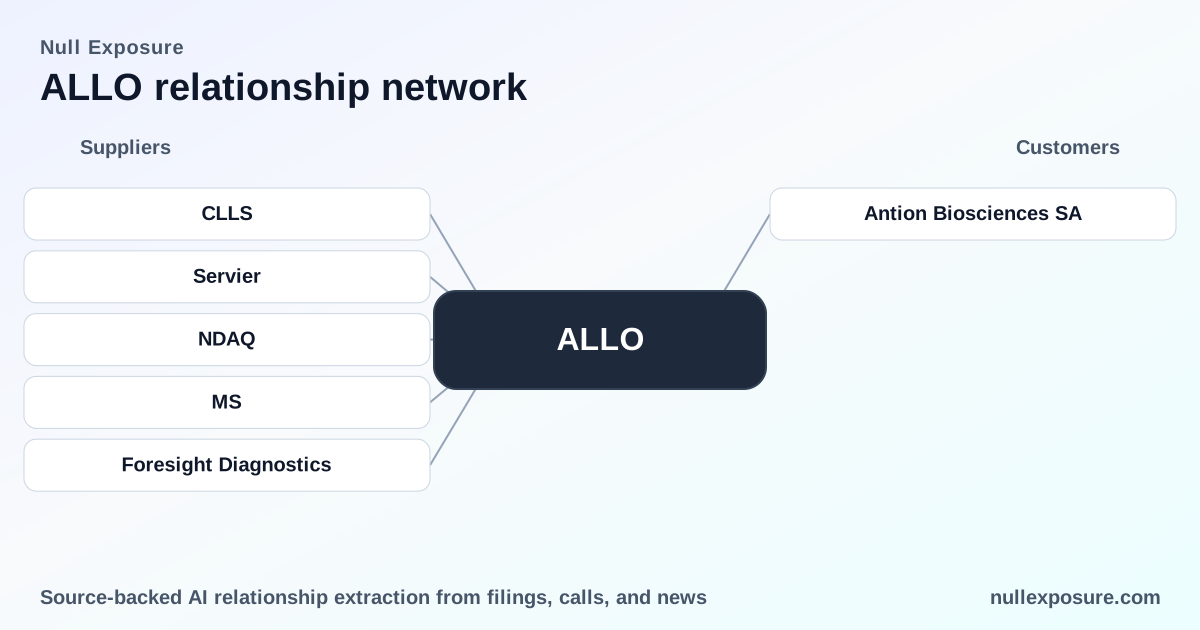
Below are the counterparties identified in recent reporting and press coverage; each relationship summary is followed by the public source that documents it.
Cellectis
Allogene licenses core genome‑editing and CAR technologies from Cellectis and uses Cellectis‑derived platforms for several AlloCAR T investigational products; Cellectis‑licensed programs such as the anti‑CD70 AlloCAR T are central to Allogene’s clinical pipeline. This licensing relationship is documented in multiple company releases across FY2025 and FY2026, including Allogene press material and market commentary in January 2026 and November 2025 on GlobeNewswire and SAHM Capital that reference Cellectis technology and the exclusive license structure.
Servier
Servier has granted Allogene exclusive rights to specific product candidates in defined territories — notably rights to ALLO‑501/ALLO‑501A in the U.S. and to cema‑cel in the U.S., EU Member States and the U.K. These grants are cited in Allogene press releases from FY2023 and FY2025 and reiterated in FY2026 company updates on GlobeNewswire and SAHM Capital that enumerate territorial exclusivity and licensing arrangements.
Foresight Diagnostics
Allogene and Foresight Diagnostics expanded a strategic collaboration to co‑develop a minimal residual disease (MRD) assay in support of Allogene’s clinical development for cema‑cel across Europe, the U.K., Canada and Australia; the partnership externalizes a diagnostic capability critical to trial readouts and regulatory dossiers. The expansion is described in a PR Newswire release and referenced in Allogene’s FY2025 investor communications.
NASDAQ
Allogene’s SEC filing for FY2026 lists NASDAQ as the market on which the company’s common stock trades; this is a procedural, exchange relationship referenced in the FY2026 filing reproduced on StockTitan. The filing also identifies exchange‑related disclosures that matter for market access and compliance.
Morgan Stanley Smith Barney LLC
An SEC filing in FY2026 lists Morgan Stanley Smith Barney LLC as Allogene’s broker for the reported transaction; this identifies an institutional brokerage relationship used for capital markets activity and secondary placement administration, as shown in the FY2026 filing posted via StockTitan.
(Each relationship above is drawn from Allogene press releases, investor updates and public filings across FY2023–FY2026; see the cited GlobeNewswire, SAHM Capital, PR Newswire and StockTitan references for the primary language.)
What the supplier footprint means for risk and execution
Allogene’s supplier profile translates directly into operational and investment risks investors should price explicitly:
- IP concentration is a live valuation lever. The company’s product rights depend on a small set of licensed technologies; loss or restriction of those licenses would be value‑destructive. Company disclosures about dependence on third‑party IP are explicit.
- Manufacturing execution is mission‑critical. While CF1 gives Allogene internal capacity for clinical manufacturing, Allogene continues to rely on CDMOs for reagents, viral vectors and ALLO‑647 supply, and describes CDMO relationships as potentially short‑term — increasing the likelihood of supply negotiation or transition risk.
- Regulatory milestones hinge on external service performance. The company acknowledges that CRO/CDMO performance and diagnostic partner deliverables are material to approvals and commercialization timelines.
- Active partnership stage implies near‑term binary events. Because many agreements are operational today, upcoming trial readouts and arbitration outcomes (previously reported) can rapidly re‑rate counterparties and the equity.
For risk managers and sourcing teams, the immediate priorities are strengthening long‑form manufacturing contracts, securing contingency capacity, and embedding IP protections in supplier agreements. Institutional investors should monitor milestone calendars tied to Cellectis‑ and Servier‑licensed programs and diagnostics integration with Foresight.
Learn more about counterparty risk frameworks and supplier scoring at https://nullexposure.com/.
Bottom line — investor checklist
- Licensing dependency and manufacturing execution are the two highest‑impact risks for Allogene.
- Monitor Cellectis and Servier licensing status, CDMO contract rollovers, and Foresight assay delivery as the primary drivers of near‑term value realization.
- Operational mitigation: secure long‑term CDMO commitments where possible and validate diagnostic partnerships ahead of registrational studies.
For a deep dive on how supplier relationships translate into credit and operational scoring for clinical‑stage biotechs, visit https://nullexposure.com/.