Ally Financial Inc (ALLY): supplier footprint and what it means for investors
Ally Financial operates as a diversified digital bank and automotive finance platform that monetizes through interest spread on loan portfolios (auto and consumer), fee income from deposit and card products, and financing / liquidity channels that support lending growth. Ally pairs a retail deposit franchise with large-scale auto lending and credit-card issuance; the firm generates earnings by originating or acquiring retail installment contracts and leasing assets, funding those assets with deposits and secured borrowing lines. Revenue (TTM ~$7.37B) and an asset-heavy funding model make third-party supplier relationships and liquidity access strategic to performance. Learn more about supplier mapping and risk analytics at https://nullexposure.com/.
How Ally’s supplier map reads for investors
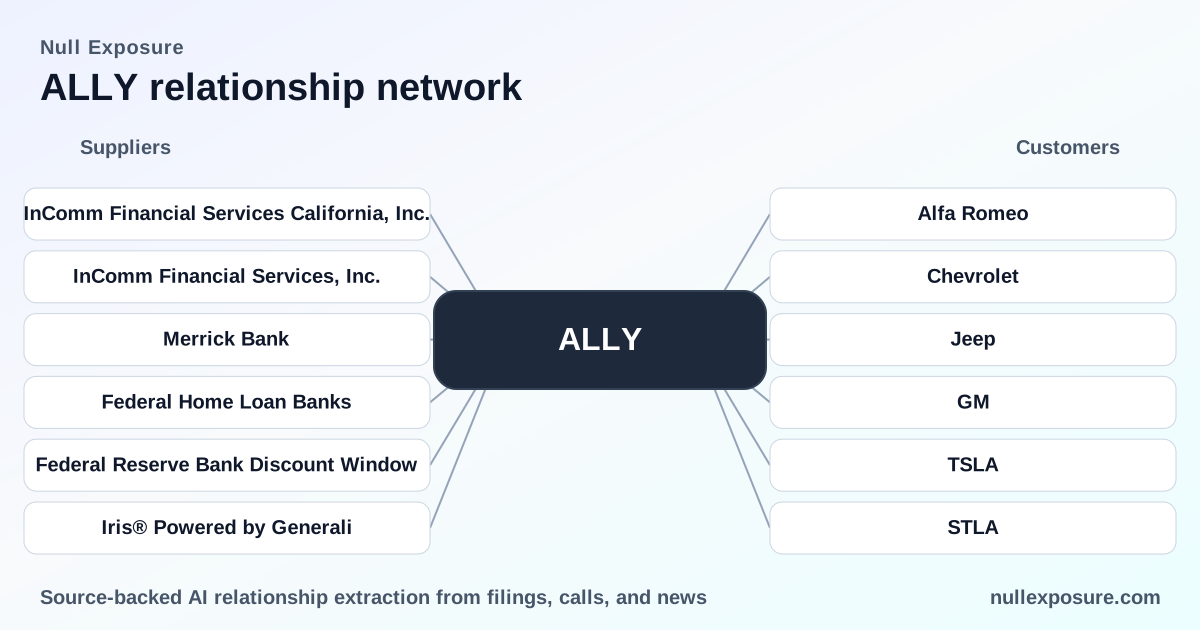
Ally’s public disclosures and customer-facing materials identify a small set of specialized partners for card issuance, cash-loading, insurance services and liquidity facilities. Below I list each relationship identified in the source material with a concise plain-English description and source note.
InComm Financial Services California, Inc.
Ally uses InComm’s VanillaDirect Pay rails to enable an “add cash” feature on Ally Bank spending accounts, outsourcing cash-loading at retail points-of-sale to a licensed money transmitter. According to Ally’s customer article (March 2026), VanillaDirect Pay is the provider for that functionality: https://www.ally.com/stories/save/financial-planning-by-age/.
InComm Financial Services, Inc.
Ally also engages the parent/affiliate InComm Financial Services, Inc. for the same VanillaDirect Pay capability, reflecting multi-entity licensing of money-transmission services used by Ally’s deposit products. See Ally consumer guidance (March 2026): https://www.ally.com/stories/save/financial-planning-by-age/.
Merrick Bank
Ally credit cards are issued through Merrick Bank, indicating Ally’s reliance on a third-party issuer for its card program rather than self-issuing. Ally’s published customer materials state simply: “Ally credit cards are issued by Merrick Bank.” Source: Ally consumer page (March 2026): https://www.ally.com/stories/save/financial-planning-by-age/.
Federal Home Loan Banks
Ally discloses significant unused borrowing capacity at the Federal Home Loan Banks, which forms a large contingent liquidity buffer supporting asset growth and funding flexibility. A ratings report cited Ally’s $36.0 billion of unused borrowing capacity at the Federal Home Loan Banks as of December 31, 2025 (MarketScreener, March 2026): https://www.marketscreener.com/news/morningstar-dbrs-confirms-ally-financial-inc-s-long-term-issuer-rating-at-bbb-stable-trend-ce7e5adddb89f726.
Federal Reserve Bank Discount Window
Ally includes the Federal Reserve Bank Discount Window among its secured borrowing options, underscoring direct central-bank access to short-term liquidity in stressed conditions; the same March 2026 coverage cites combined unused capacity across the Discount Window and FHLB of $36.0 billion as of year-end 2025: https://www.marketscreener.com/news/morningstar-dbrs-confirms-ally-financial-inc-s-long-term-issuer-rating-at-bbb-stable-trend-ce7e5adddb89f726.
Iris® Powered by Generali
Ally references Iris® Powered by Generali as a provider of a service embedded in Ally’s product experience—an example of outsourcing of value-added insurance/insurtech capabilities within customer-facing content. Ally’s online story lists Iris® Powered by Generali as the service provider (March 2026): https://www.ally.com/stories/save/financial-planning-by-age/.
Operating and business-model constraints that shape supplier risk
Ally’s disclosures, viewed as company-level signals, reveal several structural constraints that determine how the firm contracts with and depends on suppliers:
- Long-term asset tenor is embedded in the business model. Retail auto originations with extended terms (e.g., a material share originated with 76+ month terms) create long-duration credit assets that require stable funding and servicing arrangements—this drives long-dated operational and vendor relationships rather than quick vendor turnover.
- Significant government-counterparty exposure. Ally holds FDIC-insured deposits and a securities portfolio concentrated in U.S. government and agency debt, indicating that government exposures and regulatory relationships are central to funding and balance-sheet management.
- Third-party providers are critical to delivery. Management explicitly states third-party service providers are key for online/mobile banking, brokerage clearing, customer service, and infrastructure, making operational outsourcing a core dependency and a major reputational and operational risk driver.
- Buyer / manufacturer posture in the auto ecosystem. Ally acts as a dominant buyer of retail installment contracts and purchasers of operating-lease contracts and associated vehicles, embedding dependency on dealer and manufacturer flows for origination pipelines.
- Material spend profile and escalation risk. The firm’s disclosed payments (for example, a $14 million special assessment in one year) and a proposed spend band in the $10M–$100M range signal that certain vendor categories command meaningful budget and governance attention.
Because these constraints are firm-wide signals, suppliers that align with long-term servicing, regulated money-transmission licensing, and scale in auto finance or card processing will be most strategically valuable to Ally.
What this means for investors and operator diligence
Ally’s structure—asset-heavy lending, deposit funding, reliance on outsourced customer and transaction plumbing, and explicit central-bank liquidity backstops—creates a set of clear investment vectors and operational risks:
- Liquidity optionality reduces immediate funding risk. The announced $36.0 billion of unused capacity at the FHLB and Discount Window and roughly $20.3 billion of unencumbered liquid securities and cash (Dec 31, 2025) provide a large liquidity cushion that supports lending and absorbs market shocks; see MarketScreener coverage (Mar 2026): https://www.marketscreener.com/news/morningstar-dbrs-confirms-ally-financial-inc-s-long-term-issuer-rating-at-bbb-stable-trend-ce7e5adddb89f726.
- Operational outsourcing is a concentration and control issue. Dependence on a handful of specialized suppliers (card issuer, money-transmission rails, insurance partners, clearing brokers) amplifies vendor-management risk and elevates the importance of contract terms, service-level agreements, and audit rights.
- Contracting posture will be asymmetric. Ally’s role as a purchaser of dealer-originated contracts and as a bank with substantial regulatory obligations means the firm negotiates for long-term, high-control arrangements where practicable; supplier maturity and compliance posture are non-negotiable.
For a deeper look at how these supplier relationships map to risk and revenue, visit https://nullexposure.com/.
Practical next steps for investors and operators
- Require transparency on vendor SLAs, data flows, and fallback plans for critical providers (card issuer, money transmitters, clearing brokers).
- Monitor concentration metrics across third-party suppliers and dealer/manufacturer origination channels; prioritize counterparty stress tests under funding stress scenarios.
- Validate contractual access to contingency liquidity lines and the composition of unencumbered liquid securities during due diligence.
Explore a full supplier risk profile and tools for active monitoring at https://nullexposure.com/.
Bottom line
Ally is a digitally focused bank whose earnings depend on a combination of loan-originations, card and deposit products, and access to large-scale liquidity facilities. The company’s supplier relationships are concentrated in a few strategic areas—money transmission (InComm), card issuance (Merrick), insurance/insurtech (Iris/Generali), and wholesale liquidity (FHLB / Discount Window)—and those relationships are operationally critical. For investors and operators, the imperative is to treat supplier governance and liquidity posture as first-order risk controls rather than peripheral monitoring.