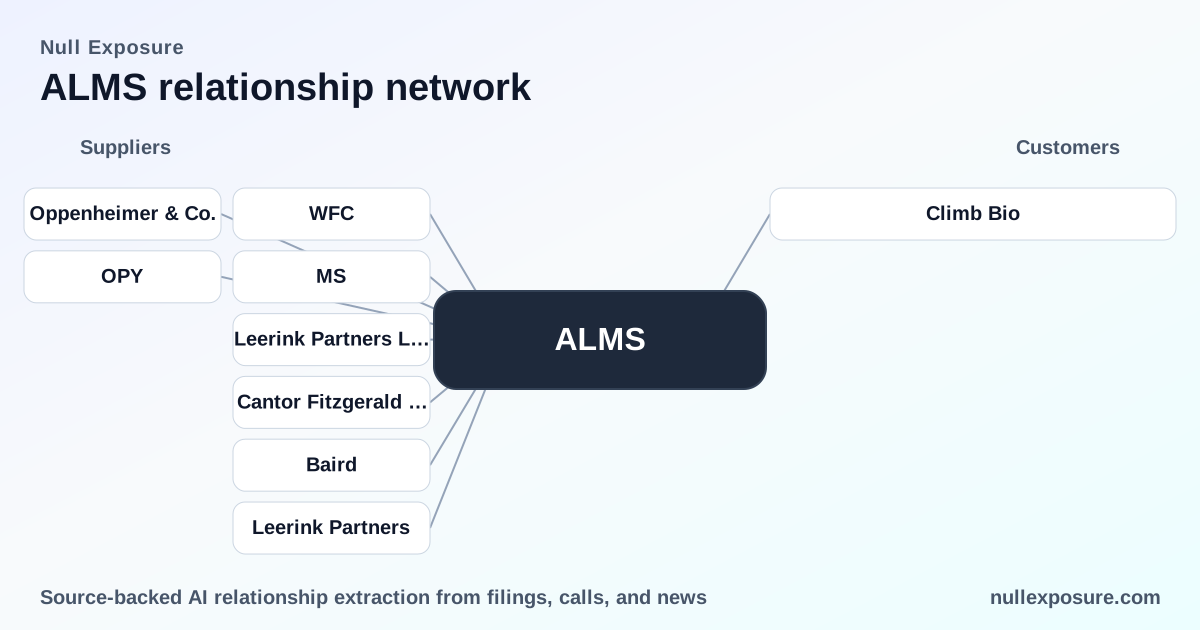
ALMS Supplier Map: What the March 2026 underwriting roster and contract signals mean for investors
Alumis Inc. operates as a developer and commercializer of high-performance aluminum products for automotive, aerospace and construction end markets; the company monetizes through product sales, targeted licensing and strategic partnerships while funding growth with public capital raises. The March 2026 public offering and its underwriting lineup are a direct signal that the company is actively financing scale‑up while retaining a mix of long‑dated property commitments and cancellable supplier arrangements that shape operational flexibility and risk. For a deeper commercial-risk read on ALMS supplier posture, see Null Exposure’s research hub: https://nullexposure.com/.
Why the underwriter list matters for a supplier-focused read
The banks and brokerages that underwrote Alumis’s recent offering are not suppliers of raw material, but their presence matters for liquidity and covenant pressure: a strong syndicate expands financing capacity and influences the terms and timing of capital deployment to factories, contract manufacturers and R&D partners. The market coverage around the offering identifies two tiers of managers — joint book‑runners and co‑lead managers — which reflects allocation of distribution, pricing support and institutional relationships that will determine the company’s access to follow‑on capital.
- Capital access is reinforced by a syndicate that includes global and specialty healthcare/bio desks.
- Dilution and timing are immediate operational levers: capital raised funds manufacturing scale and longer lease commitments described in filings.
Explore the platform for ongoing tracking and alerts: https://nullexposure.com/.
Underwriter roster — line-by-line (what the filings and press releases say)
-
Wells Fargo Securities, LLC: Wells Fargo is listed as a joint book‑running manager for the upsized public offering announced March 9, 2026, and provided distribution contact details in the prospectus supplement. According to the company press release distributed on Yahoo Finance on March 9, 2026, Wells Fargo was named among the joint book‑running managers (https://finance.yahoo.com/news/alumis-announces-closing-upsized-public-210500721.html).
-
Morgan Stanley & Co. LLC / Morgan Stanley: Morgan Stanley served as a joint book‑running manager on the offering and was listed as a contact for prospectus requests; the firm’s healthcare and institutional distribution capabilities underwrote a significant portion of the deal. This role is documented in the March 9, 2026 news release and in syndicate coverage on StockTitan and QuiverQuant (https://finance.yahoo.com/news/alumis-announces-closing-upsized-public-210500721.html; https://www.stocktitan.net/news/ALMS/alumis-announces-proposed-public-offering-of-common-mh4pt8xsaeoh.html; https://www.quiverquant.com/news/Alumis+Inc.+Announces+Pricing+of+Upsized+Public+Offering+of+17.65+Million+Shares+at+%2417.00+Each).
-
Leerink Partners LLC / Leerink Partners: Leerink is identified as a joint book‑running manager in the offering documents and press coverage, reflecting specialized equity placement capacity in healthcare‑adjacent issuers. The involvement is noted in the March 9, 2026 press materials (https://finance.yahoo.com/news/alumis-announces-closing-upsized-public-210500721.html; https://www.stocktitan.net/news/ALMS/alumis-announces-proposed-public-offering-of-common-mh4pt8xsaeoh.html).
-
Cantor Fitzgerald & Co.: Cantor Fitzgerald appears in the prospectus supplement as a joint book‑running manager and as a distribution contact, reinforcing syndicate breadth for the deal. See the Yahoo Finance release and StockTitan syndicate notes dated March 9, 2026 (https://finance.yahoo.com/news/alumis-announces-closing-upsized-public-210500721.html; https://www.stocktitan.net/news/ALMS/alumis-announces-proposed-public-offering-of-common-mh4pt8xsaeoh.html).
-
Baird: Baird acted as a co‑lead manager on the offering, supporting middle‑market placement and targeted investor outreach, as disclosed in the company notices on March 9, 2026 (https://finance.yahoo.com/news/alumis-announces-closing-upsized-public-210500721.html; https://www.stocktitan.net/news/ALMS/alumis-announces-pricing-of-upsized-public-offering-of-common-w3q3paxyfi6d.html).
-
Oppenheimer & Co.: Oppenheimer is listed alongside Baird as a co‑lead manager for the offering, providing additional distribution in growth and healthcare‑oriented accounts per the March 9, 2026 communication (https://finance.yahoo.com/news/alumis-announces-closing-upsized-public-210500721.html; https://www.stocktitan.net/news/ALMS/alumis-announces-pricing-of-upsized-public-offering-of-common-w3q3paxyfi6d.html).
-
Cantor Fitzgerald & Co. (repeat noted in multiple syndicate disclosures): Cantor’s repeated mention across press outlets confirms its practical role in the syndicate and investor outreach for the upsized offering (see the March 9, 2026 stock news coverage and press release) (https://www.stocktitan.net/news/ALMS/alumis-announces-proposed-public-offering-of-common-mh4pt8xsaeoh.html).
(Each entry above is drawn from the company’s March 9, 2026 offering communications and subsequent syndicate reporting across Yahoo Finance, StockTitan and QuiverQuant.)
Contracting posture, concentration and other supplier-facing constraints
The company’s supplier profile and contractual posture combine long and short tenors and create a mixed operational footprint:
-
Contract mix: Alumis carries long‑term real estate commitments (a South San Francisco lease through 2033) and at least one multi‑year services agreement with automatic annual renewals through 2026, while many manufacturing and materials relationships are purchase‑order based and cancellable with short notice. These are company‑level disclosures in filings and reflect a deliberate hybrid posture that preserves strategic flexibility for manufacturing while locking in facility capacity.
-
Framework vs transactional: Work under standing services agreements is executed through Statements of Work with quarterly prepaid estimates and true‑ups — a framework relationship structure that is common for analytics and development partners.
-
Geographic concentration: A significant portion of suppliers and critical raw material sources are offshore, with principal vendors in India and Taiwan and clinical/operational activity in APAC, EMEA and LATAM regions; overall supplier footprint is global.
-
Criticality and spend: Filings state that loss of third‑party manufacturers would be material to operations, while recurring external services recognized in the low‑single‑million range annually suggest R&D service spend in the $0.1m–$10m band and lease liabilities in the $10m–$100m band.
-
Roles and maturity: The supplier ecosystem includes service providers (data analytics and R&D support), contract manufacturers and distributors for packaging and clinical supplies; the company’s relationships are described as active, with recent spend and lease expense recognition in filings.
These constraints are drawn from the company’s supplier and lease disclosures and represent company‑level signals rather than attributes of any single underwriter.
Takeaway: Alumis runs a capital‑intensive operating model with long property commitments and a deliberately transactional manufacturing base; underwriters bought distribution and capital access, not operational certainty.
Explore more supplier intelligence and procurement risk reports at Null Exposure: https://nullexposure.com/.
What investors should watch next
-
Capital deployment: Track how proceeds from the March 2026 offering (syndicate priced and distributed by the roster above) are allocated between manufacturing scale, R&D and lease commitments. The underwriter mix improves execution velocity for follow‑on raises.
-
Supply security: The offshore concentration in India and Taiwan for critical inputs is a top operational risk and requires active vendor diversification or contingency manufacturing plans.
-
Contract visibility: The combination of long‑term facility leases and short‑term, cancellable supply relationships compresses runway if market access tightens; covenant and liquidity monitoring will be essential.
-
Management of third‑party manufacturing: The company’s explicit statement that a loss of third‑party suppliers would be material makes supplier performance and regulatory compliance a value‑driver to monitor.
Final read and action items
Bottom line: The March 2026 syndicate is large and capable, giving Alumis immediate capital access; operational risk persists through supplier concentration and a mixed contract posture that pairs long real‑estate obligations with cancellable manufacturing arrangements. For investors that underwrite ALMS equity or credit exposure, the cross‑section of underwriting strength and supplier fragility defines the next 12–24 months of execution risk.
For ongoing alerts and deeper supplier relationship analytics, visit Null Exposure and sign up for coverage: https://nullexposure.com/.
Data referenced above is drawn from the company’s March 9, 2026 offering communications and related syndicate coverage on Yahoo Finance, StockTitan and QuiverQuant.