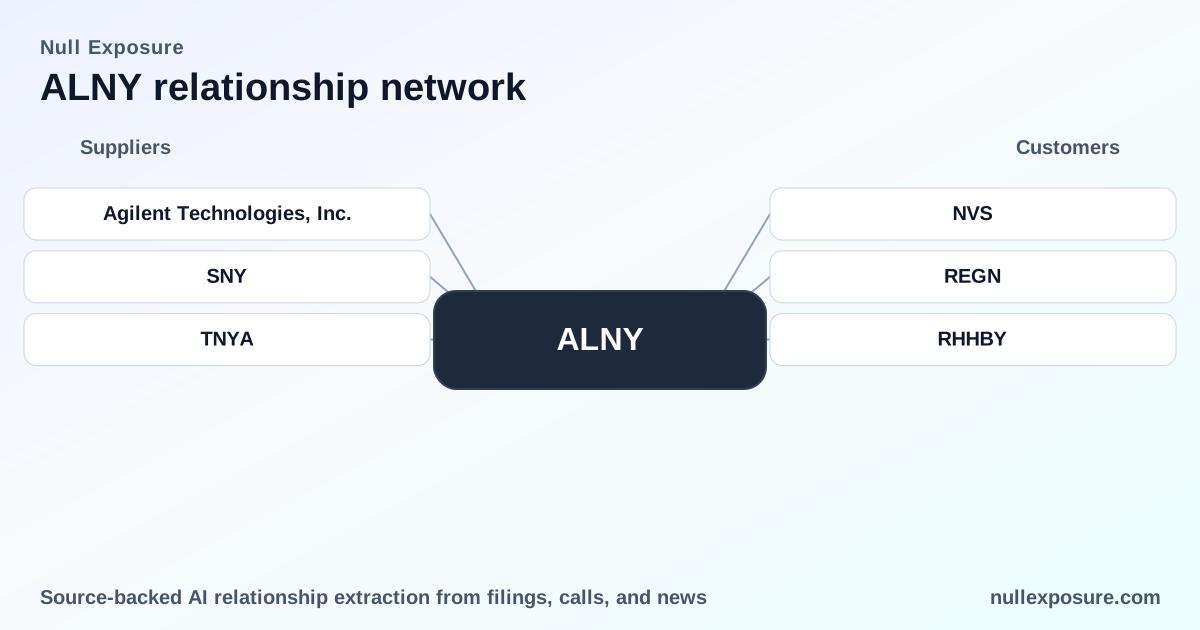
Alnylam Pharmaceuticals (ALNY): Supplier relationships that shape product continuity and margin risk
Alnylam operates by discovering, developing and commercializing RNA interference (RNAi) therapies and monetizes primarily through product sales and license-derived economics — including royalties and collaboration payments tied to approved drugs such as AMVUTTRA, ONPATTRO and GIVLAARI. Supply-chain execution and third‑party licensing materially influence gross margins and launch readiness, because Alnylam outsources key manufacturing and pays royalties under collaboration agreements that scale with revenue.
Read the full supplier intelligence offering at https://nullexposure.com/ for an interactive view of these relationships and primary-source evidence.
Where the supplier risk is concentrated: one manufacturer, multiple economic partners
Alnylam’s operating model mixes internal R&D with outsourced manufacturing and licensing commitments. That hybrid posture produces three practical characteristics for investors and operators:
- Concentration and criticality: a single contract manufacturer produces the active pharmaceutical ingredient (API) for multiple marketed products, creating a single‑point-of-failure risk for supply continuity and margin stability.
- Contracting posture and maturity: Alnylam relies on multi‑year manufacturing services agreements and ongoing third‑party collaborations; several signals point to long‑term commitments that support volume planning but reduce flexibility.
- Economic coupling: royalty and collaboration mechanics transfer margin volatility to counter‑parties as revenues scale — a commercial lever that can compress or preserve operating profitability depending on product mix.
If you want a concise map of counter‑party exposure and the documents behind it, visit https://nullexposure.com/ to see the primary filings and news links.
Key takeaways for investors and operators
- Agilent is the sole API manufacturer for multiple Alnylam products, making supply concentration the primary operational risk.
- Sanofi royalty mechanics are a direct driver of reported margin movement as AMVUTTRA revenue grows.
- Tenaya is a discovery‑stage strategic supplier: a modest upfront payment secures target access rather than manufacturing capacity.
Supplier relationships — the complete list and what each partner means to Alnylam
Agilent Technologies, Inc.
Agilent is contracted as the sole manufacturer of the API for AMVUTTRA, ONPATTRO and GIVLAARI, and Alnylam has manufacturing services agreements with Agilent to secure that supply; this creates a concentrated manufacturing dependency that is operationally critical for marketed products. According to Alnylam’s FY2025 Form 10‑K, Agilent is the exclusive API manufacturer for those products and is bound by manufacturing services agreements (FY2025 10‑K filing, filed February 2026).
Source: Alnylam FY2025 Form 10‑K (manufacturing services agreement language reported in the FY2025 filing).
Sanofi
Sanofi receives royalties tied to AMVUTTRA sales; higher AMVUTTRA revenue in 2025 raised the average royalty rate Alnylam paid and was cited as a primary driver of decreased margins. That economic link directly affects reported profitability as product volumes scale. The link between rising AMVUTTRA revenues and increased royalty expense was discussed in a Q4 2025 earnings call transcript summarized by InsiderMonkey (March 2026).
Source: Q4 2025 earnings call coverage, InsiderMonkey (reported March 2026).
Tenaya Therapeutics
Alnylam paid a $10 million upfront to secure access to 15 genetic targets for heart disease, reflecting a discovery‑stage collaboration where Alnylam acquires target access rather than clinical manufacturing or commercialization rights at this stage. This is a strategic, early‑stage deal that expands Alnylam’s R&D funnel rather than its near‑term supply obligations. Pharmaceutical-Technology reported the agreement details in March 2026.
Source: Pharmaceutical‑Technology news report (March 2026).
What the constraints signal about Alnylam’s supplier strategy
The primary constraints extracted from filings and disclosures give a practical portrait of how Alnylam manages supplier relationships:
- Long‑term contracting is present at the company level: evidence such as multi‑year commitments and facility lease terms points to an enterprise posture that favors contractual stability over short-term sourcing flexibility (company-level signal drawn from corporate filings).
- Manufacturing role explicitly assigned to Agilent: the 10‑K states Agilent is the sole API manufacturer for several products, which translates to high supplier concentration and operational criticality for production of marketed RNAi therapies.
- Service provider relationships and data processing arrangements are active company‑wide: Alnylam uses multiple third parties for services that include processing personal data under contractual obligations — a signal about the maturity of their vendor governance and the need for compliance oversight.
- License relationships and R&D access deals are part of the business model: licensing patent rights and buying target access (as with Tenaya) are recurring elements of how Alnylam replenishes its pipeline and collaborates externally.
- Active multi‑year manufacturing commitments: Alnylam expects continued reliance on contract manufacturing organizations (CMOs) across marketed products and pipeline candidates for the next several years, indicating both ongoing outsourcing strategy and limited near‑term insourcing plans (company-level signal).
Together these constraints describe a company that accepts concentrated manufacturing risk for product continuity, uses licensing and discovery partnerships to expand pipeline, and manages data/service vendors under formal contractual standards.
Risk implications and what to watch next
- Operational continuity risk: with Agilent the sole API manufacturer for multiple products, monitor Agilent’s capacity plans, change‑control notices and any regulatory inspections that could disrupt supply. A manufacturing interruption would directly affect revenue for products that currently drive much of Alnylam’s top line.
- Margin sensitivity to collaboration economics: royalty mechanics with Sanofi show that margin performance is not purely internal — earnings will be sensitive to revenue growth on products that carry external royalty rates. Investors should model royalties as a variable, not a fixed cost.
- Pipeline replenishment cadence: small upfront discovery deals such as the Tenaya agreement expand Alnylam’s target inventory but do not materially change short‑term manufacturing exposure; they are a lower operational risk but a higher optionality play for future assets.
For a practitioner’s access to source documents and an at‑a‑glance supplier map, visit https://nullexposure.com/.
Final investor‑operator checklist
- Confirm Agilent’s contract terms, capacity commitments and any exclusivity clauses in the FY2025 10‑K.
- Incorporate Sanofi royalty escalation into forward margin scenarios for AMVUTTRA.
- Treat discovery deals like Tenaya as optionality for future revenue rather than current supply mitigation.
If you evaluate counterparty operational risk or need primary‑document verification for supplier diligence, get document‑level access and visual relationship mapping at https://nullexposure.com/.
Bold conclusion: Alnylam’s growth story is driven by marketed RNAi products and a pipeline funded through licensing and collaborations — but supply concentration with Agilent and royalty economics with Sanofi are material factors that will determine near‑term continuity and margin evolution.