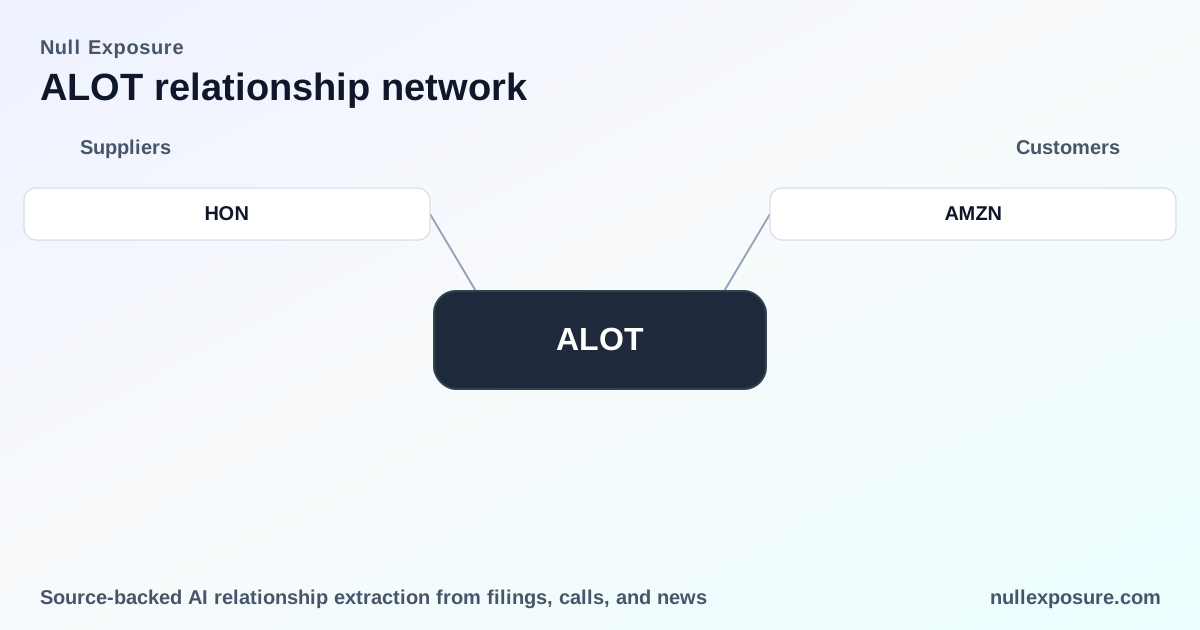
AstroNova (ALOT) — Supplier relationships that drive margin leverage and concentration risk
AstroNova monetizes through the sale of specialty printers and data-acquisition systems to industrial and aerospace customers, plus after-market parts, service and licensed production agreements that generate recurring and segment-level cash flow. Revenue combines product sales with licensed manufacturing and royalties, producing a capital-light aerospace segment that contributes outsized operating income today and margin upside as legacy royalties roll off. Investors should evaluate supplier and licensing relationships for both continuity of supply and the structural margin effects of expiring third‑party charges.
Learn more about supplier analytics and relationship risk at https://nullexposure.com/.
How AstroNova’s business model actually works in practice
AstroNova sells hardware (printers) and instrumentation alongside replacement parts and services, with manufacturing partly subcontracted to independent third parties and some components sourced from limited suppliers. This hybrid model creates direct product margin plus aftermarket annuity streams, while elevating operational dependence on a small set of external vendors. For FY2025 the company reported revenue of roughly $151.6 million and gross profit of about $51.1 million, with operating margin thin but positive at roughly 3.3% on trailing twelve‑month results, underscoring how supplier cost and licensing dynamics materially affect profitability (company Form 10‑K and FY2025 results).
Supplier relationships disclosed — the complete list from available signals
This section covers every relationship surfaced in the research results.
Honeywell
AstroNova holds an exclusive, perpetual, worldwide license to manufacture Honeywell’s narrow‑format flight deck printers for two aircraft families under an Asset Purchase and License Agreement executed in fiscal 2018; royalty payments under that arrangement have been significant historically but are scheduled to expire over the next few years, removing a recurring cost burden for the aerospace segment. According to AstroNova’s Form 10‑K for FY2025 and a news summary citing that filing, the Aerospace segment generated over $11 million in segment operating income in FY2025 with segment EBITDA near $12.5 million, and royalty obligations to Honeywell are set to lapse under the original acquisition terms. (Company Form 10‑K FY2025; Livingston Daily coverage referencing the 10‑K, March 2026.)
Contracting posture, concentration and operational constraints investors should read first
The public record shows a mix of long‑dated financing, material vendor concentration, and non‑cancelable purchase commitments that together shape procurement risk and operational flexibility.
- Long‑term committed financing: In January 2024 AstroNova entered a secured equipment loan facility for $0.8 million that matures in January 2029 at a fixed 7.06% interest rate, signaling multi‑year capital commitments to support production equipment and limited refinancing flexibility in the near term (company disclosures).
- Licensing is a structural element of margin: The fiscal‑2018 Asset Purchase and License Agreement with Honeywell is a contract that transferred manufacturing rights and created royalty flows; the scheduled expiration of significant royalties directly improves future aerospace segment margins (license agreement language and FY2025 10‑K).
- Supplier concentration is material to operations: The company disclosed a vendor that accounted for 13.3%, 46.9% and 16.2% of accounts payable as of January 31, 2025, 2024 and 2023 respectively, and two vendors that together accounted for 27.3% and 23.5% of purchases in recent years; single‑source dependence is a clear operational vulnerability (Form 10‑K disclosures).
- Outsize committed spend near term: Purchase commitments totaled $29.0 million at January 31, 2025, with $27.4 million due within 12 months and some non‑cancelable, creating short‑term cash outflow rigidity and vendor lock‑in (company filings).
- Manufacturing posture: AstroNova subcontractsthe manufacturing and assembly of certain products to independent third parties, indicating operational reliance on external production capacity and quality control outside its direct factory footprint (company disclosures).
These constraints collectively signal a procurement posture that is concentrated, somewhat inflexible in the near term, and highly sensitive to supplier pricing and availability. For investors and procurement teams, the combination of non‑cancelable commitments and single‑vendor concentration is the primary operational risk vector.
Explore supplier concentration and contract maturity dashboards at https://nullexposure.com/ for tailored due diligence.
What this means for valuation and operational diligence
Two opposing forces define the investment and operational thesis:
- Positive structural margin tailwind: The scheduled expiration of Honeywell royalties reduces an external drag on aerospace margins and supports higher segment EBITDA going forward; management reported meaningful aerospace profitability in FY2025 that should expand as legacy royalty payments fall away (Form 10‑K, FY2025; press coverage March 2026).
- Concentration and liquidity friction: Vendor concentration, non‑cancelable purchase commitments of $29.0 million and a multi‑year equipment loan create execution risk if demand softens or suppliers tighten terms. AstroNova’s market capitalization (~$66.5 million) and negative EPS highlight limited margin cushion against operational shocks.
Practical actions for investors and operators:
- Conduct contract-level due diligence on the Honeywell license to confirm the exact expiration mechanics and any residual obligations.
- Prioritize supplier replacement feasibility and elasticity analysis for the vendors that dominate accounts payable and purchases.
- Stress test cash flow against $27.4 million of near‑term purchase commitments and the equipment loan repayment profile.
- Require monthly monitoring of aerospace segment EBITDA and post‑royalty margin realization.
Bottom line: actionable takeaways
- Honeywell relationship is both an asset and a lever — the license built AstroNova’s aerospace capability and the expiry of royalties materially improves future margins (10‑K disclosures; news reporting March 2026).
- Supplier concentration is a real operational risk that can amplify any demand shock or component price inflation; purchase commitments create short‑term rigidity.
- Due diligence should focus on contract terms, replacement cost, and cash flow stress testing before increasing exposure.
For deeper, relationship‑level intelligence and contract maturity visualization, visit https://nullexposure.com/ to request tailored analysis.
AstroNova is a small‑cap industrial with a clear path to improved aerospace profitability but carries concentrated supplier risk and committed spend that require active monitoring by investors and operators. Learn more about supplier risk scoring and monitoring at https://nullexposure.com/.