Alarm.com (ALRM) — supplier relationships that drive hardware, cloud and energy strategy
Alarm.com monetizes a cloud-to-edge security and automation platform by selling subscription services on top of proprietary and third-party hardware; recurring revenue from monitored residential and commercial customers is complemented by device sales and strategic acquisitions that expand functional reach (video analytics, energy management, commercial automation). The firm earns through a hybrid model: high-margin software subscriptions and services layered over lower-margin but strategically critical hardware procurement and third‑party service contracts.
For a deeper supplier-risk briefing and marketplace comparison, visit https://nullexposure.com/.
Why supplier posture matters for ALRM investors
Alarm.com’s business is structurally dependent on two supplier categories: hardware manufacturers that deliver modules and gateways and service providers that host or transport data for core cloud features (video processing, wireless connectivity, energy services). The company’s profit profile is driven by subscription growth and device attach rate, but supplier relationships determine unit economics, delivery cadence, and product roadmap cadence. Investors should evaluate supplier concentration, contracting terms, and integration risk with the same rigor applied to SaaS vendors’ cloud providers.
What the company disclosed about key partners and strategy
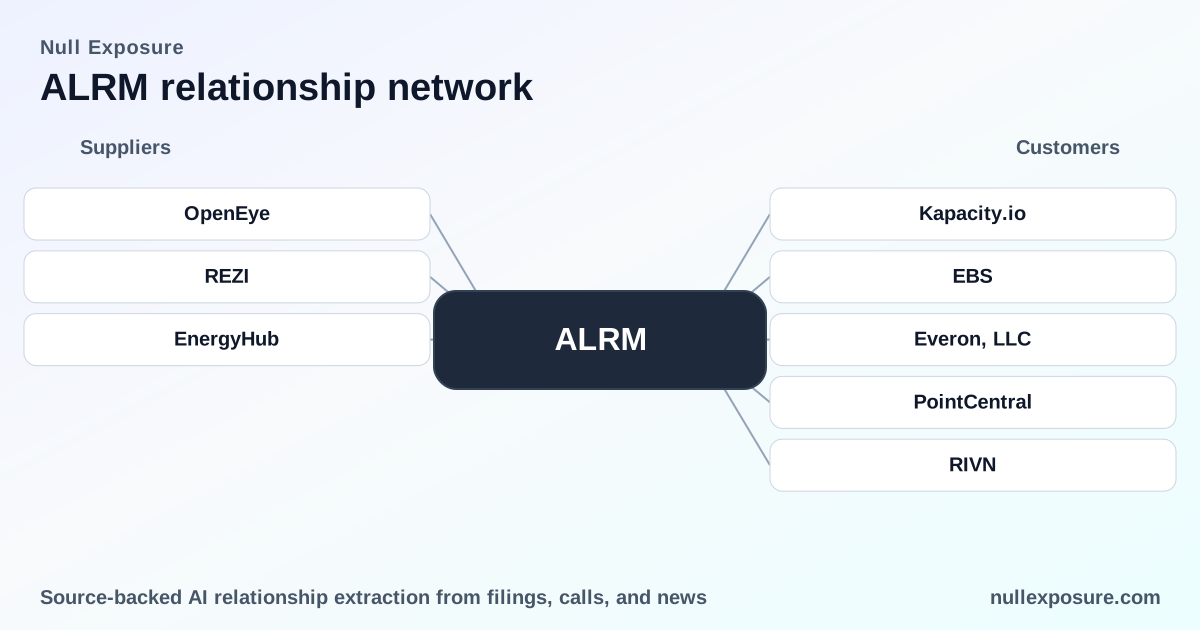
Alarm.com referenced three partner brands in recent communications: OpenEye, Resideo Grid Services (RGS), and EnergyHub. Each relationship plays a discrete role in the company’s commercial and product expansion strategy.
OpenEye — commercial video and integrator channel expansion
Alarm.com cited OpenEye in its 2025 Q4 earnings call as a platform complement that helps drive adoption of its commercial offerings among service providers. OpenEye is positioned as a partner to accelerate Alarm.com’s commercial video and property automation penetration among existing and new integrators. According to the 2025 Q4 earnings call, Alarm.com will leverage functional advantages across both platforms to cross-sell to service providers (2025 Q4 earnings call, March 2026).
Resideo Grid Services (RGS) — energy services acquisition to scale EnergyHub
Alarm.com announced that it acquired Resideo Grid Services late in 2025 to accelerate scale for its EnergyHub business line. RGS is an inorganic lift to build out Alarm.com’s energy management capabilities and enterprise-grade grid services, supporting demand-response and utility integrations. The acquisition was disclosed on the 2025 Q4 earnings call as a deliberate step to accelerate EnergyHub scale (2025 Q4 earnings call, March 2026).
EnergyHub — platform for energy management and AI-driven services
Media coverage in FY2026 highlighted Alarm.com’s expansion into AI-driven video analytics and energy management via EnergyHub. EnergyHub is the vector for Alarm.com’s push into energy services and enterprise automation, complementing security and video with utility-grade functionality. News coverage in March 2026 described the company’s portfolio expansion through EnergyHub as central to its strategy for energy management solutions (InsiderMonkey, March 2026; Bitget news recap, March 2026).
Company-level supplier constraints and what they mean for value and risk
Alarm.com’s public disclosures present a clear supplier profile: concentrated, contract-manufactured hardware procurement; dependency on wireless carriers and third-party cloud/video processors; and active, material supplier relationships with large spend commitments. These are company-level signals that affect operations and valuation.
- Concentration risk and spend scale: Alarm.com reported three key hardware suppliers that collectively accounted for 46% of hardware revenue in 2024 (29%, 10% and 7% splits). This concentration translates into meaningful single- or limited-source risk and supports the disclosed spend band that implies supplier expenditure in excess of $100 million annually.
- Contracting posture: Hardware procurement is conducted on a purchase-order basis with contract manufacturing partners; modules and gateways are designed in-house and manufactured under contract in the United States. This contracting model secures IP control but concentrates execution risk in a small set of manufacturers.
- Criticality of service providers: Alarm.com depends on wireless carriers for machine-to-machine connectivity and on third-party technology providers for video processing and storage. These providers are operationally critical: interruptions or cost escalation in network or video services directly affect service availability and margins.
- Relationship stage and maturity: Supplier relationships are active and operationally embedded; the company references active procurement of components and ongoing integrations. Mature, long‑standing relationships reduce onboarding risk but increase vendor lock-in exposure.
These constraints imply a supplier risk premium should be applied to operational forecasts when modeling: inventory lead times, gross margin sensitivity to component costs, and the potential capital required to internalize critical capabilities are all salient valuation drivers.
How these supplier dynamics influence investment and operational decisions
Alarm.com’s supplier posture creates both leverage points and vulnerabilities for investors and operators:
- Operating leverage: The subscription-based economics mean device procurement supports scalable recurring revenue growth—however, supplier concentration caps upside if shortages or price shocks force higher unit costs or slower shipping.
- Strategic M&A as a hedge: The RGS acquisition demonstrates that Alarm.com is using M&A to internalize capability and scale new service lines, which reduces go-to-market risk for energy services while increasing integration execution risk.
- Channel and co-sell dynamics: Partnerships like OpenEye enable faster commercial adoption through channel partners without ALRM assuming direct sales expense, preserving margins while expanding addressable market.
For portfolio managers and operators: evaluate supplier contract length, termination clauses, price-pass-through mechanics for connectivity and video services, and contingency plans for alternative manufacturing. For actionable vendor diligence templates and supplier concentration scoring, explore the supplier intelligence hub at https://nullexposure.com/.
Investment takeaway and recommended next steps
Alarm.com is a subscription-first platform with hardware and third-party service dependencies that materially influence margin and delivery risk. The company has taken strategic steps—acquisition of RGS and integration with EnergyHub—to diversify product capability and reduce time-to-market for energy services, while channel plays like OpenEye support commercial expansion.
Recommended actions:
- Model a supplier concentration scenario that stresses hardware gross margins and extends delivery cycles by 1–2 quarters.
- Request counterparty contract summaries during diligence: manufacturer lead times, PO terms, and exclusivity clauses.
- Monitor service-provider SLAs and pricing clauses for wireless and video processing services; factor potential pass-through costs into ARR unit economics.
For a tailored supplier risk assessment and comparative benchmarking, go to https://nullexposure.com/.
Final note
Alarm.com’s supplier relationships are strategic and material to its operating model: concentration and critical service dependencies are offset by subscription scale and selective M&A, but investors must price supplier execution risk directly into growth and margin assumptions. For a concise supplier-risk briefing and scorecard you can share with investment committees, visit https://nullexposure.com/.