Alerus Financial (ALRS): Supplier and funding relationships that shape capital and operational risk
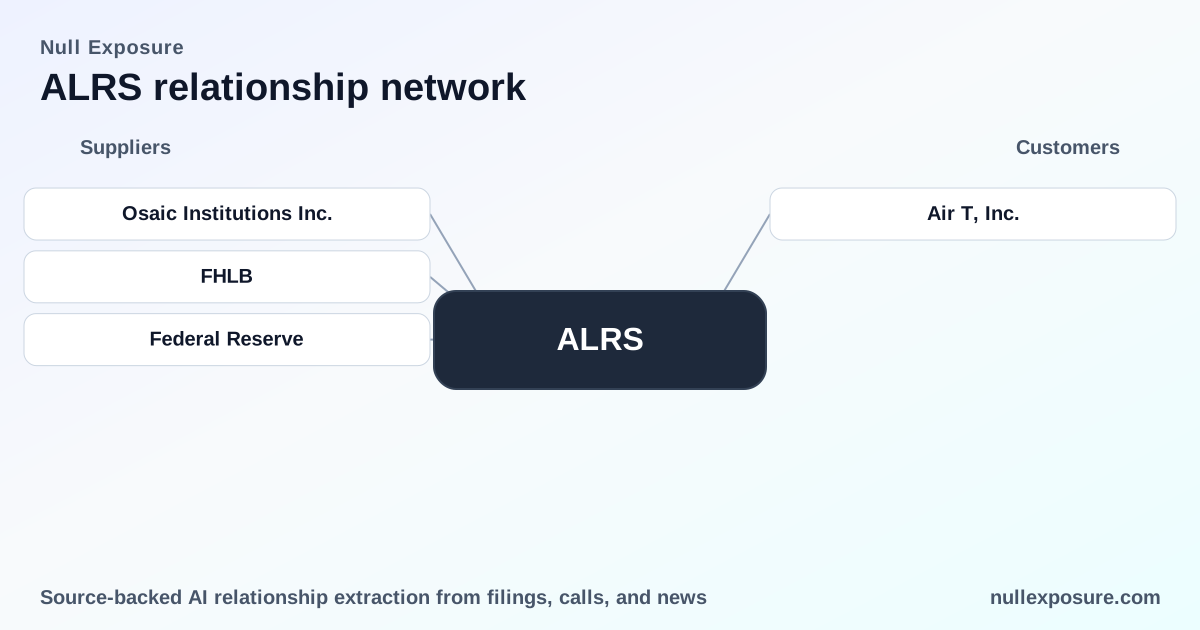
Alerus Financial Corporation operates as a regional financial holding company that monetizes through its banking subsidiary via net interest income, fee-based services, and wealth-management and retirement plan revenues; the parent extracts value primarily through dividends from the bank while managing liquidity with a mix of short-term and long-term borrowings. This note maps the supplier and funding counterparties disclosed in public filings and news, explains how those relationships support day-to-day operations, and flags the concentration and criticality signals that investors should prioritize.
For a complete view of counterparty exposures and structured supplier intelligence visit https://nullexposure.com/.
How Alerus sources funding and outsources key services — a concise investor view
Alerus funds growth and liquidity with a blended strategy: short-term borrowings (FHLB advances, fed funds) for tactical liquidity and longer-term debt for asset funding and regulatory capital. At the same time, the bank outsources core operational technology — online banking, mobile platforms and data processing — making certain third-party providers effectively critical operating partners. The company has also used central bank programs during stress periods and subsequently repaid those facilities, illustrating active balance-sheet management.
- Contracting posture: Alerus uses both short-term and long-term contracts; short-term funding is explicit in public disclosures while long-term debt supports longer-dated assets and regulatory capital positioning.
- Concentration and criticality: The company identifies core banking and information services vendors as hard-to-replace, elevating vendor concentration and operational risk.
- Maturity profile: Evidence shows recent use of short-duration liquidity (fed funds, FHLB advances) and previous participation in the Bank Term Funding Program (BTFP) that was repaid in 3Q 2024 — an operational pattern consistent with an active asset/liability team managing rate and liquidity cycles.
- Spend signals: Public excerpts disclose both modest regulated expenses (hundreds of thousands) and very large funding lines (hundreds of millions), indicating a bifurcated spend profile by category.
If you want a systematic supplier breakdown and scored counterparty exposures, see https://nullexposure.com/ for structured coverage.
Counterparty summaries: what every relationship in public results means for the company
Below are the relationships disclosed in the collected results, each rendered in plain English with source context.
-
Osaic Institutions Inc.
Alerus selected Osaic for a banker-focused model that augments compliance resources, technology and relationship-management services — signaling a strategic outsourcing choice for advisory and distribution functions. Source: PlanAdviser coverage of the transaction announcement (Nov 5, 2025), https://www.planadviser.com/advisory-ma-news-11-5-2025/. -
Federal Home Loan Bank (FHLB)
FHLB advances are an active element of Alerus’s short-term funding mix; public filings show FHLB advances in the region of $200 million as part of the company’s balance-sheet funding as of year‑end disclosures. Source: Alerus press release with year‑end results (GlobeNewswire, Jan 28, 2026), https://www.globenewswire.com/news-release/2026/01/28/3228085/0/en/alerus-financial-corporation-announces-fourth-quarter-2025-results-including-balance-sheet-repositioning.html. -
Federal Reserve (fed funds and BTFP activity)
The company used Federal Reserve‑linked facilities (fed funds purchased and the BTFP) for short-term liquidity and recorded positions in those instruments; Alerus repaid its outstanding BTFP borrowings in the third quarter of 2024, underscoring both usage and subsequent deleveraging. Source: Alerus fourth-quarter results and balance-sheet note (GlobeNewswire, Jan 28, 2026), https://www.globenewswire.com/news-release/2026/01/28/3228085/0/en/alerus-financial-corporation-announces-fourth-quarter-2025-results-including-balance-sheet-repositioning.html.
What the relationships collectively say about risk and resilience
These relationships and the associated disclosures create a coherent picture:
- Liquidity management is active and market‑sourced. The mix of fed funds purchases and FHLB advances positions Alerus to adjust funding quickly to market conditions; the presence of $200M-scale FHLB usage indicates material reliance on wholesale secured advances (source: GlobeNewswire, Jan 28, 2026).
- Operational criticality is concentrated in software and service providers. Alerus explicitly states it outsources major systems (online and mobile banking, data processing), which increases vendor concentration risk and elevates operational dependency on a small set of service providers.
- Contract maturity mix supports flexibility but creates roll‑over exposure. Short-term borrowings reduce interest-rate duration risk but create periodic refinancing points; the existence of long-term debt for capital purposes balances that, yet adds structural obligations to the capital stack.
- Regulatory and supervisory costs are visible but limited in absolute terms. The firm recorded regulatory and supervisory payments in the mid‑hundreds of thousands, indicating recurring compliance spend but not at a scale that competes with wholesale funding needs.
Practical implications for portfolio managers and operators
- Monitor wholesale funding concentrations. The FHLB position is large enough to deserve tracking through stress cycles and collateral availability changes; a material swing in access to FHLB advances would force balance-sheet adjustments.
- Prioritize vendor resilience tests. Given the outsourcing of core banking systems, investors should expect tight vendor-management disclosure and periodic third‑party risk assessments from the company.
- Watch funding cost trajectories. Short-term borrowing exposes the firm to rate volatility; management’s ability to switch between fed funds, FHLB, and term debt drives earnings stability.
For a deeper supplier mapping and to see how these counterparties score across liquidity and operational risk dimensions visit https://nullexposure.com/.
Bottom line: strategic outsourcing and market funding define ALRS’s supplier surface
Alerus runs a capital-light front office supported by a capital-intensive balance sheet: core banking functions depend on third-party software and services, while liquidity is sourced from market facilities such as FHLB advances and fed funds. That combined posture produces both operational concentration risk and funding roll‑over exposure — two factors that will drive near-term variability in earnings and capital deployment decisions.
If you are underwriting ALRS or benchmarking regional-bank supplier risk, the next steps are clear: confirm third‑party continuity plans, stress FHLB/fed funds access under adverse scenarios, and monitor disclosures tied to vendor incidents or changes in funding mix. For portfolio-level supplier intelligence and ongoing monitoring, start at https://nullexposure.com/.