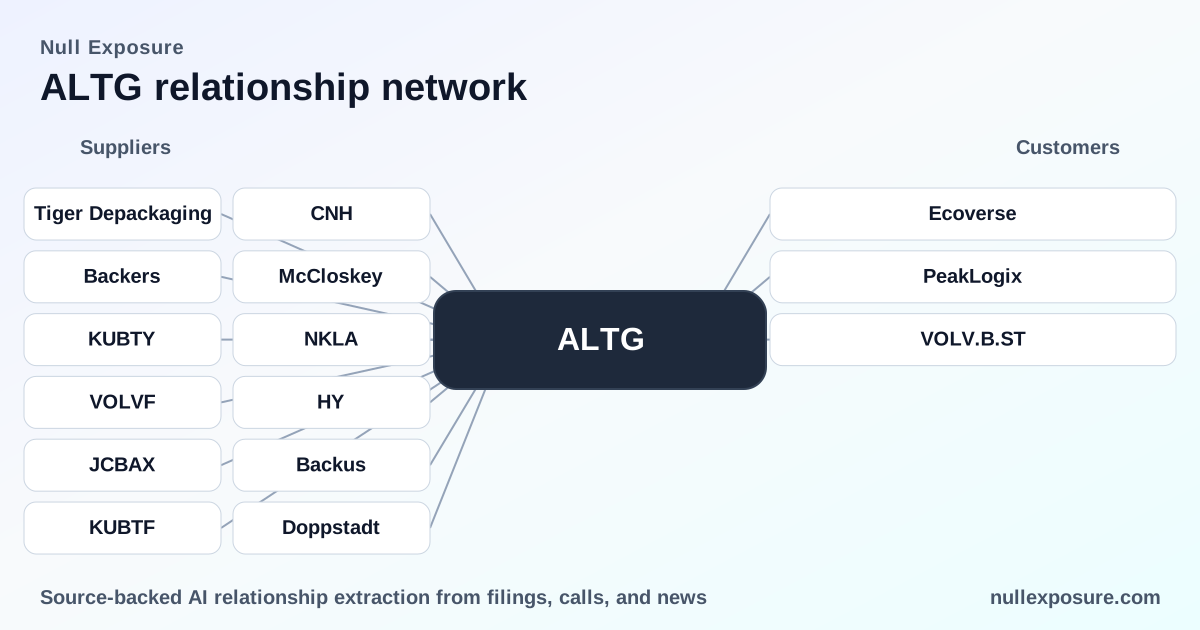
Alta Equipment Group (ALTG): Supplier map, concentration and commercial posture
Alta Equipment Group owns and operates integrated equipment distribution platforms across North America, monetizing through new and used equipment sales, rental fleets, parts and service, and exclusive master dealer arrangements for niche environmental processing OEMs. The company generates recurring aftermarket revenue by investing in rental fleets and territory-specific product mixes under long-term exclusive OEM agreements, and it relies on a concentrated set of major manufacturers for the majority of equipment and parts purchases.
Explore supplier intelligence and relationship analytics at https://nullexposure.com/ to validate counterparties and contractual footprints.
How Alta contracts with manufacturers and why that matters
Alta operates as a territorial, exclusive dealer network operator: the company holds long-term, exclusive distribution agreements in designated counties, states or provinces, which allow Alta to invest in rental fleets and prioritize product mixes that drive wallet share with customers. Alta’s 2024 Form 10‑K explicitly states these contractual arrangements, describing them as long-term and territory-specific and positioning Alta to grow market share in covered geographies.
Those contracts translate into a few structural business model characteristics:
- Contracting posture — long-term, exclusive dealer agreements support capital deployment into rental fleets and service infrastructure, aligning Alta’s incentives with OEMs on end-customer success.
- Concentration — material supplier concentration: Alta purchased roughly 58% of equipment and parts in FY2024 from five OEMs, creating a clear single‑point dependency to monitor.
- Counterparty stature and criticality — leading large OEMs are the counterparties, meaning Alta’s supply lines are with established manufacturers whose product availability and pricing materially affect Alta’s margins and uptime.
- Maturity — relationships are longstanding; the company reports mature, enduring ties with several OEMs that form the backbone of its commercial footprint.
These are company-level signals drawn from Alta’s public disclosures and acquisition press releases; they define negotiating leverage, capital intensity and the operational risk surface for investors.
Supplier relationships you need to know — straight to the evidence
Below is a concise, investor‑facing list of every supplier relationship cited in public materials in our set. Each entry is a plain-English summary plus a source.
Volvo
Alta purchased a significant portion of equipment and parts from Volvo as one of five major OEMs that accounted for approximately 58% of such purchases in FY2024, underscoring Volvo’s material role in Alta’s inventory and parts sourcing (Alta 10‑K, FY2024).
Hyster‑Yale Group
Alta identifies Hyster‑Yale among its five major equipment and parts suppliers in FY2024 and also notes long-standing dealer relationships across regional subsidiaries, signaling both volume and tenure with Hyster‑Yale (Alta 10‑K, FY2024).
Kubota
Alta’s acquisitions have expanded its relationship with Kubota and strengthened product offerings in core markets; management cited Kubota as a “world‑class OEM” in connection with a regional dealer acquisition (DBusiness, FY2021).
CNH
CNH is listed by Alta as one of the five major OEMs supplying equipment and parts during FY2024, placing CNH in the material supplier cohort that drives over half of Alta’s purchased product volume (Alta 10‑K, FY2024).
JCB
JCB is among the five major OEMs supplying Alta in FY2024; inclusion in that top group highlights JCB’s material contribution to Alta’s sales and parts mix (Alta 10‑K, FY2024).
McCloskey
When Alta acquired Ault Industries in 2023, it assumed Ault’s exclusive dealer agreement with McCloskey, securing a best‑in‑class position in crushing and screening products for Alta’s construction equipment segment (GlobeNewswire press release, Nov 2, 2023).
Nikola Corp.
Alta eMobility entered an exclusivity arrangement to sell and service Nikola Tre battery‑electric and hydrogen fuel cell trucks in Michigan, expanding Alta’s electric/hydrogen commercial vehicle offering and growing Nikola’s dealer footprint nationally to 12 states per the company release (Fleet Equipment Magazine, FY2023).
Doppstadt
As part of Alta’s acquisition of Ecoverse Industries, Alta obtained exclusive North American distribution rights for Doppstadt, giving Alta master dealer status for Doppstadt environmental processing equipment (CityBiz/DBusiness coverage, FY2022).
Backus
Alta’s Ecoverse purchase included exclusive North American distribution rights for Backus, adding specialized environmental processing product lines to Alta’s portfolio and strengthening aftermarket and service opportunities (CityBiz/DBusiness coverage, FY2022).
Backers
The Ecoverse transaction also conferred exclusive North American distribution for Backers, positioning Alta as the primary commercial channel for that OEM on the continent (CityBiz/DBusiness coverage, FY2022).
Tiger Depackaging
Tiger Depackaging was included in the Ecoverse master dealer rights granted to Alta, expanding Alta’s reach into specialized processing equipment for recycling and material recovery (CityBiz/DBusiness coverage, FY2022).
What investors and operators should infer from the supplier map
Concentration is both a strategic lever and a risk. Owning exclusive dealer positions with leading OEMs and purchasing 58% of equipment from five manufacturers gives Alta scale advantages — improved pricing, coordinated product programs and efficient rental fleet planning — while exposing the company to supplier-specific shocks, recall events, or adverse OEM pricing. Alta’s long-term, territory-based contracts create predictable capital planning but also embed renewal and contractual risk over time.
Service and aftermarket are defensive profit centers. Long-term OEM relationships plus master dealer rights for environmental processors create recurring parts and service revenue streams that stabilize margins versus one‑time equipment sales.
Electrification and new powertrains are an operational inflection. The Nikola relationship demonstrates Alta’s strategic response to EV/H2 commercialization; dealer-level service capability for alternative powertrains will become a competitive differentiator and a source of upfront investment.
Explore Alta’s counterparty footprint and contract posture in depth at https://nullexposure.com/ to align portfolio risk and operational diligence.
Operational watchlist and actionable diligence items
- Confirm the term lengths and renewal mechanics of Alta’s exclusive dealer agreements and any change‑of‑control or termination clauses that could accelerate supplier risk.
- Quantify purchase concentration beyond the headline 58%: split by OEM, by region and by product class to model stress scenarios.
- Validate inventory financing and OEM floor‑plan exposure, including any supplier‑backed credit lines or consignment arrangements.
- Assess service capability for electrified platforms (Nikola) and the capital required to scale battery/hydrogen service networks.
- Review integration risk from acquisitions (Ecoverse, Ault) where master dealer rights transferred and whether contractual exclusivity is contractual or operational.
Bottom line and next steps
Alta’s commercial model leverages exclusive, long‑term OEM contracts and a concentrated supplier base to build rental fleets, aftermarkets and niche master dealer franchises; that structure delivers growth optionality and recurring revenue while concentrating supplier risk. For institutional investors and operators, priority diligence should focus on contract terms, concentration metrics and service capability for new powertrain platforms.
For a disciplined review of supply concentration and contractual exposure, visit https://nullexposure.com/ and benchmark Alta’s supplier relationships against peer dealer networks.