Allurion Technologies (ALUR): Supplier Relationships, Risks, and Strategic Takeaways for Investors
Allurion Technologies develops a weight‑loss platform centered on the Allurion Balloon and related consumables and services; it monetizes through device sales, consumable accessories, and associated clinical and telehealth programs. The company's operating model is product‑centric with a lean balance sheet and periodic capital market activity to fund operations and growth initiatives. Investors evaluating ALUR should prioritize supplier concentration, single‑source manufacturing risk, and the company’s recent capital‑markets engagements when assessing counterparty exposure.
Explore more supplier analytics at NullExposure.
How Allurion sources and why that matters to returns
Allurion’s public disclosures explicitly state that suppliers operate under a predominantly spot contracting posture: suppliers have no contractual obligation to provide components and Allurion is not contractually obligated to purchase from them. That posture creates operational flexibility for pricing but introduces volatility and execution risk when supply tightness or single‑source failures occur.
Company filings also identify a high degree of concentration: several components and sub‑assemblies are sourced from single suppliers and are described as critical to product functionality. The disclosures name extruded film for the Allurion Balloon and items such as stylets, filler kits, accessories, and scales as dependent on a limited supplier base. This structure elevates the probability that production interruptions, price shocks, or quality events will directly compress revenues and margins.
Finally, Allurion uses third parties not only for manufacturing but also as service providers—notably for telehealth delivery partnerships and third‑party IT/security providers. That combination of outsourced manufacturing and outsourced clinical services creates two distinct operational dependency vectors: (1) physical supply continuity for devices and consumables, and (2) continuity and regulatory compliance of telehealth and patient interaction channels. Both vectors are material to revenue delivery and clinical outcomes.
Publicly observed relationships and what they signal
Below are every supplier/relationship mention surfaced in public reporting and press coverage. Each entry is followed by a concise plain‑English summary and a source citation.
-
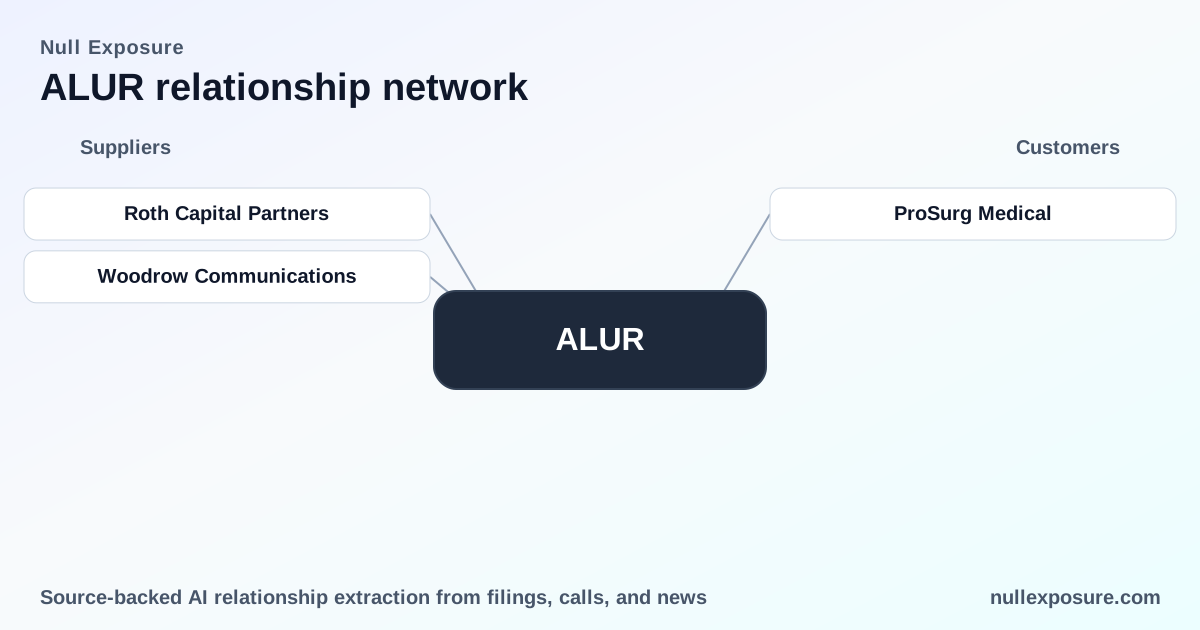
Roth Capital Partners — Allurion engaged Roth Capital Partners as a financial advisor in connection with a financing that lowered a warrant exercise price and issued new warrants; Roth will receive a 5.0% fee on gross proceeds plus up to $40,000 in expenses. This engagement signals active capital‑markets management to extend runway and adjust capital structure. According to TradingView coverage of the company’s announcement on March 9, 2026, the company also planned a resale registration for the new warrant shares within 60 days and raised approximately $3.0 million while issuing $5.32 million in new warrants (TradingView, March 9, 2026: https://www.tradingview.com/news/tradingview:88455389eb41c:0-allurion-lowers-warrant-exercise-price-to-1-15-raises-3m-and-issues-5-32m-new-warrants/).
-
Woodrow Communications (media/PR intermediary) — Allurion used Woodrow Communications as the contact for a press announcement about initial clinical results combining the Allurion program with low‑dose tirzepatide to optimize muscle mass and GLP‑1 adherence; the release included media contact details for Tara North. The same release was carried on BioSpace and republished on StockTitan, indicating a coordinated investor/market communications effort to highlight clinical progress (BioSpace press release, FY2025; StockTitan republication, March 9, 2026: https://www.biospace.com/press-releases/allurion-announces-initial-results-on-combining-the-allurion-program-with-low-dose-tirzepatide-to-optimize-muscle-mass-and-glp-1-adherence and https://www.stocktitan.net/news/ALUR/allurion-announces-initial-results-on-combining-the-allurion-program-cd8k7t4lpj3d.html).
What these relationships mean for supply‑side risk and operational resilience
Allurion’s manufacturing reliance and single‑sourcing profile is the core supplier risk. The company’s own language identifies single source suppliers for critical components and sub‑assemblies; those items are integral to the balloon product and associated kits. A single supplier disruption will directly impact shipment cadence and revenue recognition. Operational maturity indicators—such as the need to rely on third‑party telehealth providers and outsourced IT/security testing—underscore that Allurion runs a hybrid manufacturing/service model with outsourced delivery points that are critical to continuity.
Financially, Allurion is operating with limited market capitalization relative to its loss profile (Market Cap roughly $5.7 million; EBITDA negative ~$38.5 million; Revenue TTM ~$17.2 million). Capital raises and warrant restructurings—like the Roth Capital engagement—are not peripheral; they are core to maintaining supplier payments and service continuity. The financing actions observed confirm that capital markets support is an active lever to manage supplier exposure and working capital.
- Key operational implications for investors:
- Concentration risk is the principal supply vulnerability; contingency sourcing will be costly and time‑consuming.
- Spot contracting creates procurement flexibility but increases short‑term price and availability risk.
- Telehealth and IT service providers are material to the patient experience and regulatory compliance; service failures would reverberate across revenue and brand trust.
For immediate investor due diligence, prioritize supplier audit data, redundancy plans for extruded film and filler kits, and the company’s contractual terms with telehealth groups and IT/security vendors. Learn more supplier risk scoring and relationship mappings at NullExposure.
Tactical risk mitigation and what operators should press for
Operators and counterparties assessing ALUR relationships should demand:
- Clear documentation of second‑source validation for each critical component (extruded film, stylets, filler kits, etc.).
- Service‑level agreements or written continuity plans with telehealth and IT/security providers to ensure patient access and data protection.
- Transparency on inventory buffers and lead times for single‑source items to model cash needs and revenue sensitivity.
These actions convert the company’s disclosures from abstract risk statements into actionable mitigation that reduces the probability of sudden revenue shocks.
Bottom line: supplier concentration is the critical investment consideration
Allurion is a product‑and‑service provider with material single‑supplier exposures for core device components and an active need for external capital to support operations. The company’s public engagements—both in capital markets with Roth Capital Partners and in market communications via Woodrow Communications—signal an organization actively managing runway and market narrative while still dependent on a narrow supplier base. For investors, the dominant questions are supply redundancy, contract terms (spot vs. firm), and capital access—each of which materially affects downside risk.
For a deeper supplier‑level map and ongoing updates on ALUR counterparties, visit NullExposure.