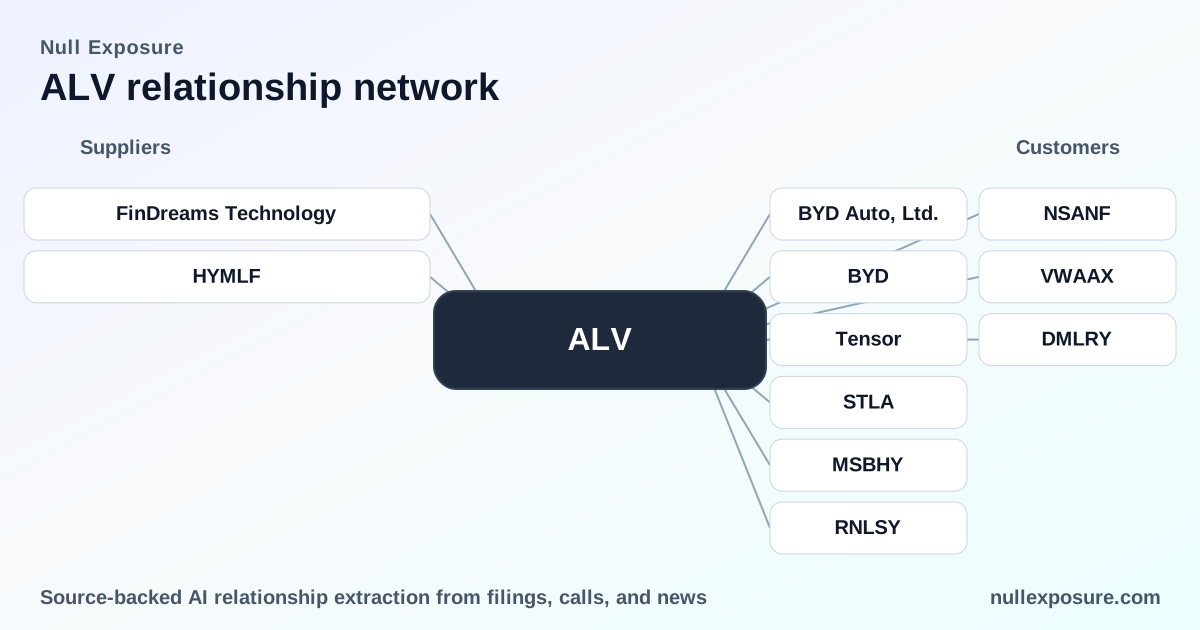
Autoliv (ALV) supplier footprint: what investors and operators need to know
Autoliv is a global designer, manufacturer and seller of automotive safety systems—airbags, seatbelts and related modules—and monetizes through OEM supply contracts, aftermarket parts and long-term program agreements tied to vehicle platforms. The company converts high-volume component flows into recurring revenue, while cash conversion is extended by industry-standard extended payables and significant supplier spend.
If you are evaluating ALV supplier counterparty risk or commercial opportunity, start with the company’s own disclosures and public reporting to understand where concentration and operational leverage sit. For deeper supplier-mapping and continuous monitoring, visit https://nullexposure.com/ for data-driven supplier intelligence.
Two concrete supplier relationships to track
Autoliv’s public documents and reporting mention a limited set of named counterparties in the supplier context. Below are the relationships surfaced in the available records, written in plain English with source references.
FinDreams Technology
Autoliv supplies components—specifically inflators—to FinDreams Technology under its production arrangements, indicating a direct upstream product flow from Autoliv into FinDreams’ systems. This relationship is documented in Autoliv’s FY2024 annual filing. (Source: Autoliv 2024 Form 10‑K.)
Hyundai
Media coverage raised a question during Autoliv’s Q4 2025 earnings call about whether Autoliv was a supplier in a Hyundai airbag recall, reflecting reputational and operational exposure to OEM safety events. The line of questioning was captured in an earnings-call transcript published in March 2026. (Source: earnings call transcript published on InsiderMonkey, March 2026.)
Constraints and what they reveal about ALV’s operating model
Autoliv’s supplier posture is best read through a few company-level signals disclosed in its filings. These constraints are not relationship-specific unless explicitly named; they instead characterize how Autoliv contracts and depends on external partners.
- Payment and contracting posture: Autoliv reports average payment terms of 117 days during 2024, which signals a supplier working-capital model that stretches payables relative to cash conversion. According to the FY2024 annual report, this is the company norm and shapes procurement negotiation dynamics.
- Materiality of suppliers: Direct materials constitute approximately 55% of net sales in 2024, making supplier continuity and material-cost inflation central to profitability and margin stability (Autoliv FY2024 filing).
- Spend concentration: Confirmed obligations outstanding at period-end are reported as $335 (reported figure), a signal of >$100m scale supplier commitments and concentrated procurement exposure that has balance-sheet and risk-management implications.
- Relationship roles and maturity: Autoliv functions predominantly as a buyer of supplier inputs and engages external service providers for functions such as information and payment facilitation (the filings reference S&P Global as an example of a service provider). The company records outstanding confirmed obligations in Accounts Payable until payment is effected, indicating active and ongoing contractual relationships (Autoliv FY2024 filing).
These constraints collectively describe an operator that runs large, material, and active supplier relationships, negotiates extended payment terms, and carries substantial confirmed obligations—features consistent with a mature OEM-tier procurement model. For procurement and treasury teams, the combination of high material share of sales and extended payables increases sensitivity to both supplier disruption and working-capital cycles.
For ongoing supplier risk monitoring and to convert these signals into operational action, consider a continuous supplier-coverage solution: https://nullexposure.com/.
What this means for investors and operators
- Operational risk is concentrated in commodity and component continuity. With direct materials at
55% of revenue, any sustained supplier disruption or raw-material inflation feeds directly to margins. Autoliv’s scale of confirmed obligations ($335 at period end) amplifies this exposure. - Recall and reputational risk is immediate and public. The Hyundai incident demonstrates that OEM recalls quickly surface in public markets and earnings calls; even a single OEM issue becomes a supply-chain and investor-relations event, affecting both orders and pricing leverage (earnings call transcript, March 2026).
- Working-capital posture could mask supplier stress. Long average payment terms (117 days) provide Autoliv with short-term liquidity benefits but can transfer cash pressure to suppliers. Investors should watch supplier solvency indicators and procurement friction that could affect supply continuity.
- Procurement leverage is real but finite. Extended payables and large spend buckets indicate negotiating power, yet the criticality of safety-critical components (airbags, inflators) reduces replaceability and increases counterparty importance.
Quick takeaways for operators and procurement teams
- Build redundancy for inflator supply chains and prioritize visibility into any counterparty producing safety-critical components. The FinDreams mention in the FY2024 filing shows product-level flows that require oversight.
- Treat OEM recall-related media events as immediate triggers for supplier validation and inventory action plans; the Hyundai reference in the Q4 2025 call underlines how fast such items become investor issues.
- Reconcile supplier payment terms with supplier financial health programs to avoid knock-on production risk driven by stretched cash flows.
- Maintain a prioritized list of >$100m suppliers and ensure contractual clauses for continuity, quality audits and recall liability.
Near-term monitoring and mitigation will be central to protecting margin and continuity. If you need a structured supplier-monitoring workflow that maps these signals to financial and operational alerts, see how we operationalize supplier intelligence at https://nullexposure.com/.
Final investment lens and recommended actions
Autoliv’s supplier profile combines large-scale, material procurement exposure with extended payables and the inherent risks of safety-critical manufacturing. For investors, focus on (1) margin sensitivity to material-cost inflation, (2) contingent liability and recall exposure from OEM relationships, and (3) the company’s ability to convert scale into stable supplier performance without creating systemic third‑party risk.
For operators, prioritize supplier financial health monitoring, contingency sourcing for inflators and modules, and contractual protections against recall costs and supply interruption. The name-level relationships disclosed—FinDreams Technology and the publicized Hyundai query—are concrete touchpoints; they should be tracked alongside the broader procurement constraints described in the company filing.
If you want a supplier-risk briefing tailored to Autoliv’s top counterparty exposures and financial implications, request a bespoke report at https://nullexposure.com/.