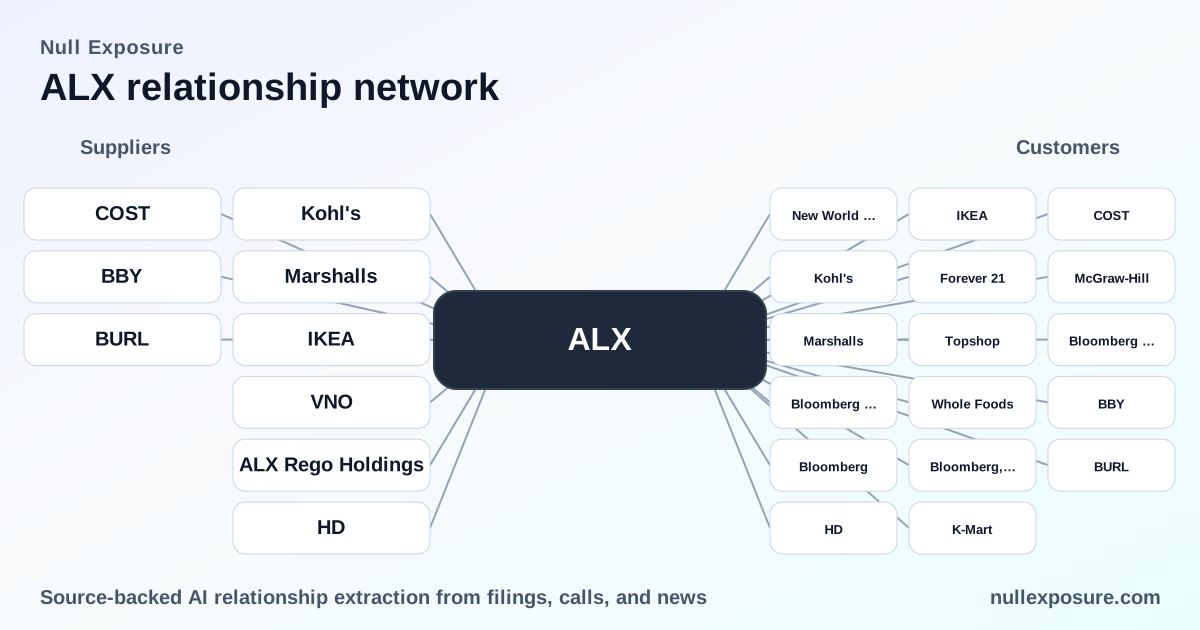
Alexanders Inc. (ALX) — supplier relationship map and implications for investors
Alexanders Inc. operates as a New York–centric REIT that monetizes high‑quality retail and office property ownership through long‑term leases, selective development, and active asset management, while outsourcing day‑to‑day property management to an external manager. The company generates cash flow from tenant rents and occasional termination payments, funds capital needs with structured financings, and preserves optionality by maintaining a concentrated but cash‑generative portfolio. For immediate investor context, visit the Nillexposure research hub: https://nullexposure.com/.
What investors need to know up front
Alexanders runs a classic landlord model in a dense retail mix: large, credit‑rated anchors and a small universe of replacement‑tenant risks define revenue stability, while outsized insider ownership and a manager relationship shape governance and operating leverage. The supplier relationships documented in public filings and press coverage show a mix of retail tenants and financing/management counterparties that are each relevant to cash flow, capex funding and operational continuity.
Visit the research homepage for the full supplier map: https://nullexposure.com/.
Tenant anchors that drive cash flow
These are the operating counterparties named in the FY2025 Form 10‑K that provide the bulk of retail rent and foot traffic.
Costco
The company's FY2025 10‑K lists a 145,000 square foot Costco as a primary anchor at one of its centers, representing a material rental and traffic driver for that property. According to Alexander’s FY2025 10‑K, Costco anchors the center and underpins retail demand.
Kohl's
A 133,000 square foot Kohl’s anchors the same center alongside Costco, providing complementary tenant diversification and rent resilience. Alexander’s FY2025 10‑K identifies Kohl’s as a major tenant at the property.
Marshalls
A 40,000 square foot Marshalls appears in the portfolio description of the FY2025 10‑K and contributes to the value of the shopping center tenant mix. The FY2025 10‑K includes Marshalls among the center tenants.
Burlington
Burlington occupies 60,000 square feet at the center and is noted in the FY2025 10‑K as one of the principal retail tenants supporting center economics.
Best Buy
Best Buy is documented as a 47,000 square foot tenant in the FY2025 10‑K and plays a role in category mix and rental income at the shopping center.
Home Depot
Home Depot was the principal retail tenant (83,000 square feet) at a property until its lease expired on January 31, 2025, which is a discrete lease‑roll event investors should monitor for replacement risk and short‑term vacancy. This fact is reported in Alexander’s FY2025 10‑K.
IKEA
IKEA negotiated a termination payment and rent schedule that Alexander’s recognized through March 16, 2026, including a $10,000,000 termination payment; this is disclosed in the FY2025 10‑K and affects near‑term cash receipts tied to that lease exit.
Non‑tenant counterparties and capital/management relationships
These relationships determine execution risk, financing flexibility, and governance.
Vornado Realty Trust
Vornado acts as Alexander’s external manager and is central to operations and development; Alexander’s 10‑K and multiple press releases state that Vornado manages leasing, development and operations under formal agreements and hosts Alexander’s earnings calls. The FY2025 10‑K and contemporaneous press notices (GlobeNewswire and StockTitan reporting on earnings calls) confirm Vornado’s managerial role and the cadence of public reporting.
ALX Rego Holdings
In FY2025 coverage, trading and press notices indicate Alexander’s implemented structured financing with ALX Rego Holdings, including a B‑Note to fund capital and leasing costs, while ALX Rego acquired an A‑Note at par and positioned itself as a senior holder — a financing arrangement that reshapes creditor priority and internal capital flows. TradingView and related press in 2025 document the ALX Rego financing actions.
Operating model constraints that matter for suppliers and investors
The public record highlights how Alexander’s contracts and relationships shape execution risk and optionality.
- Contracting posture — short‑term renewals with a long‑term dependency on the manager. The 10‑K discloses that management and leasing agreements with Vornado expire each March and are automatically renewable, producing an annual renewal cadence that creates repeated decision points for governance and supplier continuity. This is explicitly stated in the FY2025 10‑K.
- Service provider dynamic — outsized operational dependence on an external manager. Multiple public references, including the Amended and Restated Management and Development Agreement language and the 10‑K, identify Vornado as the service provider responsible for day‑to‑day leasing and development, and external audits of controls further underscore reliance on third‑party services.
- Relationship stage — active and amended agreements. Recent amendments (for example, a Second Amendment to the Rego II Real Estate Sub‑Retention Agreement dated June 18, 2024) indicate the manager/partner relationships are active and evolving, not historical or fully offloaded.
These constraints mean operational continuity and capital execution are concentrated around Vornado and a handful of large‑format retail tenants, so investors should weigh counterparty negotiation leverage and renewal timing when modeling cash flows.
Risks, opportunities, and what to watch next
- Risk — tenant roll and replacement exposure. The Home Depot lease expiration in January 2025, and IKEA’s negotiated termination payment, show that large footprint tenant turnovers drive short‑term volatility in occupancy and tenant improvement spend. The FY2025 10‑K captures both events.
- Opportunity — structured financing to accelerate leasing and capex. The ALX Rego Holdings B‑Note and A‑Note transactions increased internal flexibility to fund property capital and leasing costs while consolidating seniority; press reporting in 2025 covers these moves and signals a proactive capital posture.
- Governance and execution — manager dependence creates single‑party operational risk. Vornado’s role as manager centralizes execution; the 10‑K and related press releases confirm the legal and operational architecture.
Mid‑article action: for the full supplier index and tailored exposure reports, go to https://nullexposure.com/.
Investment takeaway
Alexanders is a concentrated, landlord‑centric REIT with stable anchor tenants but measurable tenant roll and manager concentration risks. The portfolio benefits from credit‑grade anchors such as Costco and Kohl’s, while governance and daily execution are run through Vornado under annually renewable agreements. Recent financing via ALX Rego Holdings reweights capital structure toward internal funding for leasing and capex, which is positive for near‑term execution but raises questions about lender composition.
For an investor seeking a concise supplier and counterparty risk profile, Nillexposure publishes a structured view of these relationships: https://nullexposure.com/.
Final note on due diligence
Review the FY2025 Form 10‑K for full lease schedules and the press notices from TradingView, GlobeNewswire and StockTitan for transaction timing and managerial announcements. The public filings and press reports cited here are the authoritative sources for counterparty status and recent financing events.