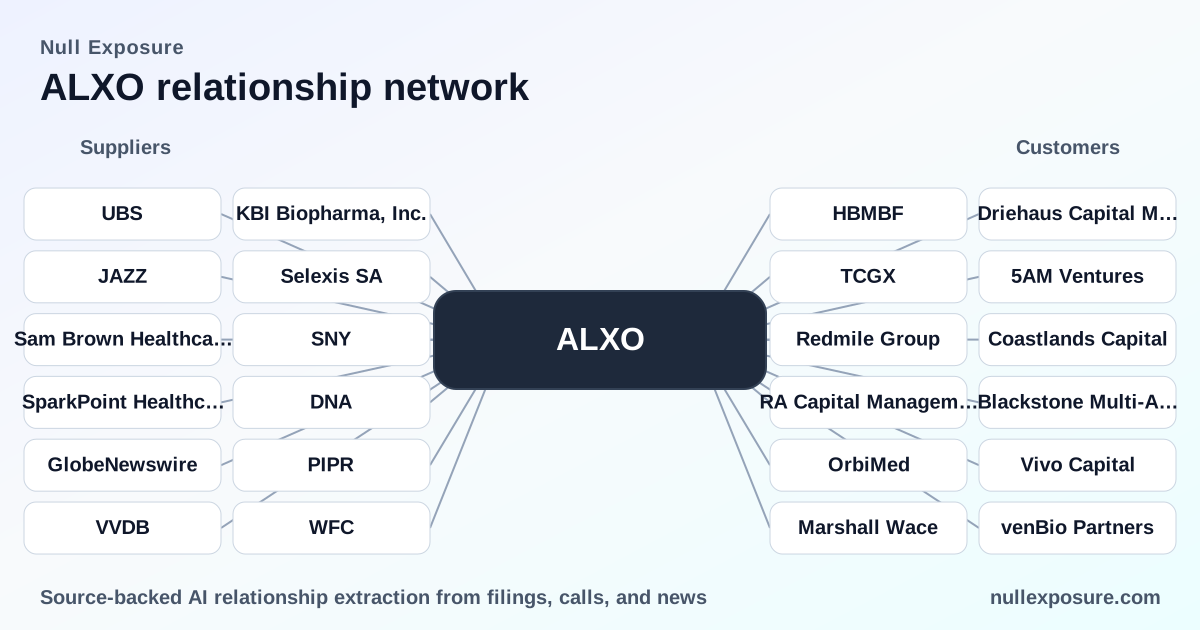
ALXO supplier map: what investors should know about Alx Oncology’s partner network
Alx Oncology (ALXO) is a clinical‑stage immuno‑oncology company that monetizes by advancing early‑stage assets through trials, licensing intellectual property, and partnering programs while funding operations with equity and debt raises. The company runs no internal commercial manufacturing; instead it outsources development, GMP manufacturing, clinical support and investor communications—an operating model that concentrates execution risk in a small set of external partners and underpins the enterprise’s capital‑intensive profile. For a concise view of counterparties, partner roles, and where operational risk is concentrated, read on. If you want a supplier risk report tailored for portfolio diligence, start here: https://nullexposure.com/.
How Alx operates and where suppliers matter
Alx’s business model is typical for a small biotech: clinical assets (evorpacept and pipeline candidates) are de‑risked through trials and strategic collaborations, and value is realized through licensing, co‑development, or commercialization deals and occasional milestone/royalty structures. Because Alx does not own manufacturing capacity and relies on third‑party manufacturers and service providers, supplier performance is operationally critical and can materially affect timelines and cash burn. Alx’s FY2024 filings explicitly document master services and licensing agreements that lock in development and manufacturing pathways, and its public communications and deal activity show an active external partner network supporting clinical programs and financing.
Operating constraints that shape supplier risk
- Outsourced manufacturing is core to execution. Alx’s filings state they “do not own or operate and do not intend to establish our own manufacturing facilities,” meaning CMOs are mission‑critical third parties; the 10‑K also documents an MSA used for cGMP manufacturing.
- Licensing posture is entrenched. The company uses licenses to secure cell lines and other IP for manufacturing and development, indicating dependency on IP licensors and potential royalty liabilities.
- Contract duration and financial cadence create longer‑horizon risk. Alx discloses long‑dated obligations (term loans that mature in 2027 and leases to 2030) and statements of work that commit future purchase obligations in the low‑million range. That financial structure raises the stakes on timely supplier delivery and capital access.
- Materiality and concentration are real. The 10‑K warns that loss of a supplier or inability to secure replacements at acceptable cost would have a material adverse impact on the business; the company records active milestone, royalty and purchase obligations tied to partner arrangements.
- Service diversification is limited but active. Alx engages CROs, CMOs, PR/IR firms and webcasting suppliers—each a single point of failure in trial operations, investor communications and access to capital markets.
Notably, constraints in public documents explicitly identify KBI Biopharma as a manufacturing MSA counterparty (manufacturer role) while other licensing examples in filings reference WuXi and milestone/royalty commitments tied to prior acquisitions; these are company‑level signals of the firm’s overall contracting posture.
Supplier roster: concise takeaways and sources
Below are every counterparty mentioned in the provided results, with a plain‑English summary and source reference.
-
KBI Biopharma, Inc. — Alx has a Master Service Agreement with KBI for formulation, process development and cGMP manufacturing of evorpacept on a project basis. Source: ALX FY2024 10‑K (MSA disclosure).
-
Selexis SA — Alx holds a worldwide, royalty‑bearing, sublicensable license from Selexis to use Selexis‑generated cell lines for manufacture and commercialization of evorpacept. Source: ALX FY2024 10‑K (license agreement, June 2016).
-
Sanofi (SNY) — Management referenced ongoing partnering activity with Sanofi in the company’s Q4 2025 earnings call, indicating active collaborative trials or programs. Source: Q4 2025 earnings call transcript.
-
Genentech (ROCHE/DNA) — Genentech appears in the record as part of executive background (senior roles held by the company’s CMO), not as an explicit current supplier; the mention provides context on leadership experience. Source: Q4 2025 earnings call.
-
Piper Sandler (PIPR) — Piper Sandler acted as a joint lead book‑running manager on an underwritten offering announced January 30, 2026, supporting ALX’s capital raise. Source: GlobeNewswire press release (Jan 30, 2026).
-
Wells Fargo Securities (WFC) — Wells Fargo Securities is another joint lead book‑runner on the January 2026 underwritten offering, reflecting ALX’s banking relationships for access to equity capital. Source: GlobeNewswire press release (Jan 30, 2026).
-
UBS Investment Bank (UBS) — UBS Investment Bank served as a joint lead book‑running manager alongside Piper Sandler and Wells Fargo for ALX’s underwritten offering. Source: GlobeNewswire press release (Jan 30, 2026).
-
Jazz Pharmaceuticals (JAZZ) — ALX announced Phase 1b/2 combination data pairing evorpacept with Jazz’s ZIIHERA (zanidatamab‑hrii), indicating a clinical collaboration or combination study in heavily pretreated metastatic breast cancer. Source: InvestingNews/press coverage and company releases (2026).
-
Sam Brown Healthcare Communications — Named repeatedly as media contact for ALX press materials and investor events, showing the company’s reliance on external PR/IR agencies. Source: InvestingNews and Yahoo Finance press releases (2025–2026).
-
SparkPoint Healthcare Communications — Listed as a media contact on multiple ALX press releases, supporting investor communications and clinical updates. Source: GlobeNewswire and Yahoo Finance releases (2026).
-
GlobeNewswire — Primary distributor of ALX corporate communications including underwritten offering notices and clinical updates. Source: GlobeNewswire press releases (Jan 2026; Jan 8, 2026).
-
Viavid (VVDB) — Viavid hosted ALX webcasts for earnings and investor events, indicating outsourced webcast services for investor access. Source: Press release webcasts and event notices (2025–2026).
-
StockTitan — An aggregator that republished ALX press releases (offering pricing and related notices), representing secondary distribution of corporate news. Source: StockTitan repost (Jan 2026).
-
InvestingNews — Covered ALX clinical data and presentations, amplifying clinical messaging and biomarker findings to investor audiences. Source: InvestingNews article on Phase 2/biomarker data (2026).
-
The Globe and Mail — Hosted a published transcript of ALX’s Q4 2025 earnings call and related clinical commentary, showing media reach into mainstream investor press. Source: The Globe and Mail earnings transcript (Q4 2025).
What the partner map implies for risk and value creation
- Execution risk is concentrated in manufacturing and CRO relationships. The KBI MSA and multiple licensing agreements mean that late‑stage development timelines and potential commercialization hinge on third‑party performance—this is an operational leverage point that can drive or destroy near‑term valuation.
- Partnerships with established pharma (Sanofi, Jazz) are strategic value catalysts. Clinical collaborations create pathways to co‑development or out‑licensing revenue and materially reduce development risk compared with lone internal programs. Positive combination data with Jazz directly increases ALX’s optionality.
- Capital markets access is active and visible. The January 2026 underwritten offering with Piper Sandler, UBS and Wells Fargo demonstrates investor appetite and the company’s ability to raise equity; banking relationships are an operational enabler for bridging development milestones.
- Communications and investor access are outsourced and coordinated. Multiple PR shops and a webcasting provider show ALX’s programmatic approach to investor relations—useful for narrative amplification but also a point of operational coordination.
If you need a bespoke supplier risk scorecard that weights manufacturing concentration, licensing exposure, and capital access, learn how we build those profiles at https://nullexposure.com/.
Final takeaways and next steps for investors
- Alx follows a capital‑intensive, outsourced execution model where CMOs and licensing partners are operationally critical. That fact elevates supplier monitoring to a first‑order investment risk.
- Clinical collaborations and recent financing activity de‑risk and fund near‑term programs, but investor returns will hinge on successful partner‑led trials and timely manufacturing deliveries.
- PR, banking and webcasting relationships are well‑established and point to active investor engagement.
For portfolio teams evaluating counterparty exposure or operational continuity, request a detailed supplier diligence pack or a custom monitoring feed at https://nullexposure.com/.