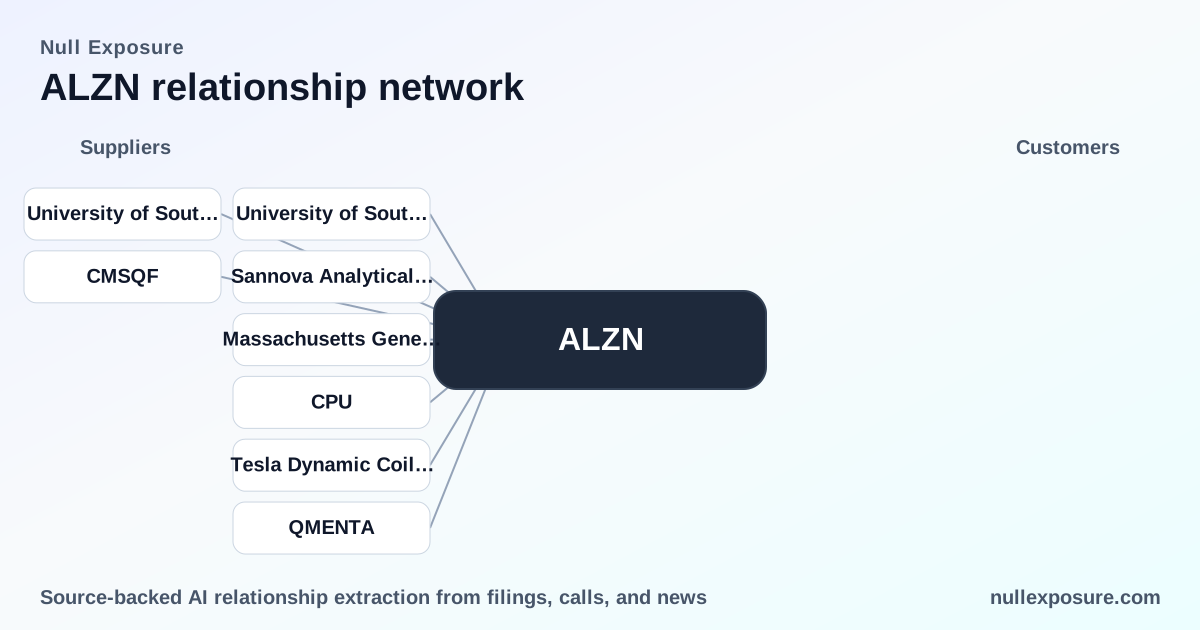
ALZN supplier map: how Alzamend monetizes licensed IP and runs clinical programs
Alzamend Neuro builds value by anchoring its clinical-stage pipeline on exclusive, royalty-bearing licenses from the University of South Florida, then outsourcing the specialized work—bioanalysis, imaging hardware, CRO services and GMP manufacturing—to third parties. Revenue upside is tied to future product sales (subject to a 4.5% combined royalty on AL001 net sales disclosed in filings) and any licensing / commercial deals; near-term value is driven by clinical readouts enabled by strategic service providers and clinical sites. For a consolidated view of counterparties and operational constraints, visit https://nullexposure.com/.
How the network is structured and what that means for investors
Alzamend’s operating model is a classic virtual biopharma: core IP is licensed in long-term, exclusive global agreements; execution is outsourced. That posture delivers capital efficiency and speed-to-proof but concentrates operational risk in external partners. Key company-level signals from filings and releases:
- Licensing is central and global. AL001/ALZN002 are licensed under exclusive worldwide licenses from the University of South Florida Research Foundation, with contractual royalty obligations and indefinite license terms tied to patent life and market exclusivity.
- Royalties and upfronts are modest relative to development cost. The company has paid a reported $200,000 initial license fee for AL001 and is contractually required to pay a combined 4.5% royalty on net sales of AL001.
- Manufacturing and trial execution are outsourced and material to outcomes. Alzamend lacks in‑house manufacturing; GMP clinical supplies and long‑term commercial production are contracted with third parties. Filings identify CRO contract terminations as a material risk to operations.
- Clinical credibility comes from premium partners. A major research hospital supplies trial capacity while specialty vendors provide imaging hardware and analytics that are critical to the company’s lithium-in-brain strategy.
These constraints imply concentration risk around licensors and CRO/manufacturing partners, contractual long-term dependency, and explicit materiality of third-party failures. If you need a supplier risk deep-dive, start at https://nullexposure.com/ for the full supplier index.
Supplier-by-supplier: concise, investable facts
University of South Florida Research Foundation, Inc.
Both AL001 and ALZN002 are licensed from the University of South Florida Research Foundation under royalty-bearing exclusive worldwide licenses, which form the legal backbone of Alzamend’s product rights. According to press materials and filings (Marketscreener/GlobeNewswire/FY2025–FY2026), these licenses carry an indefinite term measured by patent life and regulatory exclusivity and include royalty obligations. (Sources: Marketscreener FY2026; GlobeNewswire May 29, 2025)
University of South Florida
Nonclinical studies underpinning AL001’s brain/plasma lithium profile were conducted at the University of South Florida, providing laboratory execution that supports preclinical claims. The BioSpace release describing the nonclinical study lists USF as the study site (FY2024). (Source: BioSpace press release FY2024)
Sannova Analytical LLC
Sannova performed the bioanalytical measurements for lithium concentrations in brain and plasma under GLP, a critical service for the AL001 nonclinical comparison against lithium carbonate. That work is documented in the BioSpace nonclinical data release. (Source: BioSpace press release FY2024)
Massachusetts General Hospital
Massachusetts General Hospital served as the clinical trial site and CRO partner for AL001 Phase II activities, including the dosing of the first patient and completion of the clinical portion of the lithium-in-brain study; these milestones were publicized in multiple releases in 2025. The relationship supplies clinical credibility and access to high-quality imaging cohorts. (Sources: GlobeNewswire May 29, 2025; Yahoo Finance FY2025)
Tesla Dynamic Coils BV
The clinical imaging capability depended on an engineered head coil developed by Tesla Dynamic Coils BV, enabling high‑resolution whole‑brain lithium imaging used in the trial protocol and data acquisition. PR releases and news reports described the coil as an enabling technology for precise lithium quantification in specific brain structures (FY2025). (Sources: PR Newswire FY2025; Yahoo Finance FY2025)
QMENTA
Alzamend partnered with QMENTA to apply AI-powered imaging analysis to Phase II data, positioning quantitative imaging and analytics as a differentiator in endpoint sensitivity for AL001. That collaboration was highlighted in industry news around the Phase II program (FY2025). (Source: Finviz/industry news FY2025)
Sannova Analytical LLC (reiterated)
Sannova’s GLP bioanalysis was listed again in nonclinical disclosures; this duplication underscores its ongoing role in analytical verification rather than one-off consultancy. (Source: BioSpace FY2024)
Computershare Trust Company, N.A. (and Computershare / CMSQF entries)
Computershare acted as exchange agent and transfer agent for a reverse stock split and related shareholder communications, handling corporate actions and proxy transmittals as described in the company’s proxy materials and investor notices (FY2025–FY2026). That function is operational and administrative rather than scientific but is material to investor mechanics and corporate housekeeping. (Sources: Yahoo Finance FY2025; SEC filing (DEF 14A) via StockTitan FY2026)
What these relationships mean for risk and upside
Alzamend’s supplier map creates a clear investment profile:
- Upside drivers: exclusive global IP licenses, differentiated imaging-enabled clinical readouts, and the potential for downstream commercial or licensing transactions if AL001 demonstrates favorable brain-lithium delivery and clinical efficacy.
- Concentration and counterparty risk: dependence on a single university licensor for patent rights and on outsourced GMP manufacturers/CROs for execution. Filings explicitly designate third‑party failures as potentially material.
- Execution sensitivity: imaging hardware (Tesla coil) and analytics (QMENTA) are critical enablers of trial endpoints; delays or technical failures here would directly affect data quality.
- Corporate risk control: administrative tasks and corporate actions are handled by established transfer agents (Computershare), lowering governance friction for investors.
Key points to track over the next 12–18 months: regulatory-readout timelines from the MGH Phase II work, any material amendments or transfers of the USF license agreements, evidence of scale-up manufacturing contracts, and replacement or stabilization of CRO relationships after prior terminations.
- Top operational red flags to monitor:
- Loss or dispute related to USF licenses
- Manufacturing or GMP supply interruptions
- Imaging hardware or analytics validation issues
- New CRO terminations or material noncompliance
If you want a consolidated supplier risk brief or counterparty scoring for ALZN, see the supplier hub at https://nullexposure.com/ for a structured view and next-step analysis.
Final read for investors and operators
Alzamend’s model is IP-driven and execution-dependent: ownership of exclusive global licenses gives the company asymmetric upside, but value realization is tightly coupled to third-party performance across manufacturing, imaging, analytics and clinical operations. Investors should value the upside from the differentiated imaging strategy while pricing in concentrated supplier risk and modest initial license spend relative to clinical development needs. For operational teams, the priority is locking long‑term, quality-assured manufacturing and ensuring redundancy in CRO and imaging partners.
For a deeper supplier risk scorecard and to monitor updates on these counterparties, visit https://nullexposure.com/—the best starting point for operational due diligence.