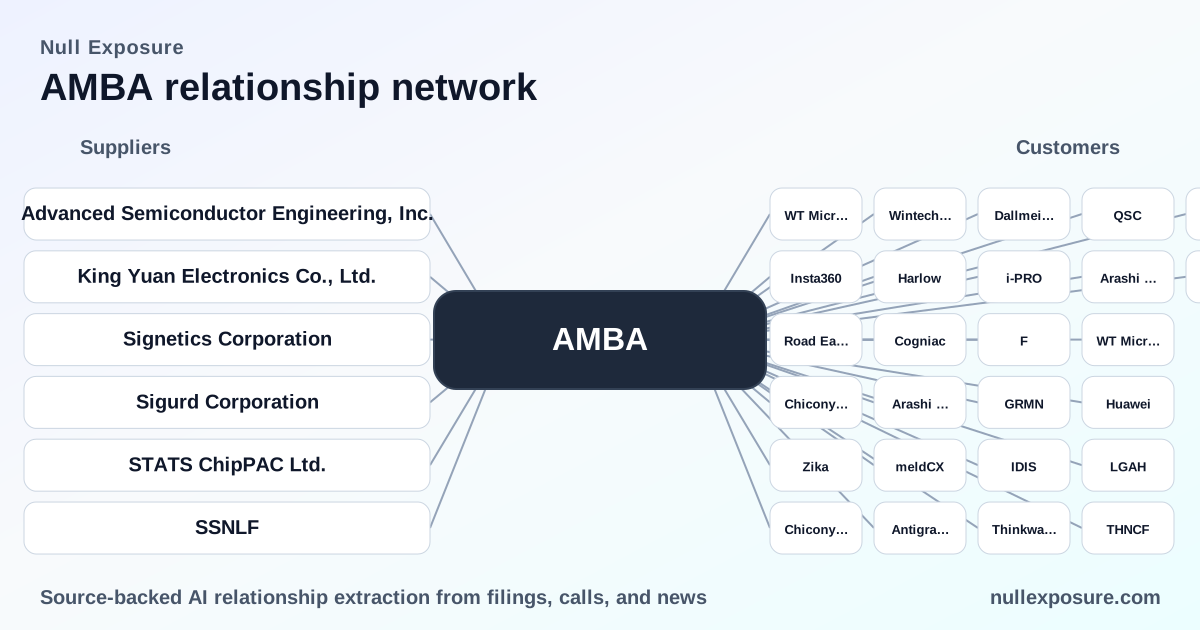
Ambarella (AMBA) — supplier map and what it tells investors
Ambarella is a fabless semiconductor designer that monetizes by selling edge-AI vision SoCs and related software/solutions while outsourcing wafer fabrication, assembly and test to third parties. The company’s business model concentrates production execution off‑balance‑sheet — Ambarella drives design and product roadmaps, while foundries and contract manufacturers convert those designs into shippable parts and final tested devices. For investors evaluating supplier exposure, the central thesis is simple: product performance and supply continuity are tightly coupled to a small set of external manufacturing and test partners. Learn more at https://nullexposure.com/.
Quick take: Ambarella’s supplier posture is concentrated, operationally dependent, and capital-light
- Concentration: The FY2025 10‑K underlines Samsung as the principal foundry for Ambarella’s SoCs, with facilities in Austin, Texas and South Korea. That makes process transitions at Samsung a company-level operational risk. (FY2025 10‑K)
- Outsourced execution: Ambarella operates a fabless model and uses third‑party foundries and assembly/test contractors to manufacture, assemble and test its products. This is the company’s normal contracting posture. (FY2025 10‑K)
- Spend profile and maturity: Manufacturing purchase commitments were disclosed at approximately $56.4 million for FY2025, and a noncancellable IT service commitment was about $8.0 million — indicators of meaningful recurring supplier spend and mid‑tier contractual commitments. (FY2025 10‑K)
- Geographic footprint: Supply infrastructure spans North America and APAC, reflecting a binational foundry presence and assembly/test partners in the region. (FY2025 10‑K)
Supplier map — each relationship and why it matters The FY2025 Form 10‑K and related public reports list five assembly/test partners and the principal foundry relationship. Below are concise, investor-focused takes on each.
-
Advanced Semiconductor Engineering, Inc. (ASE) — Ambarella contracts assembly to ASE when it purchases tested die from Samsung for assembly, signaling ASE’s role as a core assembly partner for wafer‑level product flows. According to Ambarella’s FY2025 10‑K, ASE is used to assemble tested die supplied by Samsung. (AMBA FY2025 10‑K)
-
King Yuan Electronics Co., Ltd. — Final testing of Ambarella products is handled by King Yuan under Ambarella engineer supervision, making King Yuan a direct participant in Ambarella’s quality gate before shipments. This arrangement is described in Ambarella’s FY2025 10‑K. (AMBA FY2025 10‑K)
-
Signetics Corporation — Samsung subcontracts assembly and initial testing of chips supplied to Ambarella to Signetics, reflecting a multi‑tier subcontracting chain between foundry, OSAT (outsourced assembly and test) and Ambarella. This relationship is noted in the FY2025 10‑K. (AMBA FY2025 10‑K)
-
Sigurd Corporation — Ambarella uses Sigurd for final testing under engineer supervision, alongside King Yuan, indicating redundancy in final test capacity and shared quality oversight. The FY2025 10‑K names Sigurd as a final test handler. (AMBA FY2025 10‑K)
-
STATS ChipPAC Ltd. — STATS ChipPAC receives chips via Samsung subcontracting for assembly and initial testing, situating STATS ChipPAC within the initial OSAT layer feeding Ambarella products. This subcontracting relationship is included in the FY2025 10‑K. (AMBA FY2025 10‑K)
-
Samsung (SSNLF) — Samsung is the principal foundry for Ambarella’s SoCs and the most critical single supplier: Ambarella depends on Samsung to transition to new process nodes and disclosed supply constraints from Samsung as a material operational issue. Additionally, industry reports and CES coverage in early 2026 highlight Ambarella’s CV7 SoC built on Samsung’s 4nm node, which reduced power consumption versus predecessors — underscoring both technical dependency and the upside when foundry transitions succeed. (AMBA FY2025 10‑K; CES coverage and press Jan–Mar 2026)
Operational constraints and what they signal for investors The supplier constraints disclosed in Ambarella’s filings provide company‑level signals about bargaining posture, concentration and contract maturity.
-
Contracting posture: Ambarella is firmly fabless and relies on third‑party foundries and OSATs for manufacture, assembly and test. This design-centric posture reduces capital intensity but shifts a large portion of execution risk to supplier partners. (FY2025 10‑K)
-
Concentration and criticality: The filing explicitly nominates Samsung as the principal foundry with facilities in both the U.S. (Austin) and South Korea, creating a concentrated single‑node dependency for advanced process transitions. Supply constraints from Samsung were disclosed as a company-level operational challenge, which elevates business risk if capacity or node migration issues recur. (FY2025 10‑K)
-
Maturity of supplier relationships: Manufacturing purchase commitments in FY2025 were reported at roughly $56.4 million, while service commitments (notably IT infrastructure) were about $8.0 million. These figures indicate committed, multi‑year supplier spend rather than purely spot transactions — an operational maturity that proves both continuity and concentration. (FY2025 10‑K)
-
Geographic risk distribution: Supplier footprint spans APAC and North America; that improves diversification versus a single‑country model but still concentrates process technology risk where advanced nodes are produced. (FY2025 10‑K)
Middle action: if you are tracking supplier risk for AMBA, include supplier concentration metrics and process‑node roadmaps in your next model refresh; for a practical toolkit visit https://nullexposure.com/.
Investor implications — risks and directional positives
- Primary risk: Heavy reliance on Samsung for advanced-node manufacturing creates a single-point-of-failure for product cadence and cost. If Samsung’s transitions slow or capacity tightens, Ambarella’s product launches and margins will be directly affected. (FY2025 10‑K)
- Mitigant / opportunity: Ambarella’s move to a Samsung 4nm node for the CV7 SoC reduces power and improves competitiveness; successful transitions materially enhance product value and end-market adoption. (CES and embedded coverage, Jan 2026)
- Operational exposure: Multiple OSATs (ASE, Signetics, STATS ChipPAC, King Yuan, Sigurd) show that Ambarella uses a mix of providers for assembly and test — this creates redundancy but also complexity in quality control and logistics, which requires active supplier management. (FY2025 10‑K)
Conclusion — what to watch next For investors and operators, track three items over the next 12 months: (1) Samsung process node capacity and Ambarella wafer allocations; (2) manufacturing purchase commitments and any material changes to the disclosed $56.4 million run‑rate; (3) any shift toward additional foundry partners or longer-term supply contracts that reduce node concentration. Supplier continuity and node transitions dictate Ambarella’s product roadmap and margin profile.
If you want a consolidated supplier view or tailored monitoring for AMBA, start here: https://nullexposure.com/. For portfolio teams needing recurring supplier risk signals integrated into investment workflows, explore https://nullexposure.com/ for practical implementation options.