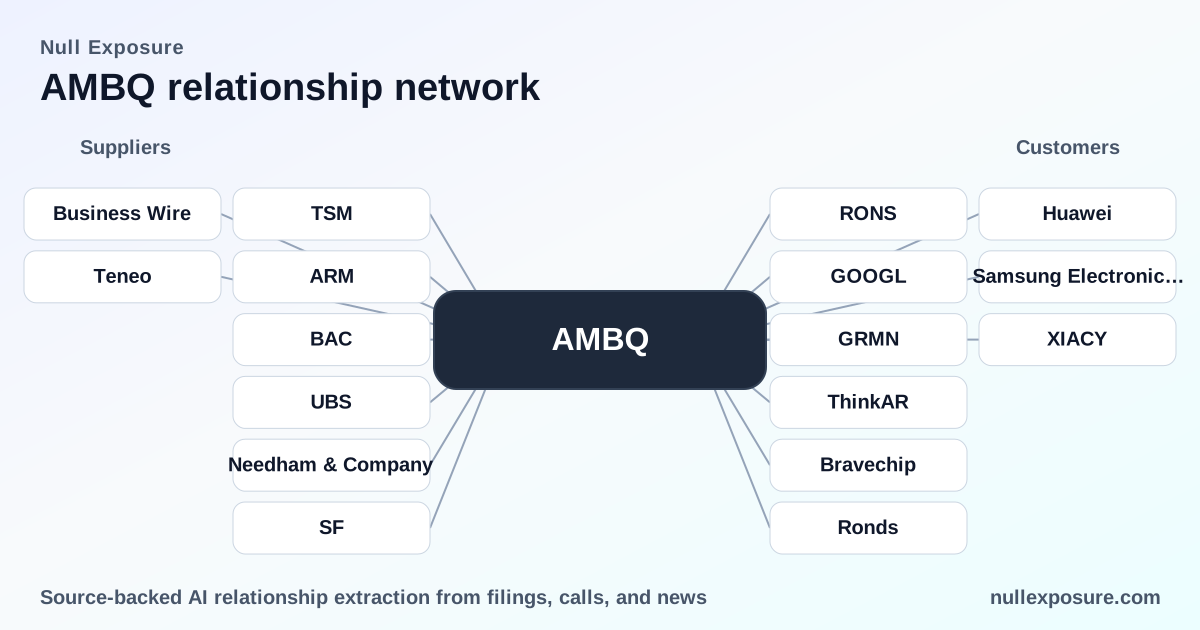
Ambiq (AMBQ) supplier relationships: what investors need to know
Ambiq monetizes by designing ultra‑low‑power SoCs and licensing/integrating third‑party IP while outsourcing wafer fabrication and capital markets activity to external partners; revenue comes from chip sales and strategic product launches supported by equity markets and underwriter financing. Investors should value Ambiq as a design‑led semiconductor supplier whose performance is heavily dependent on a small number of manufacturing and IP partners and on intermittent capital raises. For an independent supplier‑risk review and continuous monitoring, visit https://nullexposure.com/.
Why the supplier map determines Ambiq's runway
Ambiq’s business model concentrates technical execution (SoC architecture, power IP, software stacks) internally while externalizing manufacturing and go‑to‑market financing. That operating posture compresses fixed costs and accelerates product time‑to‑market, but it also creates single‑point dependencies: foundry process improvements and third‑party NPU IP determine product power and performance, and underwriters control access to public capital. Below I walk through each named relationship disclosed in recent company materials and press.
Detailed relationship rundown
TSMC — foundry partner enabling the SPOT platform
Ambiq confirmed in its Q4 2025 earnings call that the new SPOT family is the first built on a FinFET process with TSMC, enabling operation down to 300 millivolts, a company record for low‑voltage operation. This establishes TSMC as a critical manufacturing partner for Ambiq’s energy‑efficiency claims (Q4 2025 earnings call, March 2026).
Arm — NPU IP supplier for Atomiq SoC
Ambiq publicly positioned its Atomiq SoC as integrating Arm’s Ethos‑U85 NPU, enabling much larger, energy‑efficient edge AI models and on‑device inference performance exceeding 200 GOPS in some marketing disclosures (Embedded Computing and Sahm Capital coverage, January–March 2026). This relationship anchors Ambiq’s AI strategy around Arm’s NPU ecosystem and software compatibility.
BofA Securities — lead underwriter on multiple offerings
BofA Securities is named repeatedly as a joint lead book‑running manager on Ambiq’s public offerings in FY2025 and FY2026 and as a lead underwriter on the upsized offering that closed at $31.00 per share, signaling deep banking support for Ambiq’s capital plan (GlobeNewswire release July 29, 2025; GlobeNewswire and Intellectia reporting, January–March 2026).
UBS Investment Bank — co‑lead underwriter and capital partner
UBS Investment Bank is Ambiq’s co‑lead underwriter alongside BofA across the same FY2025–FY2026 offerings, providing parallel underwriting capacity and market distribution for Ambiq’s equity raises (GlobeNewswire and Intellectia coverage, July 2025 – January 2026).
Needham & Company — book‑running manager on the IPO package
Needham & Company served as a joint book‑running manager on Ambiq’s offering activity cited in FY2025 and FY2026 press, adding boutique market coverage and investor access complementary to the bulge‑bracket banks (GlobeNewswire, July 29, 2025; January 21, 2026).
Stifel — book‑running manager and distribution partner
Stifel appears as a joint book‑running manager in Ambiq’s offering transcripts and releases for FY2025–FY2026, supporting retail and institutional distribution channels for the stock (GlobeNewswire July 2025; January 2026 reporting).
Business Wire — corporate communications channel
Ambiq used Business Wire on February 19, 2026 to announce Q4 and full‑year 2025 results and related investor communications, demonstrating a conventional investor‑relations cadence for earnings and event notices (Business Wire release, February 19, 2026).
Teneo — investor relations and media contact
Teneo is listed as Ambiq’s investor relations contact in the same FY2026 investor communications, indicating the company uses an external IR firm to coordinate messaging and market outreach (Investor relations contact via Teneo, February 2026).
What these relationships imply about Ambiq’s operating model
- Concentration of manufacturing risk. Ambiq’s reliance on TSMC for the FinFET SPOT implementation makes foundry process roadmaps and capacity allocation material to product performance and lead times; manufacturing is a single critical dependency for product differentiation (Q4 2025 earnings narrative).
- Strategic IP dependency on Arm. By integrating Arm’s Ethos‑U85, Ambiq positions product competitiveness around third‑party NPU IP and Arm’s software/ecoystem, which accelerates time‑to‑market but limits vertical control over certain performance attributes (multiple FY2026 press reports).
- Capital markets dependence for scaling. Recurrent underwriter relationships with BofA, UBS, Needham, and Stifel reflect a financing posture that leans on equity raises and underwritten offerings for growth capital, making access to capital markets a recurring operational lever (GlobeNewswire, Intellectia, 2025–2026).
- Outsourced investor relations. Use of Business Wire and Teneo for disclosure and IR functions signals a mature public‑company communications process, useful for liquidity and investor access but also a cost and governance consideration (February 2026 filings and releases).
Bottom line: Ambiq’s model is design‑centric and capitalized via external financing and IP/foundry partnerships. That setup accelerates productization but elevates supplier and market‑funding risk.
Visit https://nullexposure.com/ for ongoing supplier risk dashboards and marketplace context.
Investment implications and how to track risk
Ambiq’s roadmap and valuation sensitivity track two levers: (1) TSMC process availability and performance for SPOT/Atomiq, and (2) Arm IP and software integration for on‑device AI workloads. On the capital side, the company’s repeated use of listed underwriters signals ongoing financing activity that investors must model into dilution and runway assumptions (GlobeNewswire, January 2026; Intellectia reporting).
- Monitor TSMC process announcements and foundry lead times for N12e/FinFET nodes.
- Track Arm’s Ethos product roadmap and software support life cycle for compatibility and performance upgrades.
- Watch SEC filings and press releases for follow‑on offering timing and syndicate composition; BofA and UBS involvement is a market signal for execution capacity.
For a consolidated supplier‑risk overview and alerts tied to these exact relationships, see https://nullexposure.com/.
Conclusion: a concentrated supplier footprint with clear tradeoffs
Ambiq’s supplier relationships paint a clear operating profile: product differentiation through low‑power SoC design, coupled with operational dependence on TSMC manufacturing, Arm NPU IP, and capital markets execution via core underwriters. That structure speeds innovation but concentrates execution risk in a handful of external partners. Investors should treat manufacturing cadence, Arm integration milestones, and underwriter activity as leading indicators for revenue ramp and dilution.
For tailored monitoring of Ambiq’s supplier exposures and event‑driven alerts, visit https://nullexposure.com/ and subscribe for investor‑grade supplier intelligence.