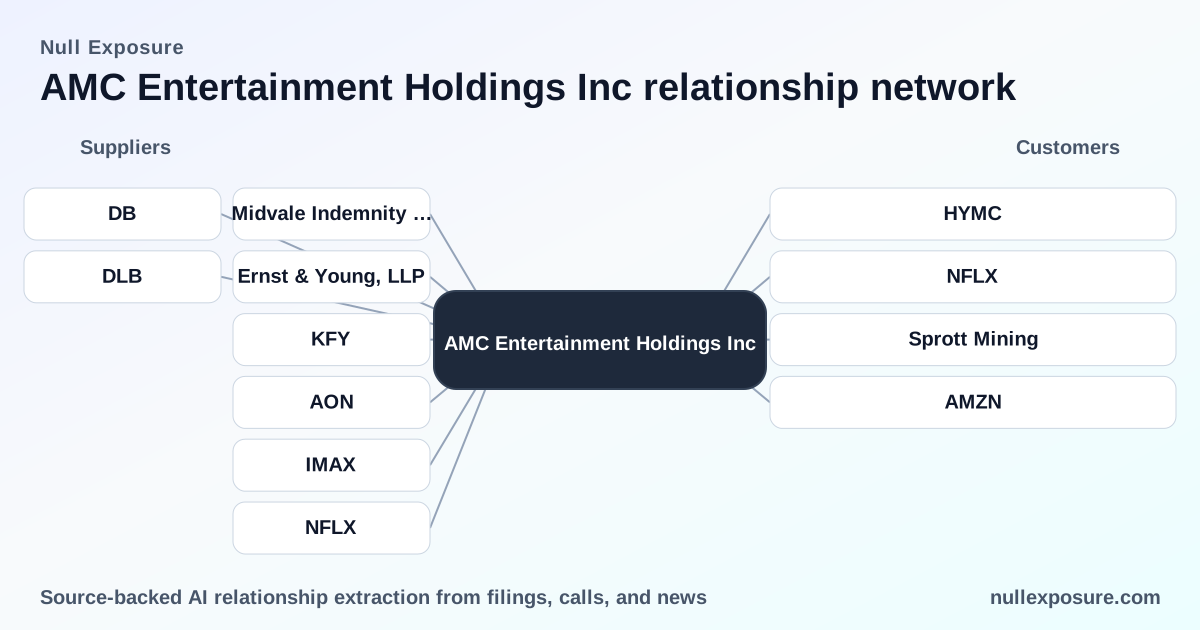
AMC Entertainment: a supplier-risk and partner map for investors
AMC operates and monetizes a capital-intensive theatrical exhibition business: it leases and operates movie theatres, sells tickets and concessions, and captures premium-format pricing for IMAX/Dolby presentations and event screenings. Revenue drivers are attendance, premium-format capture, licensing economics with studios, and F&B margins; the company offsets capital needs through long-term leases and periodic refinancing. For investors and operators evaluating supplier exposure, the relevant reality is clear: contracts are long-duration and revenue-linked, critical studio relationships concentrate box-office risk, and a mixture of professional service providers supports governance and financing. Learn more about supplier risk profiles at https://nullexposure.com/.
What to know about AMC’s supplier and contracting posture
AMC runs a hybrid supplier model that mixes long-term real-estate leases, usage-linked content licensing, and a dependence on third-party service providers. The company’s leases commonly run 10–20 years, creating fixed occupancy commitments and predictable capacity costs. Film licensing is negotiated film-by-film and theatre-by-theatre and is often usage-based (rental fees tied to box office performance), which aligns costs to revenue but amplifies downside in weak content cycles. AMC’s box-office economics are geographically concentrated in North America and materially exposed to a small number of major studios — a single slate can drive a large share of revenue. These dynamics create both leverage (variable content costs) and bilateral concentration risk (studio-dependent box-office outcomes). For a deeper supplier-risk view visit https://nullexposure.com/.
Supplier roster — concise, source-backed summaries
Midvale Indemnity Company
AMC litigated coverage disputes under its directors & officers insurance program and by the time of a Superior Court decision, Midvale remained the sole insurer in contention; subsequent appellate coverage was reported in March 2026. (Insurance Business, March 9, 2026 — https://www.insurancebusinessmag.com/us/news/breaking-news/delaware-supreme-court-backs-amc-on-dando-stock-settlement-loss-fight-560603.aspx)
Ernst & Young, LLP
The Audit Committee selected Ernst & Young as AMC’s independent registered public accounting firm to audit consolidated financial statements and internal control over financial reporting for 2025, indicating AMC’s engagement with a Big Four auditor for FY2025 audit oversight. (Definitive Proxy Statement, FY2025 via StockTitan — https://www.stocktitan.net/sec-filings/AMC/def-14a-amc-entertainment-holdings-inc-definitive-proxy-statement-516e828bd73c.html)
Korn Ferry
Following a request-for-proposals, the Compensation Committee named Korn Ferry as its independent executive compensation consultant for 2025, replacing Aon and signaling a deliberate vendor-selection process for compensation advisory services. (Definitive Proxy Statement, FY2025 via StockTitan — https://www.stocktitan.net/sec-filings/AMC/def-14a-amc-entertainment-holdings-inc-definitive-proxy-statement-516e828bd73c.html)
Aon
Aon served as an independent executive compensation consultant advising on 2024 compensation matters before being replaced for the 2025 cycle, reflecting a routine review and rotation of compensation advisors. (Definitive Proxy Statement, FY2025 via StockTitan — https://www.stocktitan.net/sec-filings/AMC/def-14a-amc-entertainment-holdings-inc-definitive-proxy-statement-516e828bd73c.html)
IMAX Corporation
Premium formats such as IMAX are credited with driving a disproportionate share of AMC’s admissions revenue and form part of the company’s strategy to expand premium experiences and capture higher per-seat revenues. (Sahm Capital reporting, December 2025 / January 2026 — https://www.sahmcapital.com/news/content/billionaire-buys-amc-stock-near-52-week-lows-as-avatar-brings-box-office-back-to-life-2025-12-22 and https://www.sahmcapital.com/news/content/a-look-at-amc-entertainment-holdings-amc-valuation-as-shares-hit-lows-despite-strong-pre-christmas-box-office-2026-01-09)
Netflix, Inc.
AMC has executed event programming partnerships with Netflix, including theatrical showings of the "Stranger Things" series finale across more than 620 theatres (over 1.1 million seats reserved) and other event collaborations, demonstrating a strategic shift into content-driven live-event monetization. (Sahm Capital reporting, Jan 2026 and Nov 2025 — https://www.sahmcapital.com/news/content/amc-stock-hits-new-all-time-low-as-holiday-momentum-fails-to-lift-shares-2026-01-01 and https://www.sahmcapital.com/news/content/amc-entertainment-q3-preview-superman-dinosaurs-superheroes-could-help-company-beat-revenue-2025-11-04)
Deutsche Bank
AMC and its wholly owned subsidiary Odeon entered a commitment letter with Deutsche Bank for a credit facility of up to $425 million to restructure existing debt and reduce interest costs, an indication of active liability management and refinancing dependency. (Intellectia.ai reporting, FY2026 — https://intellectia.ai/news/stock/class-action-filed-against-amc-entertainment-for-securities-violations)
Dolby / Dolby Cinema
Dolby Cinema premium formats contribute meaningfully to AMC’s admissions upside; Dolby-enabled auditoria are part of the company’s premium-format expansion to enhance per-seat revenue. (Sahm Capital reporting, Dec 2025 / Jan 2026 — https://www.sahmcapital.com/news/content/billionaire-buys-amc-stock-near-52-week-lows-as-avatar-brings-box-office-back-to-life-2025-12-22 and https://www.sahmcapital.com/news/content/a-look-at-amc-entertainment-holdings-amc-valuation-as-shares-hit-lows-despite-strong-pre-christmas-box-office-2026-01-09)
What the constraints tell investors and operators
- Long-term lease exposure: AMC’s theatres sit on 10–20 year operating leases with significant fixed payments, which increases operating leverage and reduces near-term flexibility. This is a company-level capital structure constraint, not tied to any single supplier.
- Licensing and usage-based economics: Film rights are largely licensed on a per-film, per-theatre basis with rental fees typically tied to box-office performance, aligning supplier costs to revenue but amplifying box-office volatility risk.
- Counterparty concentration: Films from a small set of major studios accounted for roughly 84% of U.S. admissions revenue, a critical concentration risk that elevates strategic dependence on studio slates.
- Geographic split: Operations and revenue are concentrated in North America with meaningful European exposure (EMEA), implying regional box-office and regulatory sensitivity.
- Service-provider reliance: AMC engages external firms for cybersecurity, ticketing, advertising and professional services — the company treats many third parties as essential service providers in operations and compliance.
- Materiality balance: Some supplier relationships are critical to revenue (studios, premium-format partners), while others are material for governance and financing (auditor, banks) — there is limited evidence of notable cybersecurity incidents affecting operations.
Investment implications and recommended actions
- Key risk to monitor: slate concentration and long-term lease obligations that compress cash flow flexibility if content underperforms. Stress test box-office scenarios against lease and debt schedules.
- Operational opportunity: expand premium-format capacity and event programming to boost per-seat revenue and reduce sensitivity to standard-release cycles. IMAX and Dolby partnerships play directly to this strategy.
- Governance signals: auditor rotation and compensation advisor changes indicate active board-level vendor governance; maintain scrutiny on audit opinions and compensation disclosures for governance quality.
For a tools-driven supplier risk assessment tailored to investors and operators, visit https://nullexposure.com/ to compare counterparty concentration and contract exposure across portfolios.
Wrap-up call to action: institutional investors and operators evaluating AMC should treat supplier relationships as strategic levers — studio slates, premium-format partners, long-term leases, and financing counterparties together define both upside and downside. For a structured supplier risk scorecard and more supplier intelligence, start here: https://nullexposure.com/.