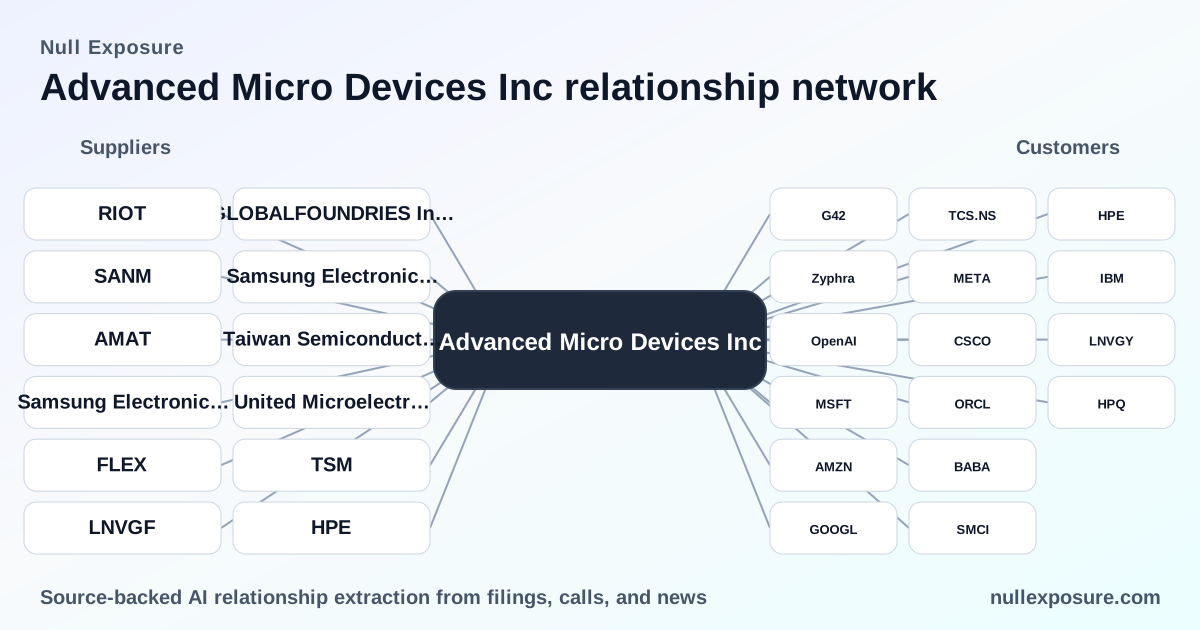
AMD’s supplier spine: concentrated foundry exposure, strategic partners, and where risk lives
Advanced Micro Devices, Inc. (AMD) designs and sells high-performance microprocessors and GPUs and monetizes through the sale of chips, IP licenses and related platform solutions to cloud, enterprise and consumer customers. The company outsources wafer fabrication and a large portion of assembly, test and final manufacturing to third-party manufacturers and service providers, converting capital-light design and software-led IP into scalable semiconductor revenue while retaining gross-margin leverage through product mix and platform adoption.
If you’re evaluating AMD as a counterparty or supplier-dependent investment, focus on foundry concentration, large-ticket ATMP commitments, and APAC manufacturing exposure. For a visual supplier map and deeper relationship scoring, visit the NullExposure homepage: https://nullexposure.com/
What the operating model tells investors
AMD’s operating model is a hybrid design company that relies on external fabrication and assembly to scale. The company captures value through differentiated CPU and GPU architecture and sells finished silicon and systems to OEMs, cloud customers and channel partners. Key monetization drivers visible in the filings and market commentary are:
- Design-led revenue with outsourced manufacturing: AMD controls product design and sales, while external foundries produce wafers and third-party contractors handle assembly/test. (FY2025 filings)
- Concentration on advanced nodes: AMD routes all sub‑7nm production to TSMC, creating a strategic dependence on that supplier for its most advanced products. (FY2025 10‑K)
- Large, multi‑hundred‑million dollar commitments to assembly/test partners: The company reports multi‑billion dollar ATMP purchases and unconditional commitments that load fiscal 2026. This creates predictable operating volume but concentrated supplier risk.
Explore supplier risk scores and contract details at https://nullexposure.com/ to see how these factors change over time.
Company-level constraints and what they mean for counterparty risk
The SEC filings and audit commentary surface several operating constraints that are relevant to investors and counterparties:
- Contracting posture — short-term purchase orders dominate. AMD discloses it does not maintain long-term minimum purchase commitments with many manufacturing suppliers and procures services on a purchase order basis, which implies flexible but potentially volatile capacity access if demand outstrips allocation.
- Geographic manufacturing concentration — APAC first, with NA and EMEA exposure. AMD identifies nearly all assembly and final testing in China, Malaysia and Taiwan, while wafer foundries operate across the United States, Europe and Asia. This creates regional risk tied to geopolitics and logistics.
- Materiality — inventory and ATMP spend are financially significant. The auditor singled out inventory valuation with a net inventory balance of $7.92 billion at year-end 2025, and the company reported purchases from an ATMP joint venture of $2.0 billion in 2025, signaling high financial exposure to manufacturing and packaging partners.
- Relationship roles — manufacturers and service providers dominate. Filings describe third‑party wafer foundries and contract manufacturers as primary partners, supported by logistics and distribution service providers that move work-in-progress and finished goods.
These constraints point to a supplier model that scales revenue efficiently but concentrates operational risk in a small set of high-impact partners.
Supplier relationships you need to know (complete list from AMD disclosures and market reports)
-
GLOBALFOUNDRIES Inc.
AMD relies on GLOBALFOUNDRIES for wafers at process nodes larger than 7 nm, making GF a primary provider for mature-node production. This is stated in AMD’s FY2025 Form 10‑K. (FY2025 10‑K) -
Samsung Electronics Co., Ltd.
Samsung supplies integrated circuits in the form of programmable logic devices and is named among third‑party IC suppliers in AMD’s FY2025 filing; Samsung is also reported to ship HBM4 memory to AMD customers in early 2026. (FY2025 10‑K; Korean Economic Daily coverage, March 2026) -
Taiwan Semiconductor Manufacturing Company Limited (TSMC / TSM)
AMD routes all wafers for microprocessor and GPU products at 7 nm or smaller exclusively to TSMC per the FY2025 10‑K, establishing TSMC as the strategic supplier for AMD’s advanced-node production. (FY2025 10‑K) -
United Microelectronics Corporation (UMC)
UMC is listed alongside TSMC and Samsung as a supplier of programmable logic ICs in AMD’s FY2025 filing, contributing to AMD’s broader IC sourcing. (FY2025 10‑K) -
TSMC (earnings call context)
On the Q4 2025 earnings call, analysts asked about AMD’s ability to source incremental capacity from TSMC and other foundries, underscoring capacity conversations and allocation risk with TSMC. (AMD 2025Q4 earnings call, March 2026) -
HPE (enterprise systems partner mention)
HPE was cited on AMD’s Q4 2025 earnings call in the context of Helios Racks and high‑bandwidth systems, signaling go‑to‑market and systems-level partnerships for AMD’s data center platforms. (AMD 2025Q4 earnings call, March 2026) -
Riot Platforms / Riot Platforms, Inc.
Multiple news reports in early 2026 cover a 10‑year, 25‑megawatt lease with AMD at Riot’s Rockdale data center, representing a significant contracted power and colocation relationship for AMD’s hyperscale and GPU compute deployments. (SimplyWallSt and Tikr coverage, March 2026) -
Sanmina (SANM)
AMD disclosed the sale of its ZT manufacturing business to Sanmina and a strategic partnership making Sanmina the lead manufacturing partner for Helios, reflecting a transfer of certain manufacturing responsibilities. (AMD 2025Q3 earnings call, 2025Q3) -
Applied Materials (AMAT)
Market commentary in 2026 highlights AMAT as a key equipment supplier supporting the AI chip production ecosystem that includes AMD, linking AMD’s growth in high‑performance compute to capital equipment demand. (MarketBeat / SimplyWallSt analysis, FY2026 commentary) -
Flex (FLEX)
News reports in March 2026 note Flex expanded U.S. production of AMD Instinct GPU platforms in Austin, fortifying AMD’s supply resilience and on‑shore manufacturing footprint. (MarketBeat news alert, March 2026) -
Lenovo
Lenovo was referenced on AMD’s Q4 2025 call as planning to offer Helios Racks, indicating channel and OEM partnerships to commercialize AMD’s Helios platform. (AMD 2025Q4 earnings call, March 2026) -
Riot Platforms (additional mentions)
Financial press reaffirmed the Rockdale lease as a landmark proof point for Riot’s data center pivot and AMD’s contracted capacity strategy in early 2026. (Finviz / March 2026 reporting)
Each relationship above is supported by AMD filings or contemporaneous market reporting, and collectively they show a mix of critical foundries, contract manufacturers, systems partners and infrastructure counterparties.
Investment implications and risk checklist
- Concentration risk at TSMC for advanced nodes is strategic and material. Investors must price in potential allocation shocks or geopolitical disruption at Taiwan‑based fabs. (FY2025 10‑K)
- Large ATMP spend and unconditional commitments create supplier credit and operational exposure. The ATMP JV accounted for $2.0 billion of purchases in 2025 and AMD disclosed $12.2 billion of unconditional commitments as of Dec 27, 2025. This makes discrete suppliers financially significant to AMD’s supply chain and to AMD’s cash commitments. (FY2025 filing evidence)
- Short-term contracting implies flexibility but lowers capacity guarantees. Purchase-order procurement can reduce fixed costs but raises the risk of being deprioritized by suppliers in tight cycles. (FY2025 10‑K)
- Regional assembly concentration in China, Malaysia and Taiwan increases geopolitical and logistic tail risk. Contingency and on‑shore production moves (e.g., Flex in Austin) partially mitigate this but do not eliminate the exposure. (FY2025 10‑K; March 2026 reporting)
For a granular supplier risk score and visual mapping that complements this commentary, visit https://nullexposure.com/.
Conclusion and action points
AMD operates a capital-efficient, design-led business built on outsourced manufacturing, but the company’s margins and delivery depend on a concentrated set of foundries and high-dollar assembly/test partners. For investors and operators, the priorities are: monitor TSMC allocation updates, track ATMP JV commitments and inventory dynamics, and watch on‑shore manufacturing initiatives that reduce Asia concentration.
To dig deeper into counterparty exposure and supplier scoring for AMD and peers, consult the NullExposure supplier platform at https://nullexposure.com/ — the best next step for underwriting operational counterparties and portfolio-level supply risk.