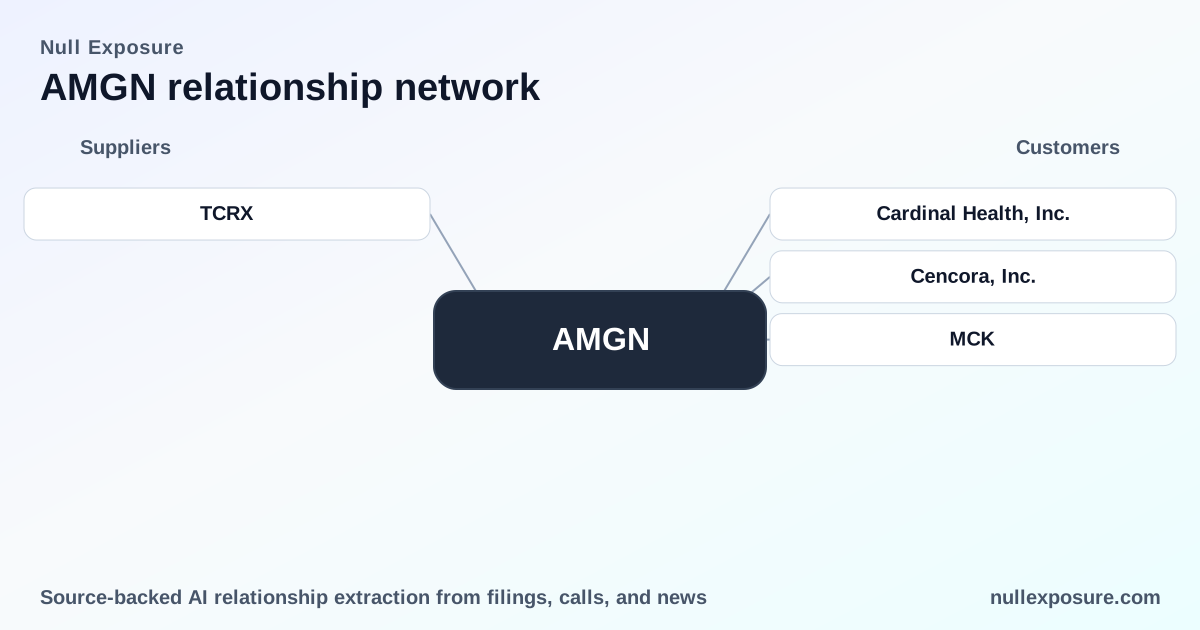
Amgen Inc. (AMGN) — supplier relationships and what they mean for investors
Amgen operates as a vertically integrated biopharmaceutical company that develops, manufactures, and commercializes biologic therapies, monetizing through product sales, licensing and collaboration revenue, and strategic partnerships that accelerate R&D and market access. The company supplements in‑house capacity with a broad ecosystem of third‑party contract manufacturers, distributors, and clinical service providers, generating predictable product revenue while outsourcing capital‑intensive manufacturing and certain clinical functions. For investors, the critical lens is how those external relationships influence production continuity, cash flow timing (notably collaboration receipts), and concentrated counterparty risk.
Explore supplier signals and ongoing partner activity on the Null Exposure homepage: https://nullexposure.com/
How Amgen structures supplier exposure and why it matters to returns
Amgen’s operating model balances large-scale internal manufacturing with selective outsourcing. Several company disclosures and excerpts surface consistent themes:
- Contracting posture — short-term operational obligations are common. Amgen discloses that most payment obligations are expected within one year, indicating a working-capital style cadence for many supplier payments rather than long-duration locked commitments.
- Materiality — supplier cash requirements are large and explicit. The company reports material cash obligations to third parties, underscoring that supplier spend is a substantive line in capital planning and liquidity management.
- Concentration and criticality — manufacturing partners are strategic and sometimes single-source. Amgen uses contract manufacturing organizations (CMOs) to supplement capacity and capability; some CMOs are single-source for key drug substances, which raises operational risk if a single node is disrupted.
- Supplier roles — distributors and service providers expand reach but add dependency. Amgen leverages third‑party distributors for global product logistics and uses contract clinical trial service providers and data handlers, creating multiple operational interfaces and regulatory touchpoints.
- Scale of commitment — large confirmed purchase obligations. As of December 31, 2024, Amgen reported $5.7 billion of purchase obligations primarily tied to R&D commitments, capital expenditures, and open purchase orders, signaling meaningful vendor spend that impacts procurement strategy and negotiation leverage.
These characteristics together define a supplier posture that is operationally flexible but economically significant: short-term payment cycles reduce long-term lock‑in but elevate the need for continuous vendor management; heavy reliance on CMOs improves capital efficiency while creating concentrated operational risk.
What the public record lists as supplier/partner relationships
Below I cover every relationship flagged in the results. Each entry is succinct and sourced.
TScan Therapeutics, Inc. (TCRX) — GlobeNewswire / FY2026
TScan attributed an increase in research‑period spending primarily to timing of research activities under a collaboration agreement with Amgen, indicating active, revenue‑bearing joint programs. Source: a March 4, 2026 GlobeNewswire press release summarizing TScan’s FY2025 results and business update.
TScan Therapeutics (TCRX) — TradingView report / FY2026
TradingView noted TScan reported $10.3 million of collaboration and license revenue for the year, driven by the timing of activities under its Amgen collaboration, and recorded a net loss of $(129.8) million. This highlights that collaboration receipts are measurable but not yet offsetting overall company losses. Source: TradingView coverage of TScan’s FY2025 results (published March 2026).
What these partner disclosures imply for investors and operators
The TScan entries illustrate a common commercial lens: Amgen pays through milestone and activity timing that moves partner revenue recognition. For investors, this produces two concrete takeaways:
- Collaboration revenue is cash‑flow relevant but timing‑sensitive. TScan’s reported collaboration revenue of $10.3 million underscores that Amgen’s external R&D agreements translate into recognizable revenue for partners when activities occur, meaning quarter‑to‑quarter variability in partner receipts will reflect internal R&D scheduling.
- Partnerships do not eliminate counterparty operational exposure. TScan’s continued net losses despite collaboration revenue confirm that small partners rely on Amgen funding cadence but retain operational risk; Amgen’s obligations to fund research and trials therefore sit on both companies’ P&Ls.
Company‑level supplier constraints amplify these partnership implications. The public signal set shows:
- Short-term contractual commitments dominate, so collaboration and purchase timing drive near‑term cash outflows.
- Material supplier spend and purchase obligations ($5.7 billion as of Dec 31, 2024) create negotiating power but also a funding requirement that competes with share buybacks and dividends.
- Reliance on third‑party CMOs and single‑source suppliers increases susceptibility to localized disruptions (the company specifically notes single‑source CMOs for certain products and geopolitical exposure tied to an Israeli CMO).
- Third‑party distributors and service providers extend Amgen’s reach but add complexity in product delivery and data handling that investors should monitor from a regulatory and continuity perspective.
Taken together, Amgen’s supplier posture blends strategic outsourcing with significant, ongoing cash commitments — an operational design that reduces fixed capital intensity while concentrating execution risk in external partners.
Explore deeper supplier signals and full relationship coverage at Null Exposure: https://nullexposure.com/
Investor implications and monitoring checklist
For investors and operators evaluating Amgen supplier relationships, focus on the following actionable items:
- Track collaboration revenue timing disclosed by small partners (like TScan) because it reveals where Amgen is actively funding R&D and how those programs impact short‑term cash flows.
- Monitor CMO concentration and single‑source calls — disruptions at a single supplier can cause outsized production impacts for specific products and influence revenues.
- Watch purchase obligation trends and capital allocation choices; the $5.7 billion figure is a baseline that affects liquidity and strategic flexibility.
- Review distributor and clinical service provider contracts for geographic and cyber/data‑handling risk, given heightened regulatory scrutiny over third‑party data processing.
Bottom line: balance capital efficiency against supplier concentration risk
Amgen’s supplier ecosystem supports scale and speed — the company captures margin benefits from product sales while offloading capital and certain operational tasks to third parties. However, the combination of material near‑term obligations, single‑source manufacturing nodes, and concentrated CMO reliance creates an operational tail risk that investors must price. Collaboration receipts reported by partners like TScan demonstrate how Amgen monetizes R&D partnerships, but they also reinforce the company’s role as a major funnel of cash into external development efforts.
If your investment thesis hinges on Amgen’s operational resilience or pipeline acceleration, prioritize monitoring partner disclosures, CMO footprints, and purchase‑obligation trends. For ongoing supplier intelligence and relationship tracking, visit Null Exposure: https://nullexposure.com/