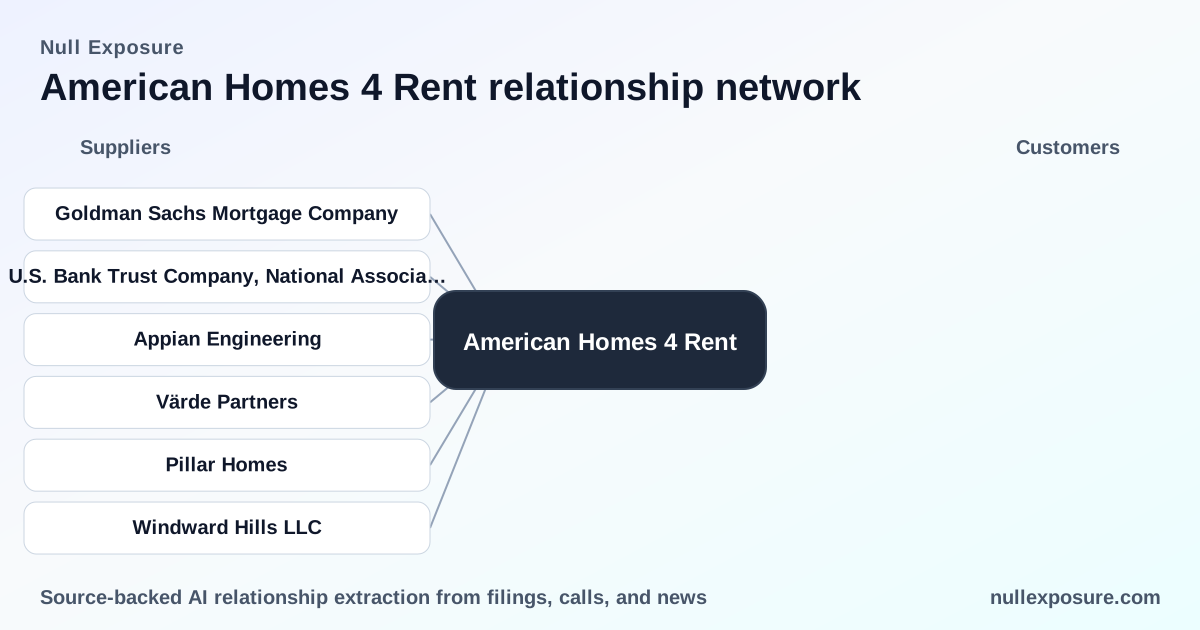
AMH supplier relationships: financing, development partners, and where operational risk concentrates
American Homes 4 Rent (AMH) operates as a large single‑family rental REIT that acquires, develops, renovates and operates single‑family homes for long‑term rental income, monetizing through rental cash flow and asset appreciation supported by scale efficiencies in acquisitions and development. Its supplier relationships span capital providers (debt trustees and lenders), land and builder partners, and episodic service providers for development and property management — relationships that together shape capital intensity, margin stability, and execution risk for operators and investors. For a quick look at mapped supplier exposure, see the Null Exposure homepage: https://nullexposure.com/.
How AMH’s supplier footprint supports a built‑for‑rental strategy
AMH runs a vertically integrated operating model that blends internal development with third‑party acquisitions and service outsourcing. From the disclosures and public reporting, several company‑level characteristics stand out as direct implications for counterparties and investors:
- Long‑term contracting posture: AMH carries long‑dated unsecured notes due in the mid‑2030s and operating leases with multi‑year terms, and its revolving credit facility extends to 2028 with extension options, signaling predictable capital cost planning and multi‑year commitments in property operations (AMH Form 10‑K, FY2024).
- Service provider reliance: AMH engages third‑party managers and specialized vendors for development transitions, cybersecurity, and property management functions — a normal operating lever for scaling portfolio integration.
- Dual buyer/seller roles: AMH both purchases newly built homes from national builders and runs an internal AMH Development Program that buys land and develops built‑for‑rent stock — resulting in procurement exposure across land sellers, builders, and construction trades.
- Capital scale and spend profile: Per‑asset acquisition windows cluster in the $250k–$600k valuation band with renovation budgets aligned to mid‑six‑figure ranges, while aggregate development commitments and surety bonds exceed $200 million, indicating both large program commitments and meaningful contingent obligations.
These are company‑level signals that define AMH’s contracting style and counterparty needs; they do not assign a specific constraint excerpt to a single supplier unless the original excerpt names that supplier explicitly.
Who AMH works with — relationship-by-relationship
Goldman Sachs Mortgage Company
AMH executed loan agreements dated March 6, 2015 (AMH 2015‑1 Borrower, LLC) and September 22, 2015 (AMH 2015‑2 Borrower, LLC) with Goldman Sachs Mortgage Company serving as lender, reflecting structured financing used to support securitized or portfolio lending vehicles. According to AMH’s 2024 Form 10‑K, these agreements are recorded as part of the company’s historical financing arrangements (AMH 10‑K, FY2024).
U.S. Bank Trust Company, National Association
AMH named U.S. Bank Trust Company as trustee under a Seventh Supplemental Indenture dated January 30, 2024, a formal trustee role for debt instruments backed by AMH entities. This trustee relationship is documented in AMH’s FY2024 10‑K filings and governs bond/indenture administration (AMH 10‑K, FY2024).
Appian Engineering
Appian Engineering is credited as the designer for a planned Clermont project (Ivey Ridge) that includes detached homes and community amenities, indicating AMH’s use of regional engineering and design firms for development projects. A GrowthSpotter article covering the Clermont development (Sept 2023) notes Appian’s design role in that project (GrowthSpotter, Sept 2023).
Värde Partners
AMH entered a strategic land banking facility agreement with Värde Partners, announced in 2022, providing a $500 million capacity for land acquisition and development scale‑up — a capital partnership that de‑risks immediate cash outlays while expanding AMH’s embedded land pipeline. This arrangement was reported by BuilderOnline in 2022 when AMH and Värde announced the facility (BuilderOnline, 2022).
Pillar Homes
AMH purchased shovel‑ready subdivisions in Apopka and Clermont that were sold by an LLC tied to Michael Boutros of Pillar Homes, illustrating AMH’s acquisition channels through local builders and sellers for immediate development. The seller linkage to Pillar Homes is described in a GrowthSpotter piece from June 2021 (GrowthSpotter, June 2021).
Windward Hills LLC
Windward Hills LLC, led by Frank Cawthon (FHC Development) and David DeCurtis (DeCurtis Corporation), is identified as the seller of specific subdivisions AMH acquired for single‑family rental conversion, highlighting the use of local development firms as disposition partners into AMH’s portfolio. GrowthSpotter’s June 2021 coverage cites Windward Hills LLC as the seller in those transactions (GrowthSpotter, June 2021).
(Each of the above relationships is drawn from AMH’s public filings and media coverage cited in the company’s FY2024 and prior reporting.)
For a consolidated supplier exposure view and to track emerging partner disclosures, visit Null Exposure: https://nullexposure.com/.
What these relationships mean for investors and operators
AMH’s supplier map suggests a clear capital‑intensive, programmatic development model supported by both institutional financiers and local builders. Key practical implications:
- Financing and maturity profile are material risks and strengths. The company’s unsecured notes maturing in 2034–2035 and a revolving credit facility maturing in 2028 provide long dated capital, supporting development timelines but concentrating refinancing activity into defined windows; these items are disclosed in AMH’s FY2024 10‑K.
- Counterparty quality matters for execution. Trustee and lender relationships (U.S. Bank Trust Company, Goldman Sachs Mortgage Company) are standard for institutional issuers and reduce operational custody risk; conversely, local seller and builder relationships (Pillar Homes, Windward Hills, Appian Engineering) drive on‑the‑ground construction execution and therefore operational delivery risk.
- Land banking and joint capital facilities de‑risk near‑term outlays but concentrate strategic exposure. The $500M facility with Värde Partners supports pipeline scale but also concentrates performance dependency on a capital partner’s underwriting and the local entitlement environment (BuilderOnline, 2022).
- Spend profile creates predictable vendor spend tiers. Per‑asset valuation bands and renovation budgets imply mid‑six‑figure vendor engagements for renovation and construction; at scale, this produces meaningful procurement leverage but also sizable surety and contingent obligations, as the company reports roughly $233.6 million in surety bonds tied to development contracts (AMH 10‑K, FY2024).
If you’re modeling counterparty risk, prioritize the debt maturity ladder, the terms of land banking facilities, and the stability of local builder relationships — these are the levers that will drive short‑term liquidity pressure or execution slippage.
For a deeper supplier risk breakdown tailored to investor diligence, check the Null Exposure homepage: https://nullexposure.com/.
Bottom line — monitoring priorities for next‑quarter diligence
- Review upcoming debt maturities and credit facility covenants tied to the 2028 maturity window and 2034–2035 unsecured notes. Refinancing concentration is a near‑term risk vector.
- Audit development commitments, surety bond exposure (~$233.6M) and the Värde Partners facility to understand capital flexibility and counterparty recourse. Large program commitments imply both runway and potential contingent liabilities.
- Validate performance and contract terms with local builders and design firms that supply shovel‑ready parcels and construction services; operational execution is where rental yield and timing are determined. Local development partners directly affect time‑to‑rent and margin realization.
For ongoing insight into supplier relationships and to surface changes as filings and news arrive, visit Null Exposure: https://nullexposure.com/.