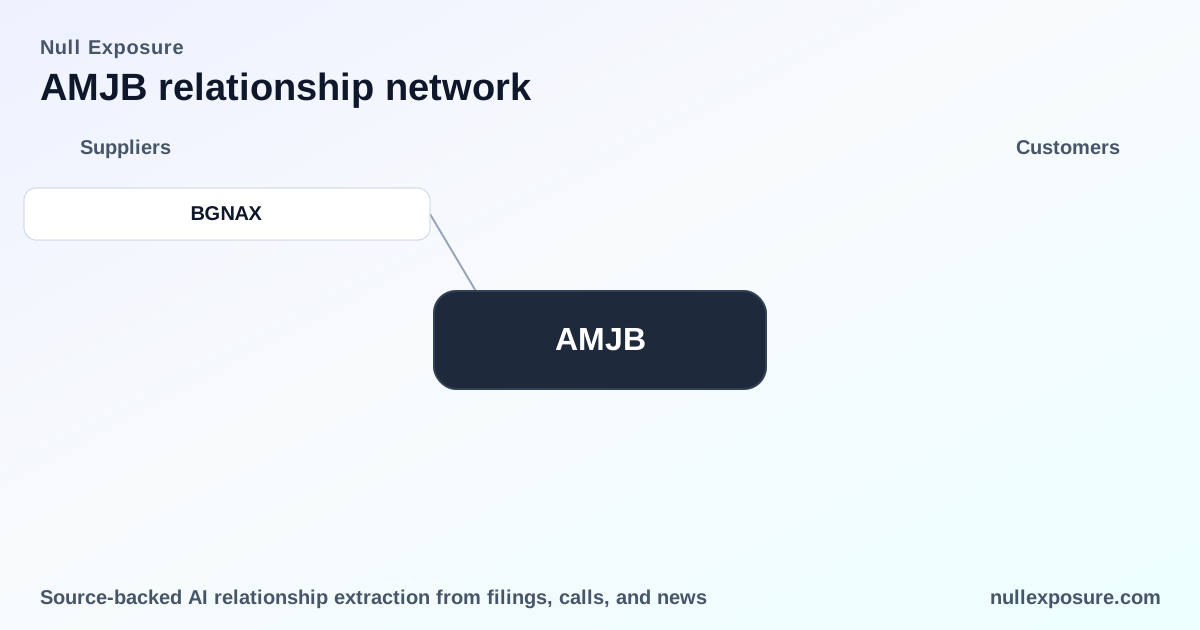
AMJB supplier relationships: what investors need to know
AMJB operates as a balance-sheet driven financial services firm that funds lending and related activities through a mix of deposits, secured and unsecured capital-market funding, and shareholders’ equity, and it monetizes by capturing interest margin and fees on originated and held loans. Investor focus should be on counterparty concentration, funding posture, and operational links to government-backed programs, because those dimensions drive short-term liquidity risk and long-term credit volatility. For a concise portal to this coverage, visit the firm’s supplier profile at https://nullexposure.com/.
A single explicit supplier relationship — Ginnie Mae — and why it matters
AMJB’s public filings identify Ginnie Mae (inferred symbol BGNAX) as a named counterparty with a specific exposure: the company recorded amounts that “relate to loans that have been repurchased from Ginnie Mae loan pools.” According to AMJB’s 2025 Form 10‑K, repurchases from Ginnie Mae pools are the primary driver of the amounts disclosed, signaling active participation in loans that ultimately carried government agency credit support but required repurchase due to loan-level defects or servicing events. (Source: AMJB 10‑K, FY2025.)
Relationship inventory: everything reported, in plain language
- Ginnie Mae — AMJB recorded that primarily all of the disclosed amounts are tied to loans repurchased from Ginnie Mae loan pools, indicating operational and credit remediation activity connected to government‑backed mortgage securitizations; this is documented in AMJB’s FY2025 10‑K filing. (AMJB 10‑K, FY2025.)
What the filing-level constraints reveal about the company’s operating model
The firm’s own disclosures provide several company‑level signals that shape supplier and counterparty risk:
- Contract tenor is mixed but includes long‑term commitments. The 10‑K describes leases with terms “of 20 years or less” and accounting for option periods when the firm is reasonably certain to exercise them, which creates a long‑dated fixed‑cost exposure that reduces near‑term operational flexibility.
- Funding strategy is multi‑tenor. The filing references both “long‑term and short‑term funding and related interest rate hedges,” highlighting an active maturity management program where interest rate movements and rollover risk are material to earnings.
- Government counterparties are part of the footprint. The company cites relationships with “U.S. Treasury and government agencies,” underlining that AMJB’s business is at least partially embedded in government‑sponsored or agency markets.
- Global funding and operational reach. Disclosures state the firm “funds its global balance sheet through diverse sources,” which signals geographic diversification of funding but also cross‑jurisdictional operational complexity.
- Third‑party service dependency. The filing calls out reliance on custodians, vendors (including cloud, data, and security services), exchanges, and clearing houses, framing suppliers as integral to both operations and cyber/operational risk.
These constraints are presented as company‑level characteristics and shape how investors should evaluate supplier relationships and contingency planning.
Financial and operational implications for investors
The interaction between the Ginnie Mae exposure and the company‑level constraints produces a compact set of investor takeaways:
- Credit and remediation risk is visible and measurable. Repurchases from Ginnie Mae pools are concrete events: they transfer loan credit and operational remediation back onto AMJB’s balance sheet and compress near‑term capital and liquidity. (Source: AMJB 10‑K, FY2025.)
- Government linkage reduces certain credit uncertainties while increasing regulatory and programmatic risk. Working with government agencies provides benefit through program support but also raises the profile of regulatory oversight and program adherence.
- Funding mix and hedges matter. The firm’s use of long‑ and short‑term funding and interest‑rate hedges means earnings volatility will track both credit events and market rates; repurchases increase the draw on short‑term liquidity that hedges and funding programs are designed to cover.
- Operational supplier dependencies elevate non‑credit risk. The company’s reliance on custodians, cloud and security vendors, and clearing infrastructures makes continuity planning and vendor concentration important lenses for due diligence.
Practical signals to watch in the next reporting cycles
- Track subsequent disclosures on the size and resolution of the repurchased pools and any movement of those loans back into pools or sales.
- Monitor liquidity ratios tied to short‑term funding lines and the firm’s counterparty list for any increase in government agency activity.
- Review vendor‑risk disclosures and any noted incidents that could interfere with servicing or repurchase processing.
For a direct way to compare AMJB’s supplier footprint against peers and to receive alerts on new filings, go to https://nullexposure.com/.
How to translate this into investment and operational action
For investors assessing AMJB’s supplier relationships, prioritize three lines of inquiry:
- Quantify repurchase exposure and cadence. Understand how frequently AMJB repurchases loans and the aggregate dollars outstanding; recurring repurchases point to structural origination or underwriting issues while one‑off repurchases are episodic events.
- Stress liquidity under repurchase scenarios. Model the funding impact when loans are returned to the balance sheet, particularly under higher rate environments when short‑term funding becomes more expensive.
- Map vendor concentration to mission‑critical functions. Identify which third parties support loan servicing, title/closing flow, and Ginnie Mae interface functions; single points of failure in these suppliers create outsized operational risk.
If you want continuous monitoring of these supplier relationships and automated alerts when filings change, visit https://nullexposure.com/ for subscription options.
Bottom line
AMJB’s public supplier footprint is concentrated and tangible: one explicit government agency relationship with Ginnie Mae tied to loan repurchases, set against a broader funding and vendor posture that includes long‑dated leases, mixed tenor funding, and third‑party operational dependencies. These elements combine to create a profile where credit remediation events have immediate funding and operational consequences — a scenario investors must model into liquidity and capital stress tests. For ongoing tracking and comparative supplier analysis, see https://nullexposure.com/.