Amkor Technology (AMKR) — supplier relationships, strategic constraints, and what investors should know
Amkor is a global outsourced semiconductor packaging and test house that monetizes by providing packaging, assembly and testing services to semiconductor designers and OEMs under contracted manufacturing arrangements and negotiated supplier pricing. The company converts capital-intensive fabs and back-end manufacturing scale into recurring revenue and margin via volume-driven pricing, long-standing customer ties, and strategic sourcing of critical materials. For investors evaluating AMKR’s supplier posture, the key questions are concentration of critical inputs, contract tenor, and how that sourcing profile influences capital allocation and operational resilience.
Explore more supplier insights at Null Exposure.
Quick operating snapshot: how Amkor runs and earns
Amkor packages and tests chips for customers across the United States, Asia and Europe and earns by charging for assembly and test services at scale. Revenue (TTM) is approximately $6.71 billion, with gross profit of $938.6 million and an operating margin near 9.8%; the company sits on a market capitalization in the neighborhood of $11.0 billion. Amkor’s economics are driven by utilization of manufacturing capacity, negotiated pricing with both customers and upstream suppliers, and preservation of throughput for high-volume customers. The business is capital-intensive and benefits from scale while remaining exposed to the cyclicality of semiconductor demand and material supply chains.
Why supplier relationships matter to the investment thesis
Amkor’s margin and delivery performance depend directly on two supplier realities: 1) access to critical materials (leadframes, substrates, gold wire) from a narrow supplier set, and 2) the practical contracting posture—combination of framework agreements for pricing and short-term purchase orders for equipment. Those characteristics mean the company can secure price predictability on consumables while retaining flexibility on capital equipment spending—a configuration that supports throughput scale but concentrates operational exposure. Investors should treat supplier dynamics as a first-order input to cash-flow resilience and capital intensity decisions.
Visit Null Exposure for further analysis and supplier mapping.
The relationships we see today
Amkor’s disclosed and reported relationships in the current record are limited but meaningful for capital markets signals. Below I cover each relationship noted in public reporting.
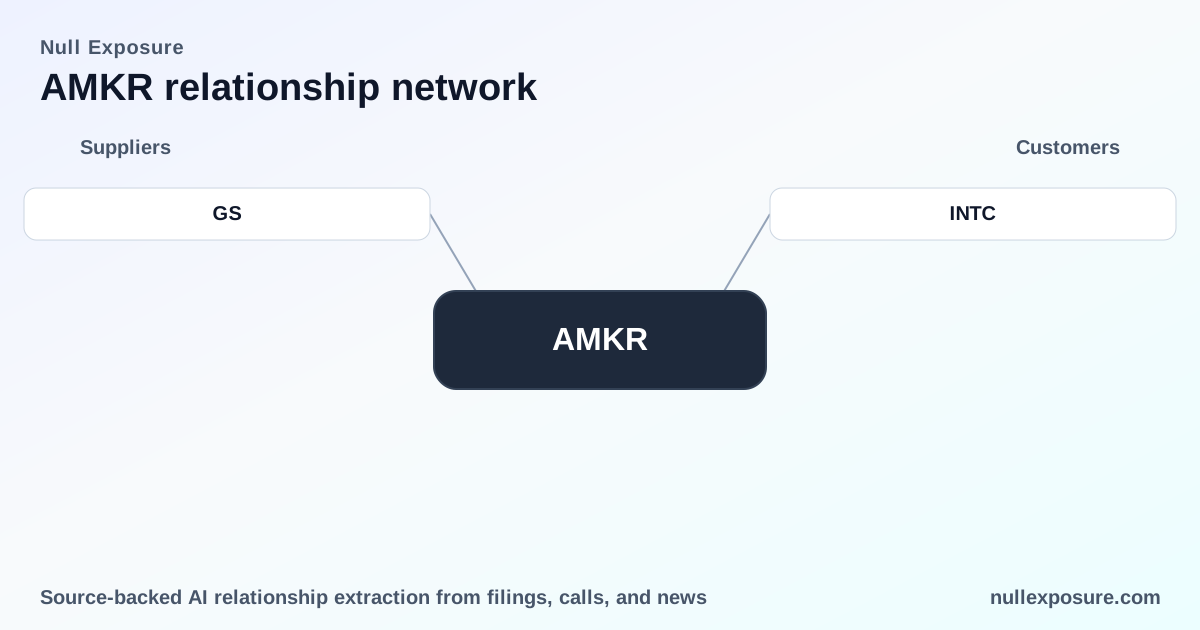
Goldman Sachs & Co. LLC — capital markets partner for a secondary offering
Goldman Sachs is acting as the sole bookrunning manager for a secondary offering of 10 million Amkor shares by the Kim family, a transaction that affects share float and signaling around insider liquidity and ownership changes. This engagement is documented in a March 9, 2026 news report announcing the offering and bank role (AI Journ, 2026-03-09).
Source: AI Journ report on the March 2026 secondary offering; see the offering notice published March 9, 2026 — https://aijourn.com/amkor-technology-announces-secondary-offering-of-10-million-shares-of-common-stock-by-the-kim-family/
(There are no additional third-party supplier relationships listed in the available results.)
What the disclosed constraints tell us about Amkor’s operating model
Amkor’s public disclosures and extracted constraint signals describe several structural features that shape supplier risk and strategic execution. These are company-level signals, not specific to any single counterparty unless the excerpt names them.
- Contracting posture — mixed: The company negotiates worldwide pricing frameworks with major suppliers to capture the benefits of scale, while equipment is typically procured under short-term purchase orders rather than long-term capital contracts. This mix produces price stability for recurring materials but flexibility (and execution risk) for capital investments.
- Materiality and concentration — critical: Amkor sources most critical packaging materials (leadframes, laminate substrates, gold wire) from a limited group of suppliers, which makes those relationships operationally critical and a potential single point of failure in constrained market periods.
- Role characterization — manufacturer-oriented sourcing: The company’s language frames suppliers as providers of the key materials Amkor needs to perform its core manufacturing services, indicating high operational integration with upstream material vendors.
The excerpts supporting these signals come directly from Amkor’s public filings and investor disclosures filed through 2025–2026.
Takeaway: The sourcing model balances negotiated pricing scale with procurement flexibility, but the concentration of critical inputs is a material operational risk that requires active supplier management and contingency planning.
Risk implications for investors and operators
- Concentration risk is primary. With critical inputs coming from a limited supplier set, production continuity is exposed in tight markets or supplier disruptions. Pricing frameworks reduce short-term cost volatility, but do not eliminate the risk of availability-driven margin pressure.
- CapEx flexibility vs. execution visibility. Short-term equipment purchasing reduces long-duration vendor lock but increases the need for effective capital planning and vendor relationships to secure lead times when demand spikes.
- Insider liquidity and share structure. The Goldman Sachs-led secondary offering changes free float dynamics and can affect trading liquidity and perception of insider intent; investors should monitor post-offering share distribution and trading volumes.
Bold strategic signal: Amkor’s operating model is optimized for scale-driven margin capture, but the company’s supplier concentration requires active mitigation—either through broader sourcing, strategic inventory, or tighter contractual terms with core vendors.
What investors and procurement teams should watch next
- Monitor vendor concentration metrics and any disclosures of additional supplier partners for leadframes, substrates, and gold wire.
- Track capital expenditure announcements and whether the company shifts toward longer-term equipment commitments or joint procurement strategies.
- Watch trading and ownership changes following the Kim family secondary offering handled by Goldman Sachs for implications on governance and insider signaling.
Final perspective and action items
Amkor is a scale-dependent manufacturer with a supplier model that mixes global framework pricing and short-term equipment procurement, and critical material concentration. For investors, the balance between stable pricing for consumables and fragility from supplier concentration is the fundamental operational tradeoff to price into forecasts and scenario analyses. For operators and procurement leaders, the priority is to translate those company-level signals into supplier diversification, contingency inventory, and reinforced contractual protections.
Learn more about supplier intelligence and mapping at Null Exposure.
For ongoing coverage of supplier relationships and targeted briefings on AMKR, consult Null Exposure — a good place to deepen diligence on counterparty concentration and contract structure.