Amplitech Group (AMPGR) — supplier relationships and why they matter to investors
AmpliTech Group designs, engineers and assembles microwave component-based amplifiers and monetizes through product sales, licensing of telecom radio-frequency intellectual property, and strategic asset acquisitions; the company finances this activity with a mix of short-term bank credit and registered-direct equity placements arranged by placement agents. Revenue runs in the mid‑tens of millions (Revenue TTM $22.6M) while operating and EBITDA metrics are negative, forcing active financing and commercial partnerships to execute growth initiatives. For a concise view of related counterparties and contractual posture, see the NullExposure research hub at https://nullexposure.com/.
Two public placement notices — what the relationship list shows
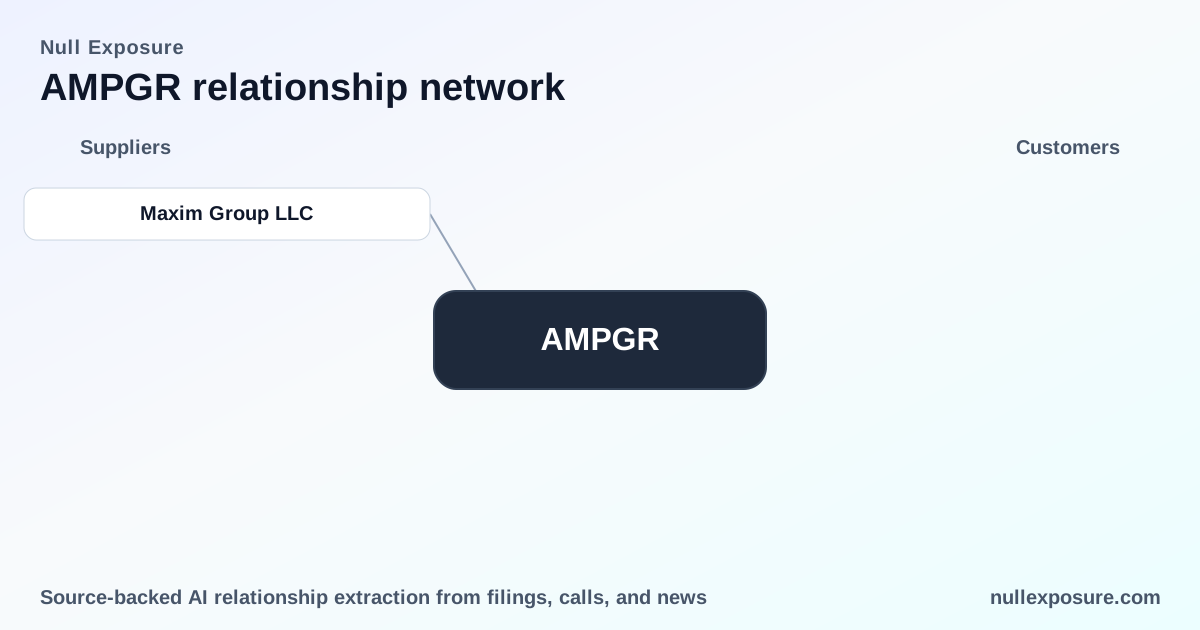
Maxim Group LLC — press notices (registered direct placements)
- AmpliTech engaged Maxim Group LLC as sole placement agent for a registered direct offering priced at $2.2 million, according to a StockTitan news release on March 9, 2026 reporting the pricing of that offering (StockTitan, March 9, 2026: https://www.stocktitan.net/news/AMPG/ampli-tech-group-announces-pricing-of-2-2-million-registered-direct-9vr4od2gsg37.html).
- A separate StockTitan notice on the same date reports Maxim Group LLC again acting as sole placement agent for a $3.1 million registered direct offering (StockTitan, March 9, 2026: https://www.stocktitan.net/news/AMPG/ampli-tech-group-announces-pricing-of-3-1-million-registered-direct-kpc70fz4h8gx.html).
Both entries are placement‑agent relationships and confirm reliance on capital markets intermediaries to raise equity capital. These are execution‑level relationships tied directly to AmpliTech’s near‑term financing strategy.
What the supplier and contract evidence reveals about AmpliTech’s operating model
Company disclosures show a mixture of short-term liquidity instruments, mid‑range licensing commitments, and a material asset acquisition program that together define the supplier and partner posture:
- On licensing: AmpliTech’s AGTGSS division executed a licensing product agreement on July 26, 2024 that grants exclusive U.S. distribution and global licensing rights for certain 5G telecom equipment for an 18‑month term; the company committed $1.25M in software IP license fees and had paid $710,000 as of December 31, 2024, recorded as long‑term deposits in the financials (company filing, July–Dec 2024). This establishes active, higher‑value vendor commitments in the low‑to‑mid millions.
- On short‑term credit: AmpliTech executed a revolving line of credit for up to $750,000 with Dime Community Bank on March 25, 2025, evidenced by a demand promissory note due March 1, 2026 if not extended (company filing, March 2025). This signals reliance on short‑term bank liquidity to manage working capital.
- On asset acquisition: The company entered an asset purchase agreement (March 26, 2025) with an aggregate purchase price of $8.0M, structured as $3.0M cash and $5.0M in restricted shares with milestone triggers tied to Telus purchase orders (company disclosure, March 2025). This demonstrates an acquisitive growth posture that converts consideration into equity and milestone contingent payments.
- On supplier concentration and criticality: As of December 31, 2024, two vendors accounted for 33.05% and 11.69% of component part purchases, underlining material supplier concentration that is classified as critical in the disclosures (company filing, FY2024).
Collectively these items indicate a company that contracts with mixed horizons (short-term credit facilities and 18‑month licensing), executes material nonrecurring asset deals, and depends on concentrated component suppliers for production. The contracting posture is therefore active, somewhat transactional, and capital‑intensive.
How these relationships influence investor risk and upside
- Capital structure and dilution: Repeated registered‑direct placements arranged by Maxim Group indicate continued equity issuance as a primary financing channel; investors should treat placement‑agent dependence as a governance and dilution vector (StockTitan, March 9, 2026).
- Liquidity runway: The $750k revolving line of credit provides near‑term operational breathing room, but negative EBITDA (EBITDA -$7.00M) and negative margins (Profit Margin -33.8%) make the company dependent on capital markets and milestone payments tied to asset purchases.
- Vendor concentration: With two vendors representing a combined material share of component purchases, supply disruption or price pressure on those vendors would be immediately consequential to production (company filing, FY2024).
- Commercialization cadence: The licensing payment schedule ($1.25M commitment with $710k paid and recorded as a long‑term deposit) and the Telus‑triggered asset consideration indicate revenue upside contingent on partner commercialization and purchase orders rather than purely organic product ramp.
For ongoing monitoring and counterparty intelligence, NullExposure collects and updates these relationship footprints — review detailed supplier maps at https://nullexposure.com/.
Short checklist for due diligence before allocating capital
- Confirm the timing and status of the Telus purchase order that triggers the cash/share payments in the $8M asset deal.
- Validate vendor continuity for the two suppliers representing over 40% of component spend and review procurement fallback options.
- Reconcile the pro forma liquidity position after the most recent registered direct offering(s) and the $750k revolver.
- Track Maxim Group’s placement activity as an early indicator of upcoming equity issuance cadence.
These items directly affect cash flow visibility and dilution risk. Given the negative operating performance, supplier concentration, and active financing posture, the company’s path to sustainable margins depends on successful commercialization of licensed IP and execution of the asset purchase milestones.
Final take — where this positions Amplitech for investors
AmpliTech operates a hybrid commercialization model that pairs hardware manufacturing with licensed telecom IP and opportunistic asset acquisitions. The supplier landscape is material to both execution risk and near‑term liquidity, with concentrated component vendors, an active licensing partner relationship, and ongoing reliance on placement agents for equity capital. Investors should weight the company’s current negative profitability and capital dependency against any revenue upside driven by Telus orders or successful monetization of licensed 5G products.
For a structured supplier‑risk view and to track counterparty changes in real time, visit the NullExposure research center: https://nullexposure.com/.
For immediate updates and to integrate this supplier intelligence into your workflow, see https://nullexposure.com/.