AMPGZ — Supplier Relationships and Commercial Constraints Investors Should Price In
AmpliTech Group, Inc. designs, engineers and assembles microwave component‑based amplifiers and monetizes through hardware sales, distribution partnerships and targeted software/IP licensing arrangements tied to 5G telecom products. For investors and operators evaluating supplier risk, the key commercial levers are exclusive distribution rights, concentrated sourcing of materials, and a discrete set of licensing payments that have been booked as long‑term deposits—each of which shapes revenue timing and operating leverage. For additional supplier intelligence, visit https://nullexposure.com/.
A concise business snapshot investors need first
AmpliTech is headquartered in Hauppauge, NY, and reports trailing revenue of $22.6M and gross profit of $5.2M, while operating metrics show negative operating results (EBITDA of roughly -$7.0M and a negative profit margin). The company combines product assembly with licensing and distribution deals, which creates mixed cash flow characteristics: product sales provide transactional revenue, licensing provides lump‑sum cash inflows but can require significant upfront payments and deposit accounting. The official site and recent filings confirm this hybrid model (see company disclosures and filings).
The visible supplier/partner in the public record
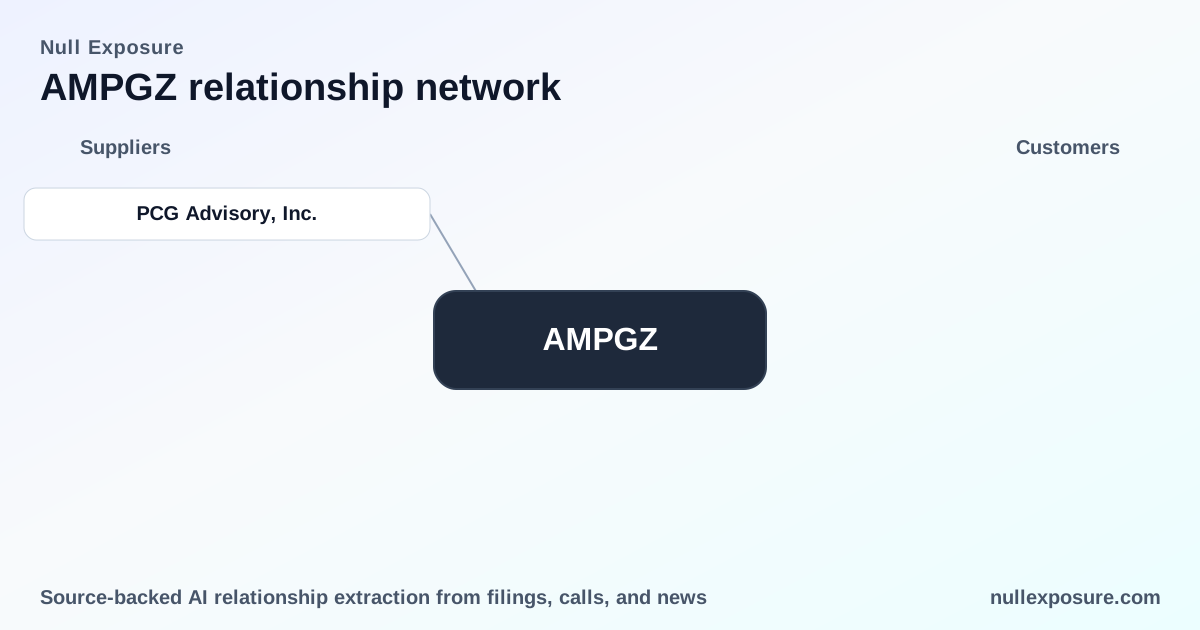
PCG Advisory, Inc. — the investor relations contact on record
PCG Advisory is listed as the investor relations contact for AmpliTech in a GlobeNewswire distribution picked up by The Manila Times on February 2, 2026; the press release cites Kirin Smith at PCG Advisory as the listed IR contact. This is a communications relationship rather than a product supplier, but it affects market access and messaging to investors. (Source: GlobeNewswire release distributed via The Manila Times, Feb 2, 2026.)
What the filings disclose about commercial contracts and licensing
AmpliTech’s recent disclosures and periodic filings provide concrete signals about its contracting posture and supplier economics:
- Licensing is an active and material commercial channel. The company’s AGTGSS division executed a licensing product agreement on July 26, 2024 that grants rights tied to certain 5G telecom equipment, and the filings explicitly describe licensing and distribution mechanics for that agreement. (Source: company filings, FY2024 disclosures.)
- Exclusive U.S. distribution with global licensing rights for an 18‑month term is central to that agreement—AmpliTech obtained exclusive United States distribution and concurrent global licensing rights for defined 5G products for 18 months for marketing, sales, rental, deployment and maintenance. (Source: company filings, FY2024 disclosures.)
- There is upfront cash commitment and active accounting recognition. The company recorded $710,000 paid toward the licensing agreement as a long‑term deposit as of December 31, 2024, and contractual software IP license fees total $1,250,000 payable to the licensor. These payments put immediate pressure on working capital while deferring revenue recognition. (Source: company filings, Dec 31, 2024 balance disclosures.)
Geography, concentration and spend: direct constraints on ops and sourcing
The filings lay out a clear geographic and concentration picture that operators must price:
- Geographic posture: The contract combines exclusive U.S. distribution privileges with broader global licensing rights, signaling an intent to control U.S. channels while generating licensing income internationally. (Source: company filings, FY2024 disclosures.)
- Supplier concentration is material. The company discloses a supplier that accounted for $1,581,069 or 33.05% of materials purchased in 2024, which is a concentration signal for procurement and production continuity risk. (Source: company filings, supplier concentration table, 2024.)
- Segment exposure: The engagement spans both distribution and software/IP, so operational success depends on hardware supply chains and the commercial exploitation of software/IP rights. (Source: company filings.)
- Spend band: The license payment structure and fee levels situate the arrangement in the $1M–$10M spend band, which is large enough to be material for a company of AmpliTech’s reported size. (Source: company filings.)
If you want a compact, actionable supplier map that integrates these constraints for decisioning, see https://nullexposure.com/ — the platform consolidates supplier signals for investment and vendor management teams.
How these factors combine into investor‑grade risks and opportunities
The mix of exclusive distribution rights, upfront license payments and supplier concentration produces a distinct risk/reward profile:
- Opportunity: Exclusive U.S. distribution for 5G equipment creates a high‑leverage commercial channel if the products scale and market adoption of targeted 5G components accelerates. Licensing receipts can create lumpy cash inflows with high margin impact when recognized.
- Risk: Concentrated materials sourcing and negative operating margins create downside sensitivity to supply disruptions and price pressure. The presence of a sizable long‑term deposit and a $1.25M licensing payment obligation increases short‑term cash strain.
- Contract horizon: The 18‑month term on the 5G rights is a relatively short commercial window that creates renewal risk and execution pressure to convert distribution rights into revenue quickly. (Sources: company filings, July 26, 2024 agreement language; Dec 31, 2024 balance disclosures.)
Practical takeaways for investors and operators
- Treat licensing as a binary execution factor. Revenue upside is dependent on converting the licensing/distribution agreement into market sales; monitor bookings and channel deployments closely.
- Mitigate supplier concentration. A single supplier representing ~33% of materials purchased is a procurement risk that must be stress‑tested in any valuation scenario.
- Watch cash flow and deposits. The $710k long‑term deposit and the $1.25M license commitment are balance‑sheet realities that reduce free cash flow until revenue is recognized.
For an investor‑grade supplier risk report and ongoing monitoring, visit https://nullexposure.com/ — the platform centralizes filings‑level signals and supplier concentration analytics.
Bottom line: price discipline and active monitoring required
AmpliTech’s commercial model combines product assembly with material licensing and distribution commitments that create both upside if deployment accelerates and downside if supply or execution stalls. Key decision points for investors are whether licensing revenue will replace or supplement hardware margins, and whether supplier concentration can be reduced before revenue scaling. Operators should demand transparency on the licensor relationship, renewal provisions after the 18‑month window, and contingency plans for the top supplier that accounted for one‑third of material purchases in 2024. For further supplier intelligence and to monitor these evolving signals in real time, go to https://nullexposure.com/.