Amphastar (AMPH): Supplier Relationships that Drive Manufacturing, Margin, and Transition Risk
Amphastar operates as a specialty and generic injectable drug manufacturer that monetizes through vertical manufacturing, licensed product acquisitions, and targeted partnerships for development and contract manufacturing. The company captures margin by owning production assets (U.S., China, France), acquiring commercial rights (for example, BAQSIMI from Lilly), and contracting selective third parties for capacity and development programs. For investors and operators, the core thesis is straightforward: Amphastar blends on‑balance‑sheet manufacturing with tactical supplier relationships to accelerate product launches, which concentrates both operational leverage and supplier risk. Learn more at https://nullexposure.com/.
How the supplier map looks in plain terms
Amphastar runs a hybrid manufacturing posture. It owns facilities in Nanjing (China) and Éragny‑sur‑Epte (France) while relying on CMOs and specialized service providers for episodic capacity and device components. That structure produces several consistent characteristics:
- Contracting posture: Amphastar uses a mix of short‑term service agreements (an 18‑month MSA for BAQSIMI is explicit) and multi‑year supply contracts for intermediates and components. The short‑term services create execution risk during transition periods, while multi‑year supply and inventory purchases lock up capital but secure continuity.
- Geographic span: Operations and suppliers are global — significant activity in APAC and EMEA — creating exposure to cross‑border sourcing, currency adjustments, and regulatory inspections.
- Criticality and concentration: Some inputs and device components are single‑source or limited‑source; Amphastar documents that an API supplier disruption previously halted production for months, underlining true operational criticality.
- Maturity of relationships: The company has active manufacturing partnerships, recently terminated transitional services with Lilly, and entered new licensing and R&D contracts that span early development to commercialization.
These signals translate into a supplier strategy that is purposeful but operationally sensitive. If you want a consolidated view of supplier risk and contractual nuance, start here: https://nullexposure.com/.
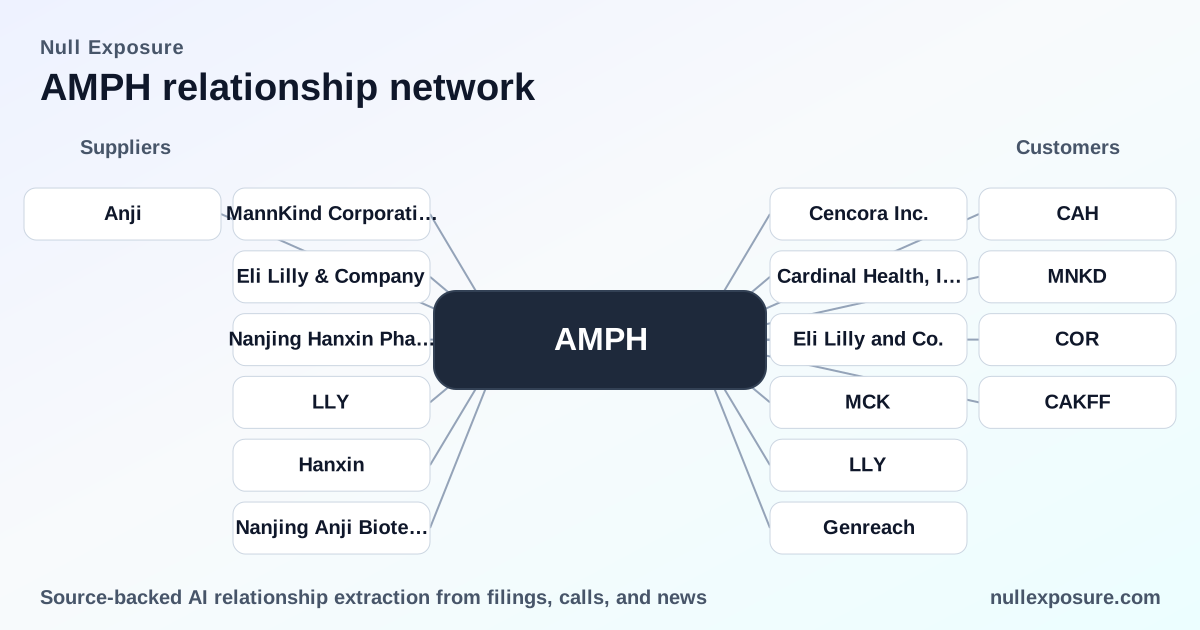
Relationship breakdown — each counterparty, one by one
MannKind Corporation
Amphastar maintains a long‑running supply relationship with MannKind that is governed by an original supply agreement from July 2014 and multiple subsequent amendments through 2023, reflecting iterative contract management and evolving terms. According to Amphastar’s 2024 Form 10‑K, seven amendments (including a fifth, sixth, and seventh amendment) indicate a durable, negotiated supplier relationship that Amphastar treats as an ongoing commercial arrangement.
Eli Lilly & Company (Lilly)
Amphastar executed a Manufacturing Services Agreement (MSA) with Lilly to provide manufacturing, packaging and labeling services for BAQSIMI for a defined period (not to exceed 18 months), and subsequently assumed distribution and inventory responsibilities, including a ~$34.0 million purchase of API, components and finished goods and a $129.0 million deferred cash payment made in June 2024. Amphastar documented the MSA’s expiration in December 2024 and completion of the transition service arrangement as of January 1, 2025, establishing Amphastar as the primary commercial manager for BAQSIMI going forward (Amphastar 2024 Form 10‑K and 2024 disclosures; press coverage on the BAQSIMI acquisition).
Nanjing Hanxin Pharmaceutical Technology Co., Ltd. (Hanxin)
Amphastar announced an exclusive U.S. and Canada license with Nanjing Hanxin for AMP‑110, a fully synthetic ACTH analog, with an upfront payment disclosed in market reports; Amphastar also has a separate 2022 contract research agreement with Hanxin under which Hanxin developed recombinant human insulin research cell banks and performed scale‑up process work, with payments of $0.2M, $1.6M and $0.6M over recent years. These actions were reported in Amphastar filings and on March 9, 2026 press releases and news coverage describing the AMP‑110 license and the prior Hanxin research agreements.
Nanjing Anji Biotechnology Co., Ltd. (Anji)
Amphastar entered an exclusive license agreement with Anji for development, manufacturing and commercialization of three proprietary peptides and recorded a $6.0 million upfront licensing charge related to that agreement, which Amphastar cites in its 2025–2026 disclosures and related press materials. Market filings and subsequent news reports summarize the agreement and the associated R&D expense increase.
What these relationships mean for investors and operations
Amphastar’s supplier footprint delivers both opportunity and concentrated execution risk.
- Operational control vs. transition risk: Taking BAQSIMI distribution and inventory from Lilly shows Amphastar’s willingness to internalize commercial supply chains, improving long‑term margin capture, but it required a substantial one‑time cash outlay and short‑term dependency on CMOs during the transition (Amphastar 2024 Form 10‑K).
- Short‑term service windows create sequencing pressure. The company explicitly used short, defined MSAs (18 months) to bridge manufacturing needs — an efficient move for temporary capacity but one that compresses timelines for qualification, regulatory handoffs and inventory buffering.
- Global manufacturing is a double‑edged sword. Nanjing and Éragny facilities give Amphastar cost and capacity advantages, but sourcing from APAC/EMEA increases exposure to inspection regimes and single‑source device issues — Amphastar has documented prior API supply stoppages that halted production.
- R&D partnerships are structured as service and license combos. Agreements with Hanxin and Anji combine development work, licensing rights and milestone economics (news coverage parsed March 2026), which both de‑risks internal early‑stage development and commits Amphastar to contingent payments.
If you want a vendor‑level risk heat map tied to contract language and spend bands, review Amphastar’s filings and summaries at https://nullexposure.com/.
Practical takeaways for portfolio managers and operators
- Expect episodic capex and working capital swings tied to inventory purchases and deferred payments (the $34M inventory purchase and $129M deferred payment are company‑level events).
- Monitor short‑term MSAs and CMO qualifications as leading indicators of potential supply disruption during product transitions.
- Treat partnerships like Hanxin and Anji as strategic levers for proprietary pipeline expansion, but price in milestone and royalty contingencies into valuation.
- Prioritize supplier redundancy for single‑source devices and APIs given documented past production stoppages.
Final recommendation and next steps
Amphastar’s supplier strategy is decisive: combine in‑house manufacturing with tactical third‑party development and short‑term manufacturing agreements to accelerate commercialization while retaining ultimate supply control. That strategy increases margin potential but concentrates operational risk during transitions. Operators should prioritize qualification timelines and redundancy; investors should bake in transition‑period cash flow volatility and contingency spend.
For a closer, contract‑level read and a tailored supplier risk summary, visit https://nullexposure.com/. If you need a supplier due‑diligence brief or scenario modeling for Amphastar, start at https://nullexposure.com/ and request a focused analysis.