Amplitude Inc (AMPL): supplier relationships that shape product delivery and margin profile
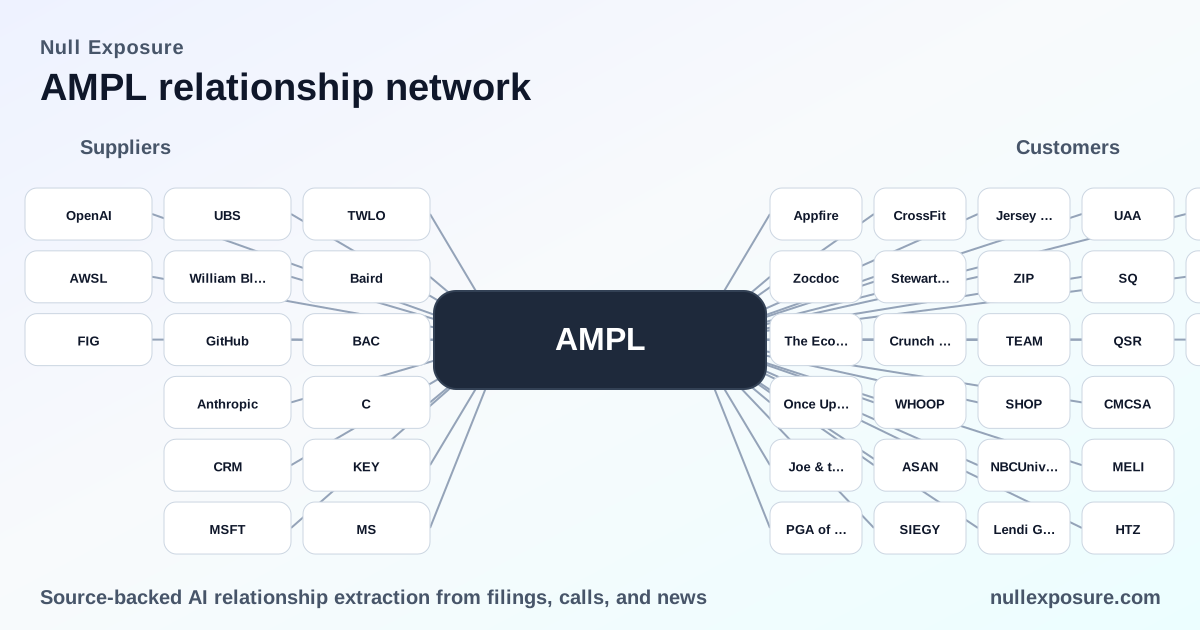
Amplitude is a product‑analytics platform that monetizes through subscription and usage fees for its cloud-hosted analytics and AI-enhanced workflows; it drives revenue by selling scale, integrations, and premium features to enterprise customers while outsourcing core infrastructure and third‑party integrations. Key investor thesis: Amplitude’s economics depend on SaaS monetization and a handful of critical supplier relationships — most notably a material, long‑term hosting commitment with AWS and a growing suite of AI and developer integrations — which together determine cost of revenue, operational risk, and the pace of enterprise adoption. For a quick supplier risk scan, visit https://nullexposure.com/.
The supplier map investors should watch
Below I run through every supplier or advisor mentioned in the available records, one relationship at a time, with a concise, cited takeaway for each.
Twilio (Segment recommendation at SIGNAL)
Amplitude announced on its 2025 Q1 earnings call that it joined Twilio at their SIGNAL conference and that Amplitude is now Segment’s recommended analytics platform, signaling channel expansion into Twilio/Segment customers and tighter go‑to‑market alignment. (Amplitude earnings call, 2025 Q1.)
Morgan Stanley
Morgan Stanley served as one of several financial advisors for Amplitude’s direct listing process in FY2021, a role documented during the company’s transition to public markets and emblematic of broad institutional advisory support. (Renaissance Capital coverage of Amplitude’s FY2021 direct listing.)
BofA Securities (Bank of America)
BofA Securities was listed among the financial advisors for Amplitude’s FY2021 direct listing, indicating involvement in capital markets strategy and investor outreach during the company’s public market entry. (Renaissance Capital coverage, FY2021.)
Citi
Citi acted as a financial advisor during Amplitude’s FY2021 direct listing, part of a multi‑firm advisory syndicate used instead of a traditional underwriting structure. (Renaissance Capital, FY2021.)
KeyBanc Capital Markets
KeyBanc Capital Markets was one of the advisory firms supporting Amplitude’s FY2021 direct listing, reflecting a diversified advisor panel across regional and national banks. (Renaissance Capital, FY2021.)
Baird
Baird is named among the financial advisors in Amplitude’s FY2021 direct listing process, contributing to the advisory network that managed the company’s market debut. (Renaissance Capital, FY2021.)
UBS Investment Bank
UBS Investment Bank appears on the FY2021 advisory roster for Amplitude’s direct listing, forming part of the advisory base used in lieu of firm underwriting. (Renaissance Capital, FY2021.)
William Blair
William Blair rounded out the FY2021 advisory group for the direct listing, a sign that Amplitude sought multiple boutique and large‑cap advisors for market access and execution. (Renaissance Capital, FY2021.)
GitHub
Amplitude announced an agent‑to‑agent integration with GitHub for enterprise product and engineering teams, expanding the company’s appeal to developer workflows and increasing stickiness inside engineering toolchains. (Press coverage of Amplitude product news, FY2025.)
Anthropic
Amplitude rolled out MCP integrations with Anthropic as part of an AI push that places analytics workflows directly into third‑party AI clients, positioning Amplitude as an orchestration point for model‑driven analytics. (Company press highlights reported in early 2026.)
Slack
Amplitude integrated with Slack to enable analytics workflows within a popular collaboration client, strengthening product utility for cross‑functional teams and accelerating internal adoption paths. (Company press highlights reported in early 2026.)
OpenAI
Amplitude added OpenAI integrations that enable analytics workflows to live inside AI clients, underscoring a strategic push to embed analytics into AI‑first tooling and to capture usage‑driven revenue. (Company press highlights reported in early 2026.)
Figma
Amplitude’s integrations with Figma bring analytics into design workflows, helping product teams close the loop between design decisions and user behavior — a practical adoption lever for product‑centric customers. (Company press highlights reported in early 2026.)
AWS (hosting commitment)
Amplitude’s 10‑K for FY2024 discloses a 60‑month hosting arrangement with AWS entered in August 2021, requiring a minimum spend of $267 million over the term and $123 million remaining as of December 31, 2024; this is a material, long‑dated contractual commitment tied directly to platform availability and cost of revenue. (Amplitude 10‑K, FY2024.)
What the supplier footprint implies for investors
Amplitude runs its platform as an outsourced, cloud‑hosted SaaS product with an increasingly AI‑centric integration layer. The supplier evidence yields several actionable signals:
-
Contracting posture and maturity: The AWS hosting deal is a long‑term, multi‑year commitment (60 months) that began in August 2021, demonstrating deliberate vendor lock‑in for core infrastructure and predictable cloud spend. The 60‑month term and remaining contractual liability reflect an operational posture that trades short‑term flexibility for long‑term pricing and capacity predictability. (Company 10‑K, FY2024.)
-
Concentration and spend risk: The AWS commitment — a required minimum of $267 million over five years — constitutes a concentrated, high‑dollar vendor exposure and anchors cost of revenue; this single relationship is a multi‑hundred‑million dollar line item that directly affects gross margin sensitivity. (Company 10‑K, FY2024.)
-
Role and criticality: Amplitude’s suppliers act primarily as service providers (hosting, third‑party AI and developer platforms) rather than commodity vendors; hosting and integrations are critical to product delivery and to the company’s ability to embed analytics in customer workflows. (Company filings and press highlights, FY2024–FY2026.)
-
Infrastructure orientation: The supplier set skews to infrastructure and developer‑tool integrations (AWS, GitHub, Figma, Slack, OpenAI, Anthropic), consistent with a product aimed at engineering and product teams rather than pure marketing audiences. This orientation supports higher switching costs for enterprise clients but increases reliance on partner platform uptime and API stability. (Company filings and product press, FY2025–FY2026.)
If you want a consolidated supplier risk scorecard or to benchmark Amplitude’s commitments against peers, see https://nullexposure.com/ for a structured view.
Risks, opportunities, and what to watch next
- Risk — cloud spend leverage: The AWS minimum spend is a direct pressure point on gross margins until the contract amortizes; monitor remaining commitment and usage economics.
- Opportunity — integration monetization: Deep integrations with AI vendors and developer platforms are a pathway to higher ARPU if Amplitude converts integration usage into paid features.
- Operational watchlist: Contract renewal terms with AWS, any renegotiation of minimums, and the pace at which AI integrations translate into enterprise bookings.
Key near‑term data points: quarterly disclosure of cloud spend, updates on remaining AWS commitment, and product‑level adoption metrics for the new AI/agent integrations.
Next steps for investors
Amplitude’s supplier relationships are a mixed structural advantage — material hosting commitments provide capacity certainty but create concentrated cost exposure, while partner integrations open up new upsell channels. For deeper supplier due diligence, licensing dynamics, and impact modeling, visit https://nullexposure.com/ to access expanded supplier intelligence and benchmarking.