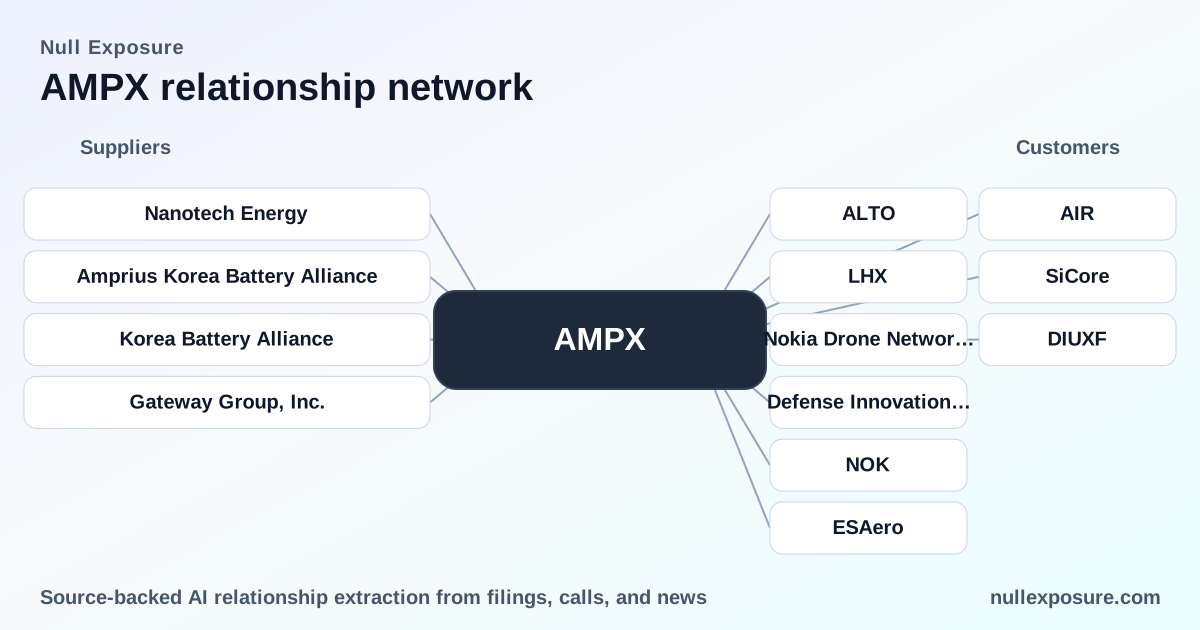
Amprius supplier map: what relationships tell investors about scale, risk and supply-chain strategy
Amprius Technologies sells high‑energy silicon‑anode lithium‑ion cells and monetizes primarily through manufacturing and selling battery cells to defense, aerospace and high‑performance commercial customers, plus licensing and materials supply agreements where applicable. The company has shifted from capital‑intensive plant builds toward a contract‑manufacturing model that leverages third‑party capacity to scale SiCore production while retaining technology and IP control—revenues come from cell sales and associated service/qualification work with large OEM customers. For a detailed monitoring workflow, visit the Null Exposure homepage: https://nullexposure.com/
One line on the supplier strategy investors should internalize
Amprius is executing a deliberate pivot to third‑party manufacturing: capacity now flows from partner factories rather than owned GWh plants, which accelerates time to revenue but concentrates execution risk on contract manufacturers and supply partners.
Who Amprius is working with today (clear, concise summaries)
Nanotech Energy — first U.S. contract manufacturing partner
Amprius announced a manufacturing partnership with Northern California‑based Nanotech Energy in early 2026 to produce its silicon‑anode battery cells domestically, a strategic move to secure a U.S. production pathway and support defense/aerospace customers that require onshore supply. This relationship was disclosed on the Q4 2025 earnings call and covered broadly in March 2026 press reports including Yahoo Finance and industry trade press. (Amprius Q4 2025 earnings call; press coverage: Yahoo Finance, March 2026)
Amprius Korea Battery Alliance / Korea Battery Alliance — established third‑party capacity in APAC
Amprius formed the Korea Battery Alliance and aligned with multiple contract manufacturers in Korea to access over 2.0 GWh of SiCore capacity, enabling rapid scale without committing to its own large GWh plant. Public coverage and investor commentary around Q4 2025 highlight this alliance as central to the company’s contract‑manufacturing thesis and capacity targets. (TradingView / investor writeups; market commentary, Q1–Q2 2026)
Gateway Group, Inc. — investor relations contact cited in filings
Gateway Group is listed in Amprius investor communications as an IR contact and appears in Q4/FY2025 investor materials as a conduit for shareholder and market outreach rather than a manufacturing partner. This is a corporate disclosure used for investor relations. (Earnings release / investor contact listing, March 2026)
Constraints and what they reveal about Amprius’s operating model
The company’s public disclosures contain several clear operating signals that shape supplier evaluation and counterparty risk:
-
Contracting posture: Amprius explicitly shifted to selecting large, experienced contract manufacturers and entered manufacturing supply agreements in 2024 that provide access to multi‑hundred MWh and GWh scale capacity. This is a deliberate, asset‑light commercialization model that trades capital expense for partner execution. (Company disclosures, FY2024–FY2025)
-
Geographic sourcing and exposure: Materials and early contract manufacturing were sourced primarily from China/APAC, while recent partnerships prioritize global and North American capacity to meet customer compliance and national‑security requirements. This mix creates a dual exposure profile—cost and scale benefits from APAC partners and regulatory/market access benefits from North American partners. (Company filing excerpts on sourcing, FY2024–FY2025)
-
Concentration and criticality: The company has aggregated production through a small set of global contract manufacturers (three primary partners cited) and the Korea Battery Alliance, which accelerates scale but concentrates critical production nodes—execution quality and on‑time ramp are therefore single points of failure for revenue growth. (Company disclosures and market commentary, FY2025)
-
Maturity and stage: Relationships are active and commercial (access to hundreds of MWh to >2 GWh of capacity was reported), but the business remains in a ramping phase where product qualification and cost reduction are the next inflection points for gross margins and profitability. (Q4 2025 operational statements)
-
Named supply exclusivity in North America: The company disclosed an Exclusive Supply Agreement with Berzelius in November 2023 for proprietary silicon anode materials in the U.S., Canada and Mexico, signaling reliance on a specific supplier for a strategic raw material in North America. This is a company‑level constraint with clear implications for upstream resilience. (Company filing, November 2023 disclosure)
For deeper monitoring of these supplier exposures, see Null Exposure’s platform: https://nullexposure.com/
What investors and operators should prioritize now
-
Execution risk over technology risk. Amprius has the technology and demand signals; the next value driver is consistent, high‑quality scale from contract manufacturers. Investors should monitor partner production yields, qualification timelines with large customers, and unit economics as contract plants ramp.
-
Geopolitical and regulatory read‑throughs. Securing U.S.‑based manufacturing (Nanotech) reduces regulatory and DoD compliance risk and is strategically important for aerospace/defense contracts; however, APAC capacity remains core to global scale and cost competitiveness.
-
Counterparty strength matters. The company signaled preference for large, reputable contract manufacturers—this reduces selection risk but elevates concentration risk because fewer, larger partners carry operational leverage over Amprius’s throughput.
-
Supplier‑material linkage. The Berzelius exclusive supply language for North American silicon anode materials creates an upstream dependency that is material to domestic supply assurance and must be tracked alongside manufacturing partner performance.
Practical next steps for due diligence
- Request partner performance metrics: yields, throughput ramp schedules, and quality escalations.
- Verify commercial terms and exclusivity clauses that could lock Amprius into unfavorable cost structures during scale‑up.
- Monitor customer qualification milestones (defense/aerospace contracts) and associated revenue recognition timelines.
For investor teams wanting continuous supplier intelligence and relationship tracking, explore Null Exposure’s supplier monitoring tools at https://nullexposure.com/
Bottom line — tradeoffs and the investment hypothesis
Amprius has transformed its go‑to‑market from build‑own‑operate to a partnered manufacturing network, which unlocks faster capacity and lower capital intensity but concentrates execution risk in a compact set of external manufacturers and upstream material suppliers. The Nanotech Energy partnership closes an important domestic supply gap; the Korea Battery Alliance provides immediate scale. For investors, the return profile rests on partners delivering predictable cost and quality improvements during the next 12–24 months.
Stay connected with evolving supplier relationships and disclosures via Null Exposure for real‑time signals and alerts: https://nullexposure.com/