Amplify Energy (AMPY): Supplier relationships that shape cash, risk and strategy
Amplify Energy operates as a U.S.-focused independent oil & gas producer that monetizes through upstream production sales, strategic portfolio reshaping, and reserve-backed financing. The company supplements operating cash flow with asset dispositions and uses both short-term commodity contracts and secured credit facilities to manage price and liquidity risk. For investors and operators, the supplier network—financial advisors, legal counsel, lenders and commodity/CO2 counterparties—drives near-term liquidity, transaction optionality and the operational continuity of key fields. Learn more about how we map these relationships at https://nullexposure.com/.
The supplier map that matters to returns and operational continuity
Amplify’s public disclosures and market notices from FY2025 onward reveal a compact but consequential set of external partners. There are three thematic clusters:
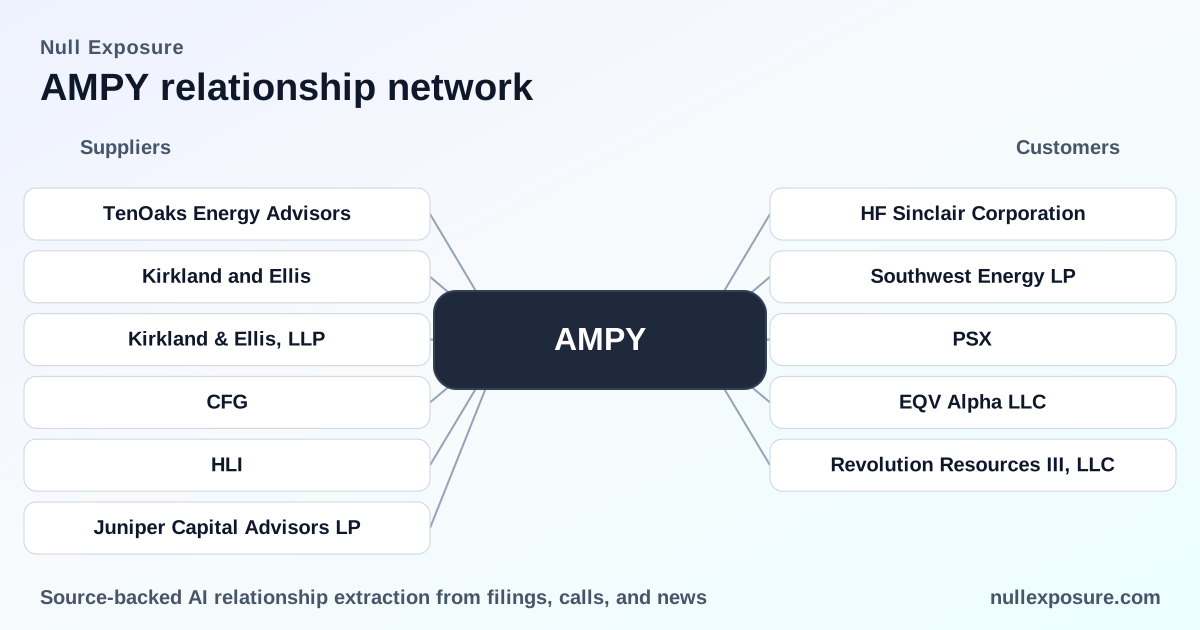
- Strategic advisers and legal counsel used for M&A and portfolio transactions (TenOaks, Houlihan Lokey, Kirkland & Ellis).
- A secured bank lending relationship that underpins working capital and liquidity (Citizens Bank acting as administrative agent).
- A portfolio expansion and asset acquisition partner (Juniper Capital Advisors) tied to mapped acreage growth in the Rockies.
Each partner performs a distinct role: advisers accelerate asset reallocation and exits, the bank extends credit capacity and maturity, and the capital partner scales reserve exposure. Below I review every reported relationship and the supporting source notes.
Detailed relationship roll call (FY2025–FY2026 coverage)
TenOaks Energy Advisors — financial advisor on multiple divestitures and strategic processes. TenOaks is listed as Amplify’s financial advisor in announcements describing the exploration and sale of East Texas and Oklahoma assets and in press releases describing completed exits during FY2025. According to GlobeNewswire (July–October 2025) and subsequent market notices, TenOaks led market outreach around the company’s East Texas and Oklahoma divestitures.
Kirkland & Ellis (Kirkland and Ellis, LLP) — legal advisor on transactions. Kirkland & Ellis served as Amplify’s legal advisor on significant transactions, including the Oklahoma sale and the transformational combination with Juniper-related upstream assets, as reported in CityBiz and GlobeNewswire filings in FY2025.
Houlihan Lokey Capital, Inc. — financial advisor on the Juniper combination. For the transformational combination that expanded Amplify’s Rocky Mountain footprint, Houlihan Lokey acted as the company’s financial advisor, as disclosed in a GlobeNewswire release covering the January 2025 transaction.
Citizens Bank, N.A. (administrative agent) — administrative agent and lender under the amended reserve-based revolving credit facility. Amplify closed an amended senior secured reserve-based revolving credit facility with Citizens Bank as administrative agent and extended the facility maturity to December 31, 2028, according to the company’s December 2025 GlobeNewswire announcement and market coverage on TradingView and QuiverQuant.
Juniper Capital Advisors LP — counterparty for portfolio build-out in the Rockies. Amplify agreed to acquire or combine upstream Rocky Mountain assets tied to Juniper, which added substantial net acreage (c.287,000 net acres) to the company’s natural gas and oil portfolio, as reported by Natural Gas Intelligence and the company’s January 2025 disclosures.
(Each relationship above is reflected in company press releases and market reports across FY2025–FY2026, including GlobeNewswire, CityBiz, Natural Gas Intelligence, TradingView and other market posts.)
What the supplier mix signals about Amplify’s operating model
The published constraints and contract excerpts convey coherent company-level signals about contracting posture, concentration and operational criticality:
-
Contracting posture mixes long-term environmental obligations with short-term commodity hedging. The company supports decommissioning obligations through long-term escrow funding and surety arrangements (sinking fund commitments stretching beyond 2029), while actively maintaining commodity derivative coverage for production over a one-to-three-year horizon. This combination indicates mature, multi-year legacy liabilities alongside tactical short-term commodity risk management.
-
Counterparty profile leans toward large, creditworthy institutions for financial and market services. Amplify’s stated policy to transact with creditworthy financial institutions for derivatives and its reserve-based credit facility administered by Citizens Bank indicate a preference for established counterparties to manage price and liquidity exposure.
-
Geographic concentration in the United States makes operational continuity local but potentially asset-specific. All revenues derive from U.S. operations, and CO2 supply constraints tied to specific properties (Bairoil) are called out as having material production impact—operational supplier risk is site-specific and material.
-
Spend and liability scale is significant. Public excerpts show sinking fund and escrow commitments in the hundreds of millions, alongside smaller CO2 purchase commitments in the low single-digit millions—a mix of very large, long-term funding commitments and modest recurring operating purchase obligations.
-
Roles are multifaceted: buyer (CO2), service consumer (transportation, gathering, processing), and issuer of long-term decommissioning guarantees. This signals complexity in supplier management and a need for robust counterparty and operational oversight.
Investor implications: what to watch and how to act
-
Credit maturity and liquidity: The December 2028 maturity extension on the reserve-based facility with Citizens Bank materially reduces near-term refinancing pressure and improves liquidity runway, but monitoring covenant compliance and usage levels remains essential given capex and debt-service profile.
-
Asset rotation strategy: Repeated use of advisors (TenOaks, Houlihan Lokey, Kirkland & Ellis) shows Amplify is actively monetizing and reshaping its portfolio to fund growth or de-lever; confirm transaction timing and proceeds trajectories to assess balance sheet trajectory.
-
Operational concentration risk: CO2 supply commitments and the associated supplier dependency for Bairoil are material to production; supply interruptions would have direct production and cashflow consequences.
If you want a structured supplier-risk brief tailored to a specific investment horizon or to model covenant stress under different commodity-price scenarios, start here: https://nullexposure.com/.
Final takeaways and next steps
Amplify’s external relationships are tightly focused on capital markets advisers, a single administrative banking agent, and asset-level counterparties that directly affect production. These relationships reduce execution risk for transactions and extend liquidity, but expose the business to concentrated operational supplier risk on specific assets. For active investors, the priority signals are credit facility usage, timing and size of asset sales, and any public updates on CO2 supply arrangements.
For a deeper, investor-grade briefing on supplier exposure, counterparty concentration and scenario-driven cashflow outcomes, request a tailored report through our site: https://nullexposure.com/.